
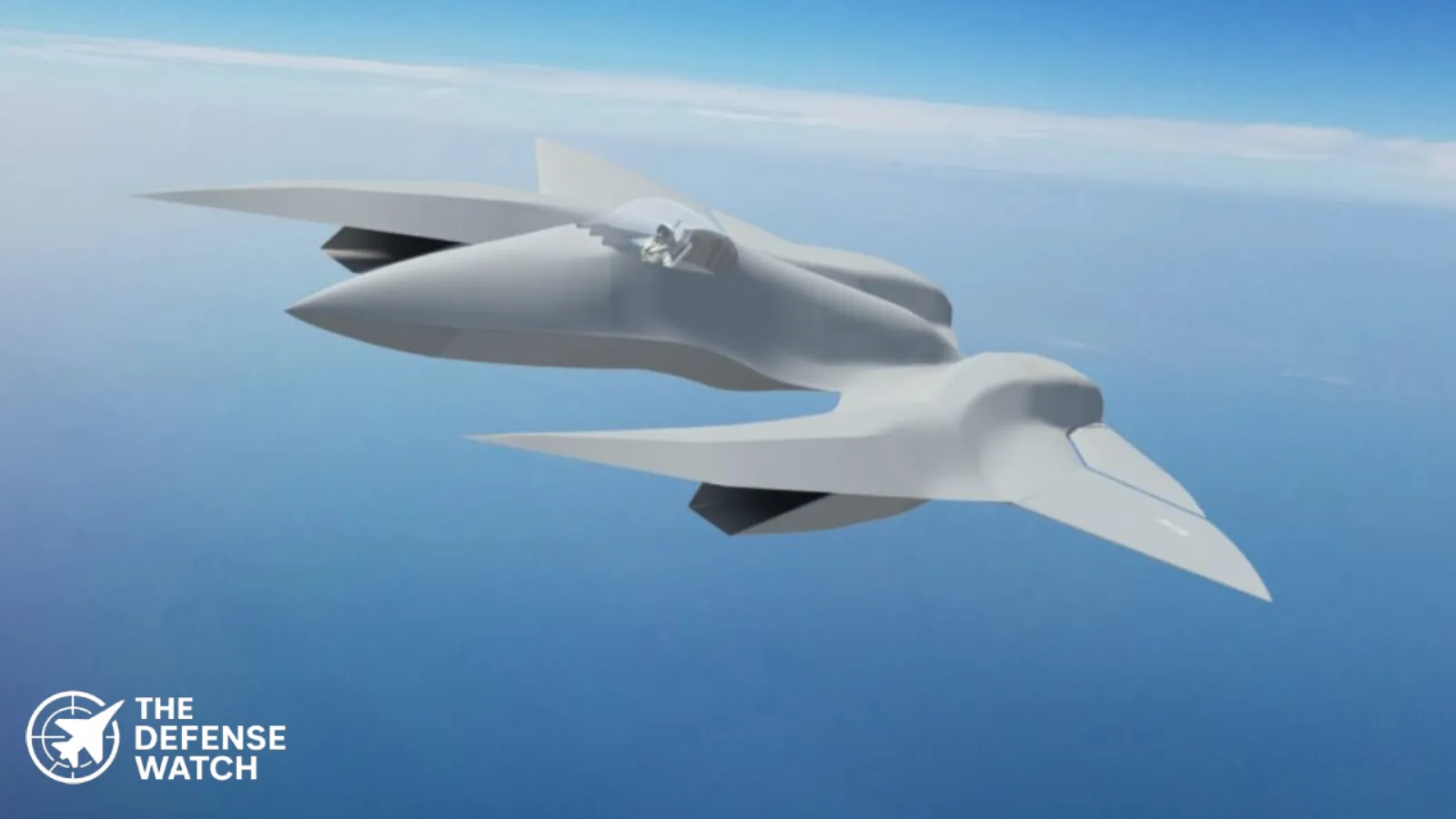
SM-39 Razor Fighter Concept
Minnesota-based Stavatti Aerospace has unveiled specifications for its SM-39 Razor, a concept sixth-generation fighter aircraft that the company claims will achieve speeds exceeding Mach 4 while carrying a price tag of approximately $85 million per unit. The triple-fuselage design represents one of the aerospace industry’s most ambitious paper aircraft proposals, targeting markets from the U.S. Navy’s Next Generation Air Dominance (NGAD) program to international customers including India.
However, the SM-39 Razor proposal emerges from a company that, according to multiple investigations by defense industry publications, has never manufactured a single aircraft in its three-decade existence—raising fundamental questions about the viability of bringing such an advanced design from concept to reality.
Unprecedented Design Configuration and Claimed Capabilities
The SM-39 Razor features a radical triple-fuselage architecture designed to minimize supersonic wave drag through careful volume distribution approximating the Sears-Haack ideal body. The center fuselage houses primary avionics, cockpit, nose landing gear, and two internal weapons bays, while secondary fuselages contain individual variable-cycle engines, main landing gear, and serpentine air intakes positioned ventrally to ensure airflow at high angles of attack.
According to Stavatti’s technical documentation, the aircraft would be powered by two proprietary NeoThrust E1400 variable-cycle afterburning turbofans, each producing 52,400 pounds of static thrust. Alternative powerplant options include General Electric Aerospace’s Adaptive Cycle Engine (ACE), though GE has not publicly confirmed any partnership with Stavatti.
Performance specifications published by the company claim a maximum level speed exceeding Mach 4 at 60,000 feet, supercruise capability above Mach 2.5, a tactical radius of 1,400 nautical miles, and service ceiling beyond 100,000 feet. The aircraft would employ non-carbothermic titanium diboride cermet construction with titanium foam metal sandwich structures to withstand the extreme thermal loads of sustained hypersonic flight.

Image: Stavatti Aerospace. Armament would include a 20mm M61A2 Vulcan cannon with 1,000 rounds or an optional gas dynamic laser weapon, plus two internal weapons bays rated for a combined 17,000 pounds of ordnance. Four external wing hardpoints could accommodate an additional 18,000 pounds of stores, bringing total warload capacity to 25,000 pounds.
The company envisions piloted single-seat (SM-39S) and two-seat tandem (SM-39T) variants, as well as unpiloted autonomous configurations (SM-39U) featuring what Stavatti describes as “Synthetically Intelligent” flight control systems.
The Credibility Question: Decades Without Production
The SM-39 Razor’s ambitious specifications must be evaluated against Stavatti Aerospace’s business history. Founded in 1994 by CEO Christopher Beskar while he was a university student, the company has promoted numerous advanced aircraft concepts over three decades without producing a flyable prototype of any original design.
According to a December 2024 investigation by The Buffalo News, Stavatti “has never produced a single airplane” despite establishing operations in Niagara Falls, New York, where it leased a former U.S. Army Reserve station. The newspaper reported that the company was evicted from portions of its occupied space in December 2024 after sub-leasing facilities to other tenants without permission and failing to advance aircraft production plans.
In February 2023, an investor filed a lawsuit against Stavatti alleging racketeering and fraud, claiming the company operated as a Ponzi scheme, according to The Buffalo News. The Niagara County Industrial Development Agency subsequently rescinded tax subsidies awarded in 2020 after determining the company made insufficient progress on its stated manufacturing plans. Local construction contractors filed additional lawsuits alleging nonpayment for services.
Defense industry analysts have repeatedly characterized Stavatti’s various aircraft proposals as “vaporware”—heavily promoted products that fail to materialize. A 2024 Vice magazine article described the company’s earlier incarnation as “the industrial equivalent of an internet troll, spreading titillating graphics depicting futuristic airplanes it stood little chance of ever producing.”
Image: Stavatti Aerospace. The company’s only tangible aerospace asset is the ATG Javelin design, acquired from bankrupt Aviation Technology Group in 2008. While a Javelin prototype flew briefly in 2005, Stavatti has not advanced the design to production. The company submitted the Javelin for the U.S. Air Force’s T-X trainer competition in 2017 but was eliminated; the contract ultimately went to Boeing-Saab’s T-7 Red Hawk.
Technical Feasibility and Industry Context
Beyond Stavatti’s business track record, aerospace engineers have questioned the technical feasibility of several SM-39 design elements. The proprietary NeoThrust E1400 engine, incorporating titanium diboride cermet materials and magnetohydrodynamic (MHD) bypass technology, represents technology that exists primarily in research laboratories rather than qualified aerospace applications.
Variable-cycle engines remain challenging even for established manufacturers. General Electric’s XA100 adaptive-cycle engine for the F-35 program required decades of development and billions in funding. The technology demands precise management of bypass ratios, thermal loads, and complex mechanical systems operating across extreme flight regimes.
The claimed Mach 4+ performance would place the SM-39 in a category currently occupied only by experimental aircraft like the retired SR-71 Blackbird. Sustained hypersonic flight presents enormous materials science, thermal management, and propulsion challenges that have eluded even well-funded programs at major aerospace corporations.
Image: Stavatti Aerospace. The proposed $85 million flyaway cost appears incongruous with the aircraft’s claimed capabilities. For comparison, the F-35A costs approximately $80 million per unit after decades of development and with economies of scale from orders exceeding 3,000 aircraft. A genuinely sixth-generation fighter with Mach 4 capability would likely require development costs measured in tens of billions of dollars.
Marketing to International Customers
Despite lacking a production aircraft, Stavatti actively markets the SM-39 to international customers. Recent reports indicate the company has pitched the design to India’s Multi-Role Fighter Aircraft (MRFA) program, which seeks 114 new fighters to modernize the Indian Air Force fleet.
According to April 2025 reporting by Defence News India, Stavatti proposed a total program cost of $3.3 billion to develop and produce the SM-39 for India. However, defense analysts note that India’s MRFA competition includes established manufacturers offering proven platforms such as the Rafale, F/A-18 Super Hornet, F-15EX, Eurofighter Typhoon, and Saab Gripen E.
The company has also positioned the SM-39 as a candidate for the U.S. Navy’s F/A-XX program and potential Air Force NGAD requirements, though neither service has publicly acknowledged Stavatti’s submissions.
Industry Perspective and Analysis
The SM-39 Razor represents a fascinating case study in the gap between conceptual aerospace design and actual aircraft development. Modern computational tools enable detailed virtual aircraft modeling, allowing companies to produce professional-looking technical documentation and renderings. However, translating digital models into flying hardware requires manufacturing infrastructure, supply chain relationships, regulatory certification, flight testing capabilities, and crucially, sustained funding measured in billions of dollars.
Successful aerospace startups like Textron with its Scorpion jet or Boom Supersonic demonstrate that new entrants can advance unconventional designs, but these companies typically focus on achievable performance targets using proven technologies and maintain transparency about development timelines and funding requirements.
The sixth-generation fighter landscape features well-funded programs like the U.S. Air Force’s NGAD, U.S. Navy’s F/A-XX, and the UK-Italy-Japan Global Combat Air Programme (GCAP), all backed by established aerospace primes and government investment totaling tens of billions of dollars. These programs face significant technical and schedule challenges despite enormous resources.
For Stavatti to realize the SM-39, the company would need to overcome not only its lack of production experience but also secure funding orders of magnitude beyond anything in its history, establish supplier relationships for thousands of components, develop or license revolutionary propulsion technology, and navigate complex military certification processes.
Conclusion
The SM-39 Razor showcases ambitious aerospace engineering concepts including innovative configuration design, advanced materials applications, and integrated autonomous systems. As a thought exercise in future fighter capabilities, the proposal contributes to discussions about next-generation air dominance requirements.
However, potential customers evaluating the SM-39 must weigh these specifications against Stavatti Aerospace’s three-decade history without producing an original aircraft, recent legal and financial difficulties, and the enormous gap between concept drawings and operational hardware. Until Stavatti demonstrates concrete progress—funded development programs, prototype hardware, or partnerships with established aerospace manufacturers—the SM-39 Razor remains speculative rather than a credible procurement option.
Defense procurement professionals emphasize that selecting a fighter aircraft represents a multi-decade commitment affecting national security, requiring proven contractors with demonstrated capabilities in design, manufacturing, certification, and sustainment. Whether Stavatti can transition from concept developer to credible defense contractor remains an open question that only time and demonstrated progress will answer.
FAQs
What makes the SM-39 Razor’s design unique?The SM-39 features a triple-fuselage configuration with a streamlined center body flanked by secondary fuselages housing engines and landing gear. This architecture aims to reduce wave drag at supersonic speeds while distributing systems efficiently across the airframe.
Has Stavatti Aerospace ever built an aircraft?No. According to multiple investigations, Stavatti has not manufactured any original aircraft design in its 30-year history. The company acquired the ATG Javelin design in 2008, which flew as a prototype in 2005, but has not produced it.
What is the estimated cost of the SM-39 Razor?Stavatti advertises a flyaway cost of approximately $85 million per aircraft, though this figure has not been validated through actual production or independent cost assessment.
Which countries are considering purchasing the SM-39?Stavatti has reportedly pitched the SM-39 to India’s MRFA program and submitted the design for U.S. Navy and Air Force next-generation fighter requirements, though no formal procurement discussions have been publicly confirmed.
What are the main concerns about the SM-39 program?Primary concerns include Stavatti’s lack of production history, unproven proprietary technologies (particularly the NeoThrust engines), legal disputes involving fraud allegations, and the enormous funding gap between current resources and typical sixth-generation fighter development costs.
How does the SM-39’s claimed performance compare to existing fighters?If realized, the claimed Mach 4+ speed would exceed all current operational fighters. However, these specifications remain theoretical without validated testing or demonstrated prototypes.
Get real time update about this post category directly on your device, subscribe now.


