Table of Contents
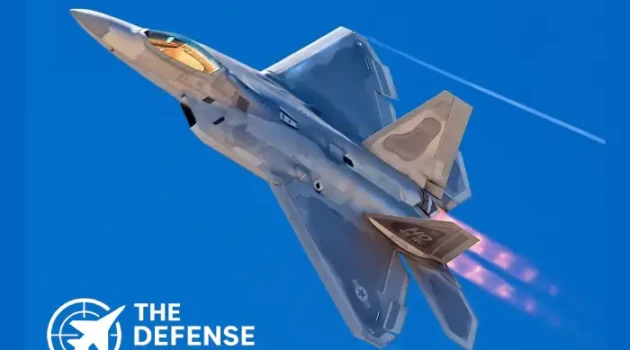
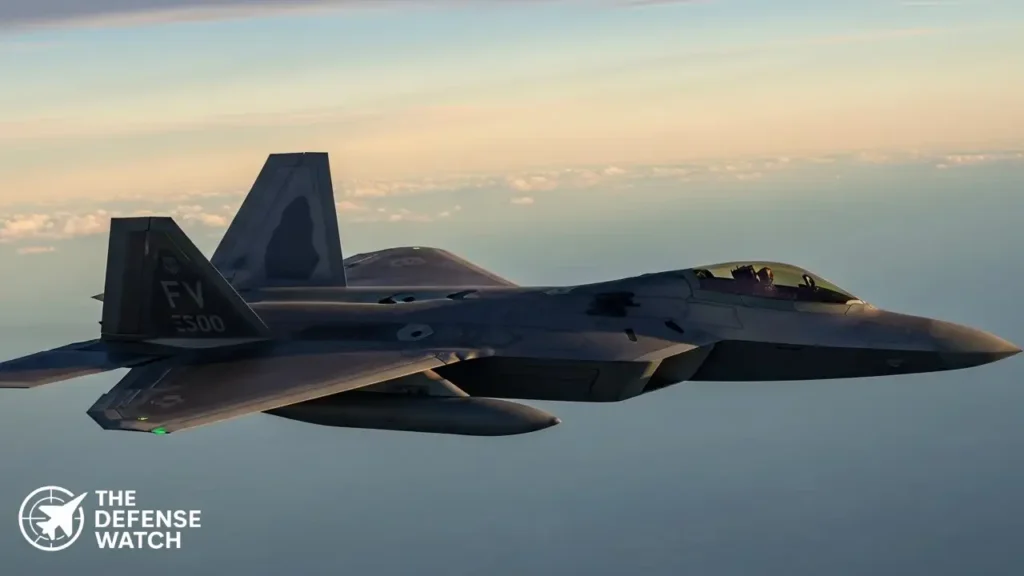
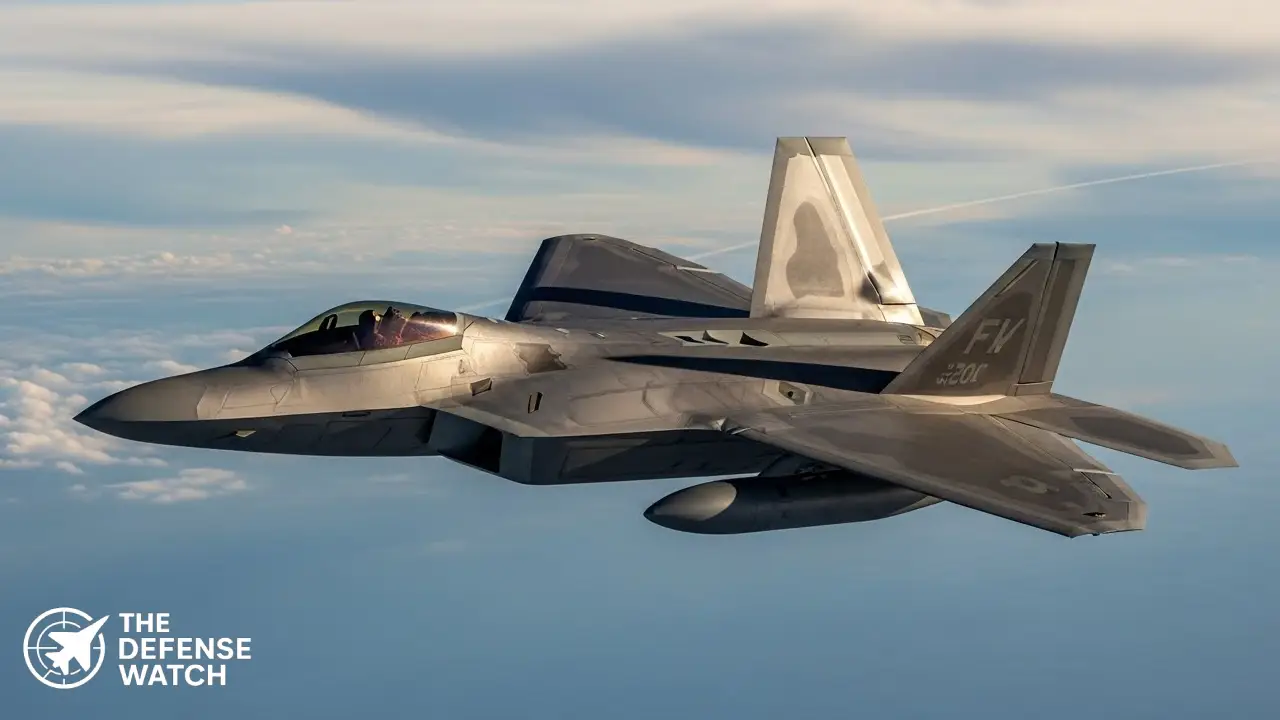
The F-22 Raptor remains central to U.S. air superiority doctrine — and under the newly elevated “F-22 Super” upgrade plan, the Raptor is being readied with enhanced sensors, stealth refinements and extended-range capabilities that seek to preserve its dominance until the next generation arrives. The “F-22 Super” upgrade — the focus of growing congressional and service support — reflects an emerging consensus that modernization of existing stealth assets is essential to sustain “first look, first shot, first kill” advantage in contested airspaces.
With the Next Generation Air Dominance (NGAD) family of systems still several years from full deployment, upgrading the F-22 is viewed by many as a cost-effective and prudent way to maintain edge amid evolving threats from near-peer competitors.
What Is the “F-22 Super” Upgrade
Upgrade Scope and Key Technologies
Under the proposed FY 2026 budget, the U.S. Air Force has earmarked approximately $90 million to begin what it calls a “viability package” for the F-22.
Key components of the upgrade package include:
- A new Infrared Defensive System (IRDS), to improve missile-launch detection and warning.
- Provision for pod-mounted Infrared Search and Track (IRST), enhancing passive detection of threats — especially valuable in contested electromagnetic (EW) environments.
- Sensor and avionics refresh: updated radar, open-architecture data fusion, cryptographic upgrades and other “future-proofing” to allow better integration with other platforms (e.g., NGAD, F-35 Lightning II).
- Improved electronic warfare capabilities and updated threat-warning receivers, under what the Air Force refers to as “Project Keystone.”
- Extended-range fuel tanks and low-drag pylons (the “Low Drag Tanks and Pylons,” LDTP), enabling longer missions — including potentially supersonic ferry or deployment flights — while minimizing radar signature when tanks are mounted.
- A helmet-mounted display (HMD) for pilots, a long-requested capability that provides off-boresight weapon cueing and improved situational awareness.
Together, these improvements are intended to transform the F-22 into a more resilient, networked, and flexible sensor-shooter — sometimes described as a “fifth generation plus” or “F-22 Super” configuration.
Why the Upgrades Are Gaining Renewed Support
NGAD Delays and Capability Gap Risk
The overarching driver behind the push for the F-22 upgrade is the reality that NGAD — slated to succeed the Raptor — remains years away from full operational deployment. Recent public reporting notes that the older jets of the fleet have begun to show their age, and reactivating non-combat-coded airframes requires substantial investment.
By investing in upgrades now, the U.S. Air Force hedges against a capability gap should NGAD face further delays, or if the initial NGAD fleet is limited in size. Maintaining a credible stealth-air superiority force with F-22 “Super” modifications buys critical time.
Evolving Threat Environment
Advances in adversary air-to-air missiles, infrared search-and-track systems, and radar/infrared hybrid detection platforms — particularly by near-peer competitors — have heightened the risk to legacy stealth aircraft which rely primarily on low observable radar signature and limited passive threat detection tools. The F-22’s planned IRDS/IRST and EW upgrades directly address those vulnerabilities.
In addition, range limitations have long hampered Raptor deployments in theaters such as the vast Indo-Pacific region, where long-range reach is critical. The LDTP initiative addresses those concerns, extending the Raptor’s reach while preserving stealth and speed advantages.

Cost-Effectiveness Compared to New-Build Programs
Restarting production of F-22 airframes or accelerating NGAD procurement comes with high cost and risk. By contrast, upgrading existing airframes draws on established maintenance/logistics chains, and avoids the industrial, training, and supply-chain burdens of fielding a completely new fleet. This makes the “Super” upgrade a more economical bridge strategy until NGAD matures.
The Role of “F-22 Super” in the NGAD Era and U.S. Air Dominance
Bridging to NGAD
With the NGAD program still in development, the F-22 Super acts as a “bridge” — preserving critical stealth-air superiority capability while NGAD’s manned sixth-generation fighters, loyal-wingman drones, and sensor-shooter architectures are finalized.
By integrating NGAD-derived technologies (sensors, data fusion, EW, avionics) into the F-22, the Air Force aims to ensure interoperability across legacy and future platforms — a key consideration for joint operations.
Enhancing Force Flexibility and Deterrence Posture
A modernized F-22 fleet — refreshed, sensor-upgraded, and extended in range — supports rapid response, long-range deployment, and forward-deployed deterrence concepts. Some reports describe a “Rapid Raptor” model: a small group of F-22 Supers capable of deploying globally within 24 hours, carrying advanced missiles or even hypersonics, with integrated links to joint force networks.
This flexibility remains valuable even once NGAD becomes operational: a mixed force of NGAD fighters, loyal-wingman drones, and upgraded F-22s would maximize coverage, offering both quantity and quality across different mission sets.
Challenges & Constraints
While the F-22 Super plan offers clear advantages, it is not without hurdles:
- Fleet size constraints: The legacy fleet is limited — only a fraction of the original ~185 Raptors remain combat-coded, and some older Block-20 jets are slated for retirement or reactivation only with major investment.
- Maintenance and sustainment burden: Stealth coatings, low observable materials, and complex avionics make sustainment resource-intensive — reactivation and upgrade of older airframes will require careful logistics and parts supply.
- Budget and prioritization pressure: With NGAD and other modernization programs consuming significant funding, balancing investment between upgrading legacy platforms and funding next-generation systems remains politically and strategically challenging.
- Technological limits: Even upgraded, the F-22 will remain a 5th-generation airframe. Some envisioned NGAD capabilities — such as optionally crewed operations, integrated loyal-wingman drone control, advanced sensor-to-shooter kill chains — may be beyond retrofit scope.
Analysis: What “F-22 Super” Means for U.S. Air Dominance
The renewed push for “F-22 Super” upgrades reflects a pragmatic recalibration of U.S. air dominance strategy. Rather than banking solely on generations-ahead platforms like NGAD, the Air Force seems increasingly focused on maintaining — and optimizing — existing capabilities to reduce risk and cost.
In the near to mid-term, the upgraded Raptor fleet can provide credible deterrence and warfighting capability in contested zones, especially in regions like the Indo-Pacific or Europe where adversaries field improving stealth, IRST, and long-range missile threats.
In the longer term, pairing a modernized F-22 with NGAD and other new systems offers a layered force architecture — combining proven fighters with next-gen platforms and drone-enabled mass. That architecture could offer both flexibility and formidable redundancy: if NGAD faces delays, cost overruns, or initial limited basing, the F-22 Super ensures the core air-superiority mission remains covered.
Still, this approach is not a substitute for NGAD’s ambition. The F-22 Super should be seen as a bridge — but a strategically vital one.
FAQs
Will the F-22 production ever restart?There is no public indication that full-scale F-22 production will restart. The current “Super” upgrades focus on existing airframes. Restarting production would be costly, and past cost estimates for hundreds of new Raptors ran into tens of billions of dollars.
How long will upgraded F-22s remain in service?With the Super upgrades, F-22s could remain relevant well into the 2030s and even 2040s — effectively bridging the gap until NGAD and other future platforms are fully operational.
Does the upgrade include new weapons or just sensors/avionics?The upgrade package emphasizes sensors, avionics, defense systems and endurance enhancements. However, the new open-architecture avionics could facilitate integration of modern weapons, long-range missiles, and future munitions.
How does the F-22 Super compare to NGAD capabilities?NGAD is expected to deliver a fundamentally new generation of capabilities — optionally crewed aircraft, loyal-wingman drones, advanced networking and sensor-fusion architecture. The F-22 Super is not a replacement, but a bridging upgrade: a 5th-generation “plus” that borrows NGAD-derived sensors and avionics to remain effective until the new generation arrives.
Why not simply rely on the F-35 fleet instead of upgrading the F-22?The F-35 serves a complementary but different role: multi-role strike, close air support, and networked operations. The F-22’s unique combination of stealth, supercruise, maneuverability and range — particularly after Super upgrades — is irreplaceable for dedicated air superiority and first-look, first-shot engagements in contested environments.
Conclusion
The “F-22 Super” upgrade is gaining traction not as a nostalgic effort to preserve Cold War-era airframes, but as a deliberate, strategic investment in sustaining U.S. air superiority through a complex transition period. As NGAD and associated sixth-gen programs press forward — but remain years away from full deployment — the Air Force appears to be hedging its bets: modernizing and extending the life of proven platforms while simultaneously preparing for the future.
In an era of rapidly evolving air and missile threats, contested electromagnetic environments and near-peer adversaries fielding advanced stealth, IRST and long-range missiles, that dual-track strategy may be the most realistic path to preserving U.S. global air dominance.
Get real time update about this post category directly on your device, subscribe now.