• Home
  • About
  • Defense Systems
  • Manufacturer
  • Comparisons
  • Compare 
  • Tools
TheDefenseWatch.com
  • Aerospace & Aviation
  • Military & Ordnance
  • Naval & Maritime
  • Cyber & Space Defense
  • Policy & Strategy
  • Global News
  • Tools Library
    • Smart Calculator
    • Drone Flight Time Calculator
    • Drone Range Calculator
    • Counter-Drone Jammer Effective Range Calculator
    • Counter-Battery Radar Detection Calculator
    • Artillery Fire Correction Calculator
    • Thermal Camera Detection Range Calculator
    • Missile Range & Time-of-Flight Calculator
    • Radar Detection Range Calculator
    • FPV Strike Drone Payload vs Range Calculator
    • Loitering Munition Endurance Calculator
    • Sniper Ballistic Drop & Windage Calculator
    • Bullet Drop Calculator
    • U.S. Army Combat Fitness Test (ACFT) Calculator
    • Military Pension Calculator
    • Military Retirement Calculator
    • Military Pension Calculator
    • Large Number Calculator
Font ResizerAa

TheDefenseWatch.com

The Defense Watch | U.S. & Global Defense News, Analysis & Military Updates

Search
  • Home
  • About
  • Defense Systems
  • Manufacturer
  • Comparisons
  • Compare 
  • Tools

Stay Updated

Get the latest update

Subscribe

Explore

  • Drone
  • Fighter Jets & Military Aircraft
  • Hypersonic Weapons
  • Aircraft Carriers
  • Strategic History & Missions
  • Tools Library
Home » UK’s DragonFire Laser Weapon Successfully Downs High-Speed Drones, Deployment Accelerated to 2027
Global News

UK’s DragonFire Laser Weapon Successfully Downs High-Speed Drones, Deployment Accelerated to 2027

TeamDefenseWatch
Last updated: December 2, 2025 5:26 am
TeamDefenseWatch
Share
6 Min Read
DragonFire laser weapon drones 650 km/h
SHARE

UK’s High-Power Laser “DragonFire” Downs Fast Drones in Landmark Trials

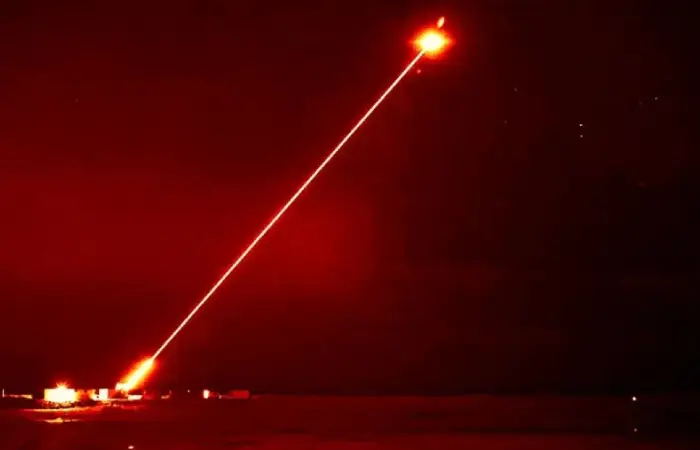
On 20 November 2025, at the Ministry of Defense (MoD) test range in the Hebrides, Scotland, the UK successfully demonstrated that its high-powered laser weapon system DragonFire could destroy drones flying at speeds up to 351 knots (404 mph / 650 km/h).

Contents
  • UK’s High-Power Laser “DragonFire” Downs Fast Drones in Landmark Trials
  • Context: Why DragonFire Matters
  • Trial Details: What the Tests Showed
  • Challenges & Considerations
  • What’s Next

In light of this success, the government awarded a £316 million contract to MBDA UK to deliver the system to the Royal Navy — accelerating the planned in-service date from 2032 to 2027.

Context: Why DragonFire Matters

Directed-energy weapons like DragonFire are being developed to address evolving aerial threats — notably fast, low-cost drones and swarming unmanned aerial vehicles (UAVs) that challenge traditional missile- and gun-based air defense.

Conventional air-defense systems expend expensive missiles (often costing hundreds of thousands or millions of pounds per shot) to intercept relatively cheap drones. A laser system like DragonFire — with its near-instantaneous “projectile” (light), high precision, and low per-shot cost — offers a fundamentally different and potentially more sustainable approach.

- Advertisement -
  • DragonFire Laser Defense Weapon

    DragonFire Laser Defense Weapon

    • Maximum Range: Classified (line-of-sight)
    • Maximum Altitude: Not Disclosed
    • Radar Detection Range: Not Applicable (Laser System)
    • Missile Speed: -
    • View Details →
    8.0

    First unveiled as a technology demonstrator in 2017, DragonFire has since matured through a series of tests — ultimately culminating in this high-speed drone interception capability.

    Trial Details: What the Tests Showed

    • The test on November 20, 2025, saw DragonFire take down drones travelling up to 650 km/h (404 mph), marking the first time a British laser weapon intercepted a target at such speed.
    • The system demonstrated an “above-the-horizon” targeting capability, meaning it engaged drones at altitudes and distances where line-of-sight targeting would previously have been impractical or impossible.
    • According to the MoD, DragonFire can hit a target the size of a £1 coin (roughly 23 mm in diameter) from one kilometer away.
    • The cost per “shot” — i.e., the energy required to fire the laser for the necessary engagement duration — is reportedly about £10.
    • The contract awarded to MBDA UK covers development and delivery of systems suitable for installation on Type 45 destroyers beginning in 2027.

    In announcing the contract, officials described DragonFire as a major step forward: the system will be “the first high-power laser weapon in service with any European nation.”

    The programme brings together UK firms and government science laboratories: MBDA UK, Leonardo UK, QinetiQ, and the government research body Defence Science and Technology Laboratory (Dstl).

    Strategic Implications: What This Means for Naval Defence

    The accelerated deployment of DragonFire signifies a shift in naval air defence doctrine — from relying solely on conventional missiles and guns to incorporating directed-energy weapons capable of cost-effective, rapid response against emerging threats like swarming drones or high-speed UAVs.

    The “above-horizon” targeting capability is particularly significant. Because traditional laser or point-defense systems are constrained by line-of-sight, they can struggle to engage low-signature or distant aerial targets. DragonFire’s ability to integrate with shipborne radar, airborne sensors, or networked detection assets could extend its effective engagement envelope — enhancing a destroyer’s layered defense capacity.

    Moreover, with each shot costing only a fraction of a missile or gun round, DragonFire presents a more sustainable and scalable weapon for engaging multiple or repeated drone threats, particularly important in densely contested or high-tempo conflict zones.

    Industry & Job Impact

    The £316 million contract with MBDA UK is also designed to create or sustain nearly 600 skilled jobs across the UK — with significant allocations in Scotland, the South West, and the East of England — underscoring the government’s framing of defense procurement as an engine for industrial growth.

    Officials emphasized the broader aim of meeting the priorities set out in the Strategic Defense Review by rapidly fielding next-generation directed-energy capabilities.

    Challenges & Considerations

    While the trials demonstrate promise, certain limitations remain inherent to laser-based systems: atmospheric conditions (e.g., rain, fog, sea spray), power generation and thermal management aboard ships, and the requirement for line-of-sight or sensor-linked targeting systems. Several analysts caution that real-world maritime conditions will test the robustness of the system before it can be fully trusted in combat scenarios.

    Also, while firing costs are low per shot, the total lifecycle cost — including maintenance, optics degradation, power supply, and integration with combat management systems — remains to be assessed over time.

    What’s Next

    With the contract now in place, the first DragonFire installation is scheduled for a Type 45 destroyer by 2027 — five years ahead of the original plan.

    Over the next two years, MBDA UK, Leonardo, and QinetiQ will refine the system design, complete integration efforts, and prepare the first “deployable capability.”

    Observers and defense watchers will be closely monitoring the system’s performance in real-world maritime conditions. Should DragonFire perform reliably, it may mark the beginning of a broader shift toward energy-based air defense across NATO navies and beyond — reshaping how militaries counter drone threats, cruise missiles, and swarming UAV attacks.
TAGGED:Anti-droneDirected Energy WeaponDragonFireMBDA UKRoyal Navy
Share This Article
Facebook Copy Link Print
ByTeamDefenseWatch
TeamDefenseWatch is the official editorial byline of TheDefenseWatch.com. Working under one umbrella, TheDefenseWatch.com, the team delivers verified, factual reporting on global defense, military technology, aerospace systems, and security developments. Articles are sourced from official statements, defense industry releases, and trusted media, with editorial review to ensure accuracy and clarity.Contact: info@TheDefenseWtach.com
2 Comments
  • Pingback: US and South Korea to Build Navy Underwater Drone Swarms to Counter China
  • Pingback: Cambodia Employs Chinese Type‑90B and PHL‑03 Rocket Launchers in Border Strikes on Thailand

Leave a Reply Cancel reply

Your email address will not be published. Required fields are marked *

Latest Defense Systems

  • Voyager Tanker Voyager Tanker
  • YU-20 Tanker YU-20 Tanker
  • China KJ-500 Aircraft China KJ-500 Aircraft
  • SPY-6 Radar SPY-6 Radar
  • Boeing VC-25B Presidential Aircraft Boeing VC-25B Presidential Aircraft
  • SM-3 Block IB Missile SM-3 Block IB Missile
  • USS Abraham Lincoln Aircraft Carrier USS Abraham Lincoln Aircraft Carrier
  • M142 HIMARS M142 HIMARS
  • Terrex S5 Infantry Vehicle Terrex S5 Infantry Vehicle

Recent Compares

  • Tejas vs Gripen: Key Differences and Capabilities Tejas vs Gripen: Key Differences and Capabilities View Comparison →
  • Tejas vs MiG-21 Bison: How India Replaced Its Iconic Supersonic Fighter Tejas vs MiG-21 Bison: How India Replaced Its Iconic Supersonic Fighter View Comparison →
  • F-35 vs F-16: Stealth, Sensors and Combat Roles F-35 vs F-16: Stealth, Sensors and Combat Roles View Comparison →
  • Tejas Fighter Jet vs F-16 Fighting Falcon: Capability Compared Tejas Fighter Jet vs F-16 Fighting Falcon: Capability Compared View Comparison →
  • Rafale Fighter Jet vs F-16 Fighting Falcon : Which Fighter Has the Edge? Rafale Fighter Jet vs F-16 Fighting Falcon : Which Fighter Has the Edge? View Comparison →
  • Su-57 Fighter Jet vs J-20 Fighter Jet: Stealth and Air Combat Compared Su-57 Fighter Jet vs J-20 Fighter Jet: Stealth and Air Combat Compared View Comparison →
  • Mirage 2000 vs Tejas Mk1A: Legacy Combat Power vs Indigenous Modernization Mirage 2000 vs Tejas Mk1A: Legacy Combat Power vs Indigenous Modernization View Comparison →
  • Rafale Fighter Jet vs F-22 Raptor: Which Air Dominance Fighter Has the Edge? Rafale Fighter Jet vs F-22 Raptor: Which Air Dominance Fighter Has the Edge? View Comparison →
  • Tejas Fighter Jet vs. Rafale Fighter Jet: India’s Indigenous Fighter Meets France’s Proven Multirole Combat Aircraft Tejas Fighter Jet vs. Rafale Fighter Jet: India’s Indigenous Fighter Meets France’s Proven Multirole Combat Aircraft View Comparison →
  • F-22 Raptor vs. F-35 Joint Strike Fighter: Which Fifth Generation Fighter Has the Edge? F-22 Raptor vs. F-35 Joint Strike Fighter: Which Fifth Generation Fighter Has the Edge? View Comparison →

Recent Posts

  • RAF Voyager Completes 14 Missions During Saudi Arabia Deployment
  • L3Harris Wins $250 Million GMLRS Rocket Motor Contract
  • L3Harris Wins $55 Million U.S. Army Contract for NOVA Night-Vision Goggles
  • Lockheed Martin Outlines Layered Air Defense Plans, Debuts PAC-3 Edge
  • China-Egypt Air Drills Highlight J-16, KJ-500 Teaming Against Rafale Fighters

You Might Also Like

US B 1B bombers Iran
Global News

US B 1B Bombers Loaded With Bunker Buster JDAMs At RAF Fairford As Iran Strike Campaign Expands

September 7, 2026
US Air Force F-15 crash
Global News

US Air Force F-15 Jet Reportedly Crashes In Kuwait Amid Regional Tensions

September 7, 2026
US Canada airspace warning
Global News

US Warns It Could Send Fighter Jets Into Canadian Airspace if F-35 Deal Collapses

September 7, 2026
Eurofighter Typhoon vs Rafale vs F-35 Comparison
Naval & MaritimeNaval Strategy & Maritime Security

UK Moves To Secure Strait Of Hormuz As Iran Crisis Threatens Global Shipping

September 7, 2026

Logo

Copyright © 2026 TheDefenseWatch.com

Helpful Links

  • Home
  • About Us
  • Privacy Policy
  • Terms of Use / Disclaimer
  • U.S. Privacy Notice – CCPA Compliance

Defense Systems

  • Defense Systems
  • Comparisons 
  • Manufacturer
  • Tactical Calculators

Popuplar

Which 5 Air Forces Possess the Costliest Fighter Jet Fleets in the World
Evolving Strategic Value: Carrier Strike Groups in the Indo-Pacific’s Future Security Architecture
Autonomous Weapon Systems Spark U.S. Ethics Debate Amid Rapid Military AI Integration

We report on developments involving military forces, governments, defense companies, research organizations, and security institutions around the world. 

Welcome Back!

Sign in to your account

Username or Email Address
Password

Lost your password?