• Home
  • About
  • Defense Systems
  • Manufacturer
  • Comparisons
  • Compare 
  • Tools
TheDefenseWatch.com
  • Aerospace & Aviation
  • Military & Ordnance
  • Naval & Maritime
  • Cyber & Space Defense
  • Policy & Strategy
  • Global News
  • Tools Library
    • Smart Calculator
    • Drone Flight Time Calculator
    • Drone Range Calculator
    • Counter-Drone Jammer Effective Range Calculator
    • Counter-Battery Radar Detection Calculator
    • Artillery Fire Correction Calculator
    • Thermal Camera Detection Range Calculator
    • Missile Range & Time-of-Flight Calculator
    • Radar Detection Range Calculator
    • FPV Strike Drone Payload vs Range Calculator
    • Loitering Munition Endurance Calculator
    • Sniper Ballistic Drop & Windage Calculator
    • Bullet Drop Calculator
    • U.S. Army Combat Fitness Test (ACFT) Calculator
    • Military Pension Calculator
    • Military Retirement Calculator
    • Military Pension Calculator
    • Large Number Calculator
Font ResizerAa

TheDefenseWatch.com

The Defense Watch | U.S. & Global Defense News, Analysis & Military Updates

Search
  • Home
  • About
  • Defense Systems
  • Manufacturer
  • Comparisons
  • Compare 
  • Tools

Stay Updated

Get the latest update

Subscribe

Explore

  • Drone
  • Fighter Jets & Military Aircraft
  • Hypersonic Weapons
  • Aircraft Carriers
  • Strategic History & Missions
  • Tools Library
Home » US Marines Begin Production of MADIS Drone Hunter Vehicles
Conventional Weapons & ModernizationMilitary & Ordnance

US Marines Begin Production of MADIS Drone Hunter Vehicles

TeamDefenseWatch
Last updated: September 8, 2026 1:00 am
TeamDefenseWatch
Share
2 Min Read
Marine Air Defense Integrated System
SHARE

US Marines Launch Production of MADIS Counter Drone Vehicles

The United States Marine Corps has begun production of its new Marine Air Defense Integrated System, marking a key step in strengthening short range air defense against hostile drones. The system, known as MADIS, is now being built for operational units after several years of testing and evaluation. Production is taking place in the United States, with initial vehicles expected to reach Marine units in the near term.

Contents
  • US Marines Launch Production of MADIS Counter Drone Vehicles
  • Growing Drone Threat Drives Urgent Need
  • What Is the Marine Air Defense Integrated System
  • Transition From Testing to Production
  • Role Within Marine Corps Force Design
  • Industry and Program Partners
  • Strategic Impact and What Comes Next

The move reflects growing concern within the US military over the rapid spread of small unmanned aerial systems on modern battlefields. From surveillance missions to one way attack roles, low cost drones have become a persistent threat to forward deployed forces.

Growing Drone Threat Drives Urgent Need

Small drones have played a major role in recent conflicts, particularly in Eastern Europe and the Middle East. These systems are difficult to detect, fly at low altitudes, and can be launched in large numbers. Traditional air defense systems were not designed to counter such targets, leaving gaps in protection for ground forces.

For the Marine Corps, which often operates from austere and forward locations, the threat is especially serious. Expeditionary bases, amphibious units, and maneuver forces need mobile and layered air defense that can move with them.

- Advertisement -

The Marine Air Defense Integrated System was developed to meet this requirement. It provides a vehicle mounted solution that can detect, track, and defeat small drones and other low flying threats.

What Is the Marine Air Defense Integrated System

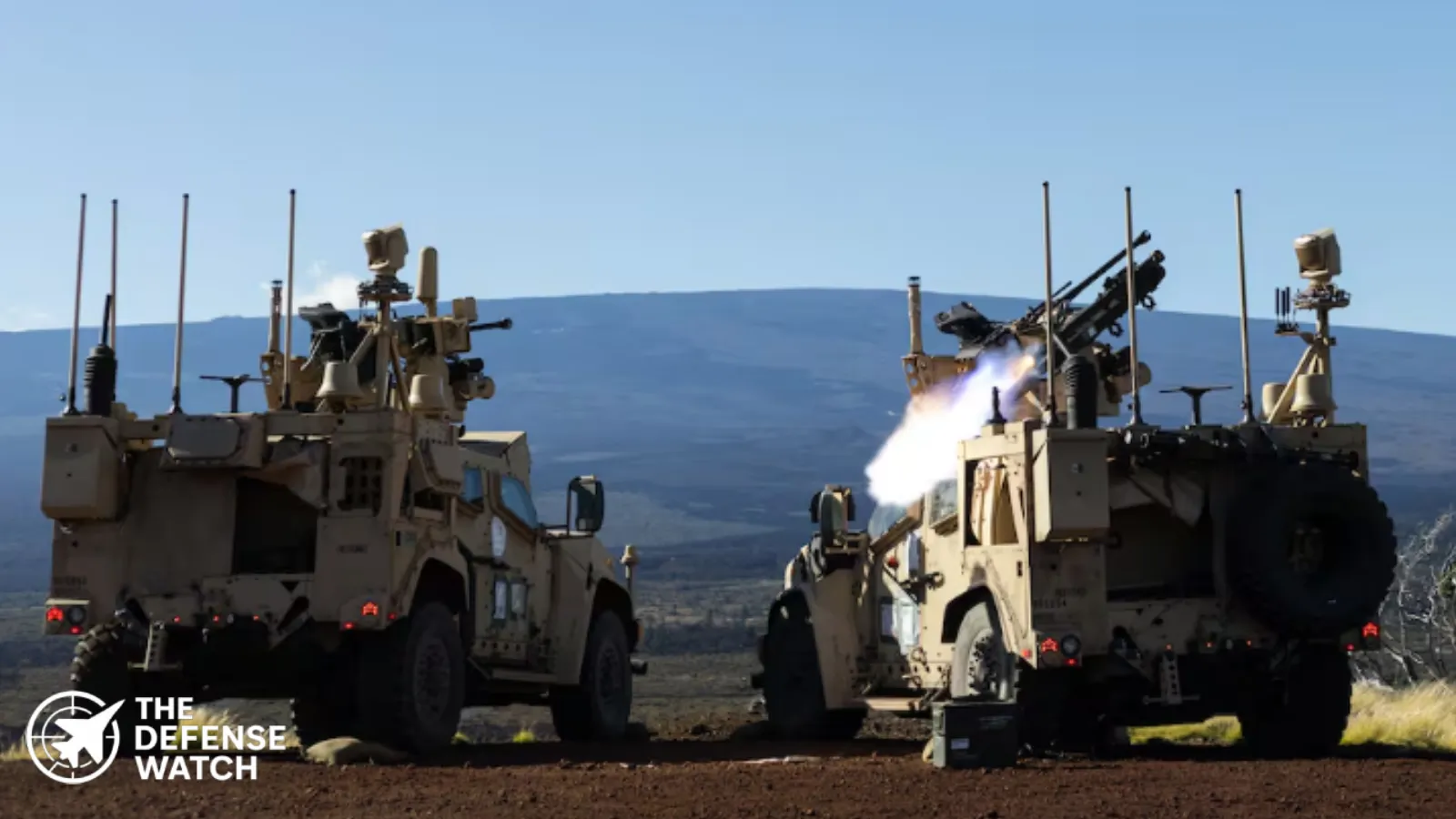
MADIS is built on the Joint Light Tactical Vehicle platform, giving it high mobility and protection. The system uses a combination of sensors, electronic warfare tools, and kinetic weapons to counter aerial threats.

Each MADIS vehicle is equipped with radar and electro optical sensors to spot drones at short range. Once detected, the system can jam control links or navigation signals. If electronic attack is not enough, the vehicle can engage targets with a chain gun or missiles.

This layered approach allows Marines to respond flexibly depending on the type of threat and rules of engagement. The Marine Air Defense Integrated System is designed to operate as part of a wider air defense network, sharing data with other sensors and command nodes.

Transition From Testing to Production

The decision to begin production follows a series of operational tests and user evaluations. Marine air defense units have been working with early versions of MADIS for several years, refining tactics and identifying improvements.

According to defense officials, feedback from these tests confirmed that the system meets operational needs and is ready for fielding. Production vehicles will include updates based on lessons learned during exercises and live fire events.

Initial production quantities are focused on equipping active duty Marine units. Over time, additional vehicles may be assigned to reserve components and deployed forces overseas.

Role Within Marine Corps Force Design

The Marine Corps has been reshaping its force structure under its Force Design initiative. This effort aims to prepare for future conflicts, particularly in contested maritime regions. Air defense against drones and cruise missiles is a key part of this plan.

- Advertisement -

MADIS fills a critical gap at the short range level. It supports Marine Littoral Regiments, expeditionary advanced bases, and maneuver units operating close to the enemy. By providing organic air defense, the Marine Air Defense Integrated System reduces reliance on joint or allied assets.

The system also supports naval operations. When Marines operate from amphibious ships or temporary shore bases, MADIS can help protect ships, logistics nodes, and command posts from aerial surveillance and attack.

Industry and Program Partners

Several US defense companies are involved in the MADIS program, supplying sensors, weapons, and electronic warfare components. The integration effort brings together proven subsystems into a single mobile platform.

Program officials emphasize that using existing technologies helped speed development and control costs. This approach also allows for future upgrades as new sensors or counter drone tools become available.

The Marine Corps plans to keep MADIS adaptable, with software updates and modular components that can evolve as drone threats change.

Strategic Impact and What Comes Next

The start of production signals that counter drone defense is now a core requirement, not a niche capability. As drones continue to spread among state and non state actors, systems like MADIS are likely to see heavy use.

Looking ahead, the Marine Corps is expected to expand training for air defense Marines and integrate MADIS into large scale exercises. Data sharing with Navy and joint force networks will also be a priority.

The Marine Air Defense Integrated System represents a shift toward mobile, networked air defense at the tactical level. Its production marks a significant milestone in adapting US forces to the realities of modern warfare.


TAGGED:Air DefenseCounter Drone SystemsMilitary VehiclesUnmanned ThreatsUS Marines
Share This Article
Facebook Copy Link Print
ByTeamDefenseWatch
TeamDefenseWatch is the official editorial byline of TheDefenseWatch.com. Working under one umbrella, TheDefenseWatch.com, the team delivers verified, factual reporting on global defense, military technology, aerospace systems, and security developments. Articles are sourced from official statements, defense industry releases, and trusted media, with editorial review to ensure accuracy and clarity.Contact: info@TheDefenseWtach.com
6 Comments
  • Pingback: Ukraine to Receive Additional S-300 Interceptors as Norway Expands Air Defense Support | TheDefenseWatch.com
  • Pingback: Sweden Orders Saab Trackfire Remote Weapon Stations in SEK1.5B Contract | TheDefenseWatch.com
  • Pingback: U.S. Army Unveils New M1E3 Abrams Tank Prototype, Highlights Key Design Changes | TheDefenseWatch.com
  • Pingback: B-21 Raider Production Expansion Deal Expected by March 2026 | TheDefenseWatch.com
  • Pingback: Raytheon Wins DARPA Contract to Develop Maritime Defense System Against Drone Threats | TheDefenseWatch.com
  • Pingback: USS Gerald R. Ford SOUTHCOM Deployment Supports Operation Southern Spear | TheDefenseWatch.com

Leave a Reply Cancel reply

Your email address will not be published. Required fields are marked *

F-22 Reptor

Latest Defense Systems

  • B61 Nuclear Bomb B61 Nuclear Bomb
  • Japan E-767 Airborne Japan E-767 Airborne
  • Remington 870 Shotgun Remington 870 Shotgun
  • RUTA B1 Cruise Missile RUTA B1 Cruise Missile
  • XQ-67A Drone XQ-67A Drone
  • B-25 Mitchell Bomber B-25 Mitchell Bomber
  • F-100 Super Sabre F-100 Super Sabre
  • North American F-86 Sabre North American F-86 Sabre
  • North American XB-70 Valkyrie North American XB-70 Valkyrie

Recent Compares

  • J-10C vs JF-17 Thunder: Which Fighter Is More Capable? J-10C vs JF-17 Thunder: Which Fighter Is More Capable? View Comparison →
  • Tejas vs Gripen: Key Differences and Capabilities Tejas vs Gripen: Key Differences and Capabilities View Comparison →
  • Tejas vs MiG-21 Bison: How India Replaced Its Iconic Supersonic Fighter Tejas vs MiG-21 Bison: How India Replaced Its Iconic Supersonic Fighter View Comparison →
  • F-35 vs F-16: Stealth, Sensors and Combat Roles F-35 vs F-16: Stealth, Sensors and Combat Roles View Comparison →
  • Tejas Fighter Jet vs F-16 Fighting Falcon: Capability Compared Tejas Fighter Jet vs F-16 Fighting Falcon: Capability Compared View Comparison →
  • Rafale Fighter Jet vs F-16 Fighting Falcon : Which Fighter Has the Edge? Rafale Fighter Jet vs F-16 Fighting Falcon : Which Fighter Has the Edge? View Comparison →
  • Su-57 Fighter Jet vs J-20 Fighter Jet: Stealth and Air Combat Compared Su-57 Fighter Jet vs J-20 Fighter Jet: Stealth and Air Combat Compared View Comparison →
  • Mirage 2000 vs Tejas Mk1A: Legacy Combat Power vs Indigenous Modernization Mirage 2000 vs Tejas Mk1A: Legacy Combat Power vs Indigenous Modernization View Comparison →
  • Rafale Fighter Jet vs F-22 Raptor: Which Air Dominance Fighter Has the Edge? Rafale Fighter Jet vs F-22 Raptor: Which Air Dominance Fighter Has the Edge? View Comparison →
  • Tejas Fighter Jet vs. Rafale Fighter Jet: India’s Indigenous Fighter Meets France’s Proven Multirole Combat Aircraft Tejas Fighter Jet vs. Rafale Fighter Jet: India’s Indigenous Fighter Meets France’s Proven Multirole Combat Aircraft View Comparison →

Recent Posts

  • Remington 870 in Military Service: Mark 1 to MCS
  • Boeing Receives $16.9 Million Contract Modification for Japan’s E-767 AWACS Support
  • Lockheed Martin Wins $80 Million Air Force Mission Planning Software Contract
  • Pakistan Tests Indigenous Fa’az Air-to-Air Missile for First Time
  • Operation Unified Resolve Reports 70% Drop in Rio Grande Valley Border Crossings

You Might Also Like

MDA low cost interceptor
Military & OrdnanceMissile Defense Systems

MDA Pushes Low Cost Interceptors Below $750,000 As Affordability Becomes U.S. Missile Defense Priority

August 16, 2026
best shotgun for home defense
Conventional Weapons & ModernizationMilitary & Ordnance

Best Shotgun for Home Defense: Tactical Comparison of Home Defense Shotguns, Daniel Defense PCCs, and Handguns for Personal Defense

September 7, 2026
SIGMA 155 Roem artillery system
Artillery & Missile SystemsMilitary & Ordnance

Israel Fields SIGMA 155 Roem as Automated M109 Replacement

September 8, 2026
Top 5 air defense systems in the world
Military & OrdnanceMissile Defense Systems

Top 5 Air Defense Systems in the World: The Most Powerful Shield Technologies of 2026

September 12, 2026

Logo

Copyright © 2026 TheDefenseWatch.com

Helpful Links

  • Home
  • About Us
  • Privacy Policy
  • Terms of Use / Disclaimer
  • U.S. Privacy Notice – CCPA Compliance

Defense Systems

  • Defense Systems
  • Comparisons 
  • Manufacturer
  • Tactical Calculators

Popuplar

Which 5 Air Forces Possess the Costliest Fighter Jet Fleets in the World
Evolving Strategic Value: Carrier Strike Groups in the Indo-Pacific’s Future Security Architecture
Autonomous Weapon Systems Spark U.S. Ethics Debate Amid Rapid Military AI Integration

We report on developments involving military forces, governments, defense companies, research organizations, and security institutions around the world. 

Welcome Back!

Sign in to your account

Username or Email Address
Password

Lost your password?