

Sikorsky And Robinson Unmanned Secure $15.5M USMC Contract To Advance Autonomous Aerial Logistics
The U.S. Marine Corps has awarded a $15.5 million contract to Sikorsky, a Lockheed Martin company, for the Medium Aerial Resupply Vehicle – Expeditionary Logistics (MARV-EL) Increment 2 program — a move that accelerates the Corps’ push toward autonomous aerial logistics in contested environments.
- The U.S. Marine Corps awarded a $15.5 million contract to Sikorsky, a Lockheed Martin company, for the MARV-EL Increment 2 program on April 27, 2026.
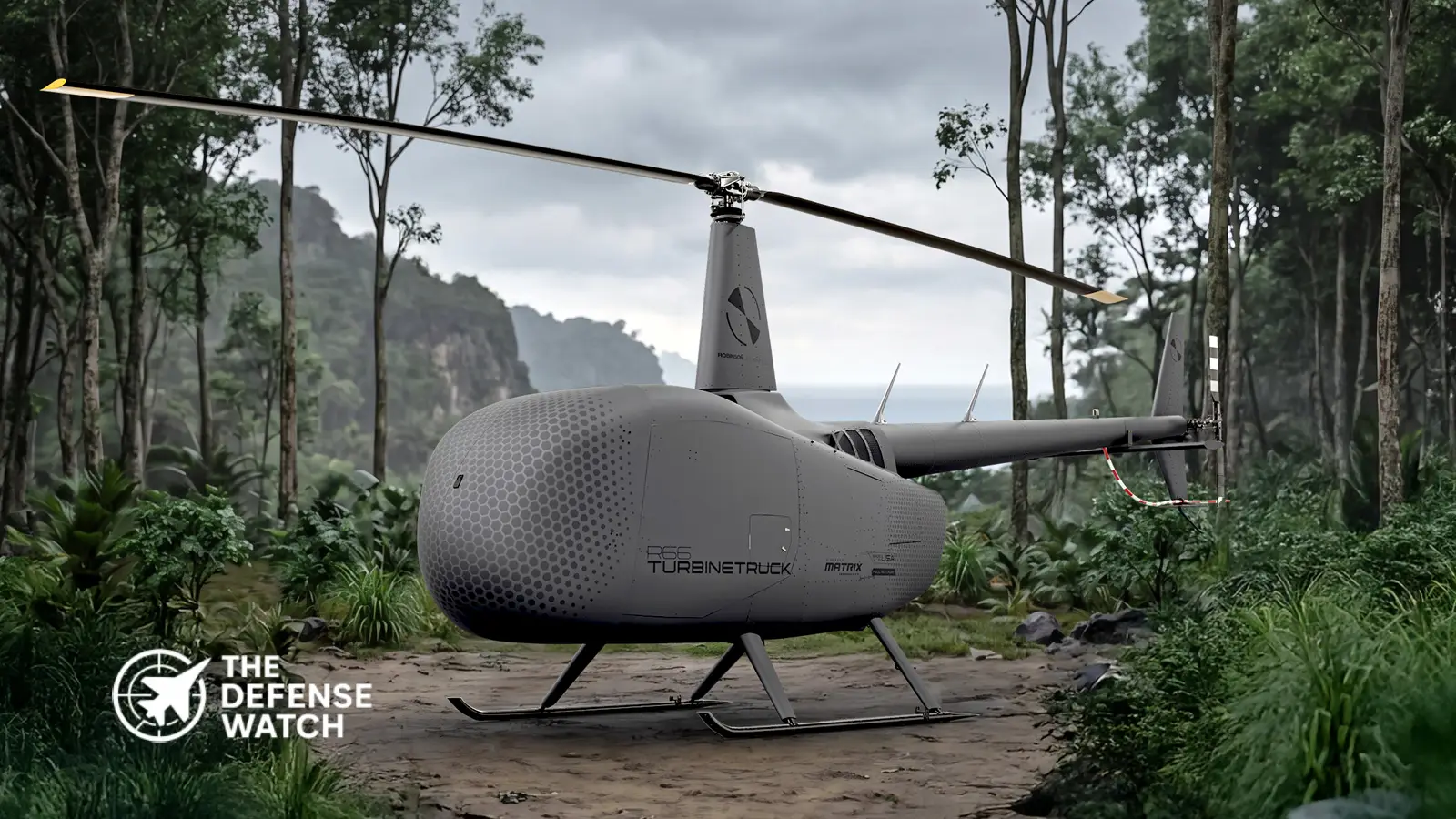
- The selected platform is the R66 TURBINETRUCK — an autonomous cargo helicopter pairing Sikorsky’s MATRIX™ autonomy system with Robinson Helicopter Company’s proven R66 turbine airframe.
- MARV-EL requires an uncrewed aircraft capable of carrying 1,300 to 2,500 lbs of logistics payload to a combat radius of 100 nautical miles, controlled via a digital handheld device.
- The program fills a critical capability gap between small tactical drones and large crewed assault-support aircraft in contested Marine Corps logistics operations.
- Sikorsky’s MATRIX autonomy system has logged more than 1,000 flight hours across 21 aircraft types, giving the R66 TURBINETRUCK a mature and battle-tested autonomous foundation.
The selected platform is the R66 TURBINETRUCK, an autonomous cargo helicopter commercially developed by Sikorsky and Robinson Unmanned that combines Sikorsky’s proven MATRIX™ autonomy system with the rugged R66 airframe from Robinson Helicopter Company, designed to provide flexible, affordable, and rapid combat sustainment. The contract is more than a procurement milestone. It marks a deliberate strategic decision by the Marine Corps to invest in a commercially derived, turbine-powered autonomous rotorcraft rather than a purpose-built military drone — a philosophy that prioritizes mature supply chains, proven airframe reliability, and lower operating costs at the tactical edge.
Filling the Logistics Gap: What MARV-EL Is Designed To Do
The MARV-EL program fills a capability gap between small tactical drones and large strategic airlifters, delivering a reliable “middleweight” uncrewed logistics platform capable of operating from austere forward operating bases, ship decks, or unimproved landing zones. The MARV-EL program requires an uncrewed aircraft capable of carrying a logistics payload between 1,300 and 2,500 lbs to a combat radius of 100 nautical miles, operated through a common digital handheld device. This places the R66 TURBINETRUCK in a unique operational niche — heavier than quadcopter resupply drones like those evaluated under earlier Marine Corps trials, but far more accessible and economical than crewed assault-support aircraft such as the CH-53K King Stallion or MV-22B Osprey. For distributed maritime operations and Expeditionary Advanced Base Operations (EABO) — both central to Marine Corps Force Design 2030 — this class of autonomous logistics aircraft represents a force multiplier that keeps Marines supplied without exposing aircrews to anti-aircraft threats.
The R66 TURBINETRUCK: A Proven Airframe, Autonomized
Robinson says the TURBINETRUCK will offer a useful load exceeding 226 kg and range beyond 325 nautical miles — exceeding the minimum MARV-EL requirement of transporting at least 136 kg for more than 50 nautical miles, with fully autonomous take-off, landing, and waypoint navigation. The autonomy behind that capability is Sikorsky’s MATRIX™ system — one of the most operationally mature autonomous flight platforms in the defense rotorcraft sector. As of March 2026, MATRIX had been integrated into 21 aircraft types and accumulated more than 1,000 flight hours of operational data across platforms ranging from small drones to large cargo rotorcraft. The operator workflow is straightforward by design. Operators enter mission objectives into a digital tablet, and the MATRIX system automatically creates a flight plan, using onboard sensors and algorithms to guide the R66 TURBINETRUCK safely to the target location — mirroring the approach used on Sikorsky’s S-70UAS U-Hawk autonomous helicopter. Critically, the TURBINETRUCK integration is not a clean-sheet design effort. MATRIX will integrate into the R66 TURBINETRUCK in a similar manner as the S-70UAS U-Hawk, while incorporating a smaller footprint, different performance parameters, and a lower operating cost. That approach reduces integration risk and compresses timelines — a key advantage when the Marine Corps needs operational capability, not a decade-long development program.
Industry Voices: What the Contractors Are Saying
Rich Benton, vice president and general manager of Sikorsky, emphasized the platform’s adaptability: “The commercially developed R66 TURBINETRUCK is simple, economical and re-configurable; ideal for high-risk, hard-to-reach environments where keeping personnel out of harm’s way is essential.
David Smith, president and CEO of Robinson Helicopter Company, highlighted the significance of the partnership for the rotorcraft industry: “Together, we are delivering a game-changing capability that will enhance warfighter readiness and open new opportunities for safe, reliable and affordable autonomous transport.
Paul Fermo, president of Robinson Unmanned, framed the operational logic clearly: “By combining MATRIX’s advanced autonomous capability with the rugged, flight-proven R66 airframe, the R66 TURBINETRUCK delivers that capability whenever and wherever it’s needed — no matter the environment.”
Program Background: Built on Hard-Won Experience
This award does not emerge from a standing start. Sikorsky participated in the U.S. Marine Corps’ Aerial Logistics Connector (ALC) Phase 1 in 2025 and is bringing that operational experience forward into the MARV-EL Increment 2 program.
In July 2024, PMA-263 evaluated competing medium aerial resupply prototypes at Yuma Proving Ground, Arizona, including systems from Kaman Aerospace and Leidos/Elroy Air, with payloads, software, navigation, and ground and flight tests used to refine Marine Corps requirements. The selection of Sikorsky and Robinson therefore signals that the Corps is prioritizing aviation-grade engineering and a mature turbine supply chain over experimental drone architectures.
Robinson Unmanned itself is a newly established but rapidly growing business unit. In March 2026, Robinson announced the creation of an uncrewed aircraft business unit dubbed Robinson Unmanned, with the TURBINETRUCK as its first major program — and within weeks, the division secured its first major military contract.
What Comes Next: Integration, Testing, and Demonstration
Under the contract, Robinson Unmanned will deliver the first R66 TURBINETRUCK to Sikorsky for integration, testing, and evaluation. Demonstrations will focus on the autonomy system’s compatibility with the R66 airframe and its open architecture design.
The Marine Corps requirement calls for an uncrewed aircraft able to carry a logistics payload between 1,300 and 2,500 lbs to a combat radius of 100 nautical miles. Robinson’s public specifications list up to 1,300 lbs of internal payload, external loads through a cargo hook, a reinforced flat cargo floor, and seven tie-down points.
The program also feeds into a broader Marine Corps unmanned air logistics construct. Separate from MARV-EL, the USMC is pursuing a larger ship-to-shore autonomous resupply solution under the Aerial Logistics Connector (ALC) program, where Sikorsky is competing with its OPV Black Hawk — facing a rival team offering an autonomous derivative of the Airbus UH-72 military utility helicopter, the MQ-72, using Shield AI’s Hivemind autonomous flight software.
Strategic Analysis: Why This Contract Matters Beyond the Dollar Figure
At $15.5 million, the MARV-EL Increment 2 award is modest by Pentagon standards. Its strategic weight, however, is considerably larger.
The Marine Corps has committed to Force Design 2030 — a sweeping restructuring that eliminates tanks, reduces infantry battalions, and reorients the service toward distributed, maritime, and expeditionary operations in contested Pacific environments. Sustaining dispersed forces across island chains, austere coastal sites, and temporary forward bases in a degraded logistics environment is one of the central operational problems that Force Design creates. MARV-EL is part of the answer.
The operational logic is especially strong in the Indo-Pacific, where Marines may operate from small islands, temporary coastal sites, and dispersed firing positions inside an adversary’s weapons engagement zone. Ground convoys are vulnerable; crewed aviation is scarce and high-demand. An autonomous turbine helicopter that can repeatedly move ammunition, blood, and batteries to the tactical edge — without a pilot — addresses a real and urgent requirement.
The TURBINETRUCK also represents a broader industry trend: the convergence of commercial aviation technology and military autonomous systems. By building on a commercially certified airframe with a known maintenance profile and an existing parts supply chain, Sikorsky and Robinson have developed a platform that is not only operationally capable but also potentially affordable at scale — a combination the Pentagon has historically struggled to achieve in the unmanned systems market.
