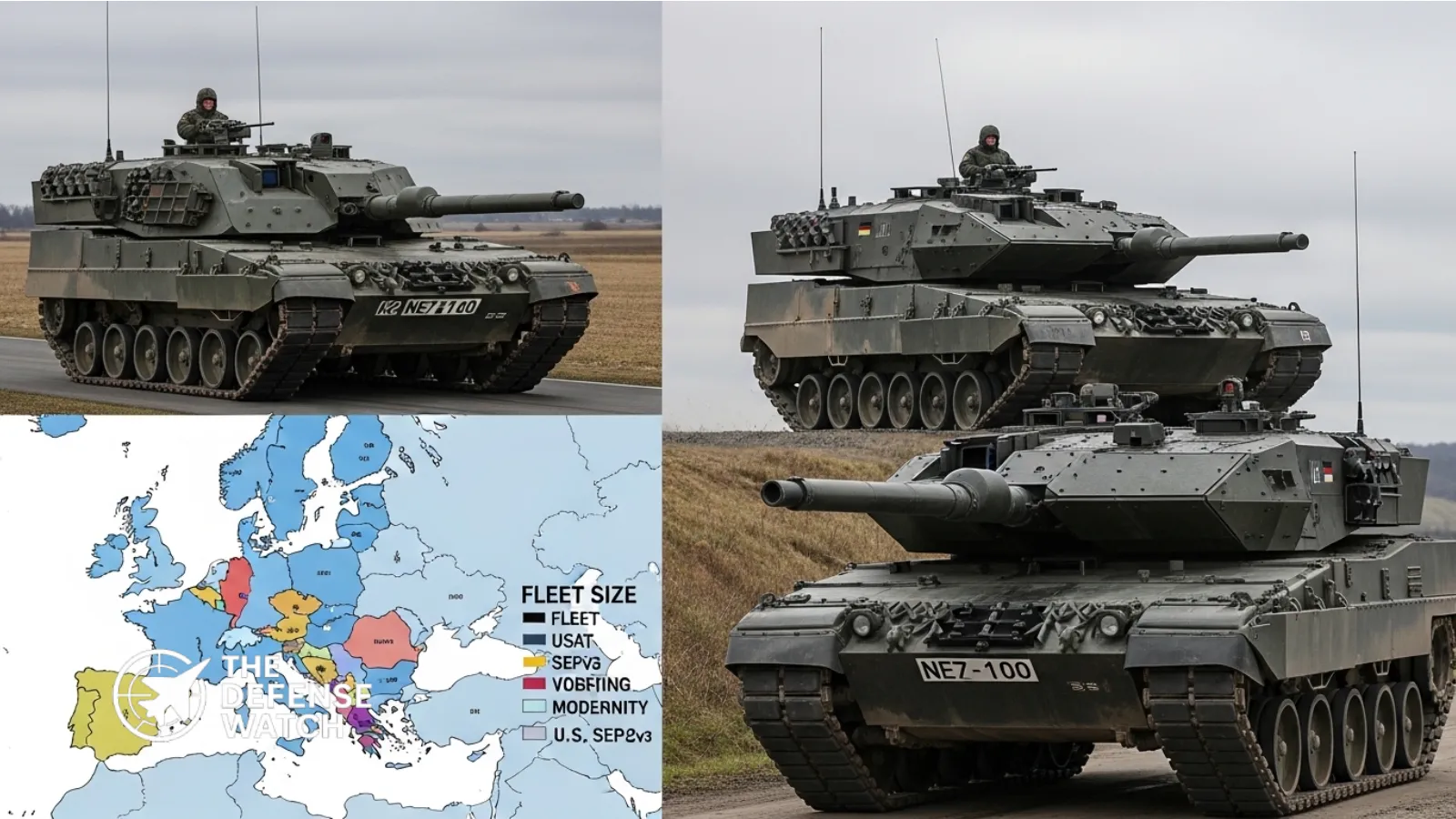
Europe’s Tank Power Rankings in 2026: A Continent in Transition
Europe’s armored landscape in 2026 looks dramatically different from even five years ago. The Russia-Ukraine war shattered longstanding assumptions about the relevance of massed tank formations and triggered a continent-wide scramble to rebuild and modernize ground forces. As a result, the traditional metrics of tank power — raw fleet size and Cold War-era inventories — are giving way to a new calculus that weighs platform generation, battlefield readiness, digital integration, and NATO interoperability. Across this evolving landscape, the question of who truly leads Europe in tank power has become more complex and more consequential than ever.
- Europe’s Tank Power Rankings in 2026: A Continent in Transition
- Türkiye: Europe’s Largest Fleet, but an Aging One
- Poland: The Most Capable Armored Force in Europe
- Germany, France, and the UK: Quality Over Quantity
- Greece, Romania, and the Legacy Fleets
- The Leopard 2A8: NATO’s Next Armored Standard
- The Global Context: Europe’s Place in the Wider Balance
- Analysis: The New Definition of Armored Power
- FAQs
Türkiye holds the largest tank fleet on the continent with 2,381 main battle tanks. Yet Poland, with its aggressive rearmament program, is rapidly challenging that dominance — not merely in numbers, but in the quality and combat readiness of its armored force. The 2026 European tank power rankings reveal that numbers alone no longer tell the full story.
- Türkiye remains Europe’s largest tank operator in 2026 with 2,381 main battle tanks, though much of its fleet consists of older M48 and M60-series platforms.
- Poland currently fields 897 tanks and is expanding toward 1,800–1,900 MBTs, combining K2 Black Panther, M1A2 SEPv3 Abrams, and Leopard 2 variants.
- Germany fields 313 Leopard 2 tanks including 104 of the advanced 2A7V variant — the highest concentration of next-generation armor in Western Europe.
- The Leopard 2A8 standard is emerging as the future backbone of NATO’s European armored forces, with Germany, Czech Republic, Norway, and others adopting it.
- Globally, China leads with approximately 4,700 MBTs, followed by Russia at around 3,460 and the United States at 2,640 Abrams tanks.
Türkiye: Europe’s Largest Fleet, but an Aging One
Türkiye’s position at the top of the European rankings is built on volume, but the composition of that force is a significant caveat. Its fleet of 2,381 tanks includes approximately 750 M48A5 T2 and 650 M60A3 TTS platforms — systems that trace their lineage to Cold War-era American designs. The more capable components include 236 Leopard 2A4 tanks and 80 locally upgraded Leopard 2A4 T1s, alongside smaller numbers of Leopard 1 variants. Notably, only three Altay main battle tanks — Türkiye’s homegrown next-generation MBT — have entered service to date, meaning the country’s indigenous modernization effort remains in its infancy at the operational level.
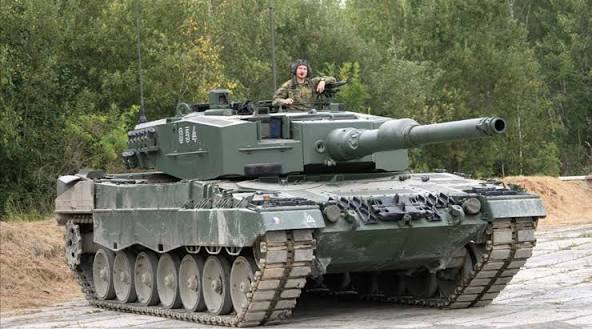
Türkiye’s fleet size gives it undeniable strategic mass, particularly in its near-abroad and within NATO’s southern flank. However, a force in which the majority of tanks are multi-decade-old designs — lacking modern composite armor, digital fire control, and thermal imaging — carries limitations that sheer numbers cannot offset. In a high-intensity conflict against a near-peer adversary fielding modern systems, numerical bulk without technological parity becomes a liability.
Poland: The Most Capable Armored Force in Europe
Poland’s transformation into Europe’s leading armored power by capability is among the most consequential defense developments of the 2020s. In 2026, the Polish Army fields 897 tanks — a figure that already reflects aggressive acquisition — comprising 180 K2 Black Panthers, 117 M1A2 SEPv3 Abrams, 116 M1A1 Abrams, 105 Leopard 2A5, 92 Leopard 2PL, 205 PT-91 Twardy, and 46 T-72M1/M1R variants. What distinguishes Poland is not just what it has purchased, but what it has committed to buying.
Warsaw has signed contracts for up to 1,000 K2 and locally produced K2PL tanks, a deal that would eventually bring Poland’s total fleet to between 1,800 and 1,900 modern MBTs. At that level, Poland would approach Türkiye’s total fleet size while holding a decisive generational edge: the overwhelming majority of its tanks would meet or exceed NATO’s most demanding standards for firepower, protection, and network integration. No other European country is building armored power at this pace and with this level of platform quality simultaneously.
Poland’s approach also reflects a strategic awareness of geographic vulnerability. Sharing a border with Russia’s Kaliningrad exclave and Belarus — and as a direct logistics corridor for any NATO response to eastern threats — Warsaw has concluded that credible deterrence requires a force capable of both absorbing an initial blow and launching a sustained armored counteroffensive. That logic is shaping every procurement decision.
Germany, France, and the UK: Quality Over Quantity
Germany fields 313 Leopard 2 tanks in active service, including 104 of the highly capable Leopard 2A7V variant, which features an improved turret, active protection provisions, and enhanced urban warfare capability. While Germany’s fleet is relatively small for a nation of its strategic weight, the quality of its armor — and its role as the hub of the Leopard 2 ecosystem across NATO — gives Berlin outsized influence over the direction of European armored modernization.
France maintains 200 Leclerc tanks, with 51 in the upgraded XLR configuration. The Leclerc remains one of the most automated and mobile Western MBTs, though France’s fleet size limits its ability to sustain mass armored operations independently. The United Kingdom fields 213 Challenger 2 tanks and is in the process of transitioning to the Challenger 3 standard, which brings a new 120mm NATO-compatible gun, improved composite armor, and a fully modernized fire control system — reversing years of relative stagnation in British armored capability.
Greece, Romania, and the Legacy Fleets
Greece ranks third in Europe with 1,385 tanks, a figure that includes strong modern components — 170 Leopard 2A6HEL and 183 Leopard 2A4 — alongside a substantial legacy mass of approximately 500 Leopard 1 platforms. Greece’s fleet gives it significant regional deterrence capacity, particularly in its Aegean and southeastern NATO context, but the mixed generational structure limits its effectiveness in a fully modern high-intensity scenario.
Romania fields 377 tanks, the fourth largest fleet in Europe, but one that is heavily legacy-based: 220 T-55AM and 103 TR-85 platforms, supplemented by only 54 TR-85M1s. Bulgaria operates 90 T-72 variants. Serbia, outside NATO, fields 229 tanks including 195 M-84s. These Eastern European forces represent the last large concentrations of Cold War armor on the continent — forces that provide territorial mass but lack the protection, digital systems, and interoperability of modern Western designs.
The Leopard 2A8: NATO’s Next Armored Standard
One of the most strategically significant trends in European armored development is the consolidation around the Leopard 2A8 as the emerging common standard for NATO ground forces. Germany is leading adoption as part of its broader Bundeswehr expansion. The Czech Republic is moving toward Leopard 2A8 procurement to fully retire Soviet-era T-72 variants. Norway’s next-generation tank replacement program aligns closely with the A8 configuration. Sweden, Spain, Finland, and the Netherlands are all positioned to follow, either through new procurement or structural upgrades.
This convergence is significant beyond the technical level. A shared, advanced MBT standard across a large coalition of NATO members creates genuine interoperability — common ammunition, shared logistics chains, compatible digital architectures, and unified training frameworks. It is the kind of structural alignment that transforms individual national armies into a coherent, mutually reinforcing alliance force.
The Global Context: Europe’s Place in the Wider Balance
Against the global backdrop, European tank power remains formidable but structurally outmatched in raw numbers. China fields approximately 4,700 MBTs — a force combining aging mass with a growing core of advanced ZTZ-96A and ZTZ-99A platforms. Russia maintains around 3,460 tanks in active formations, including 620 T-90M systems, though the Ukraine war has imposed severe material and personnel costs on its armored forces. The United States fields 2,640 Abrams tanks across active units, with an additional 1,500 in reserve — a force that sets the global benchmark for sensor integration, survivability, and network-centric combat effectiveness.
Europe’s collective armored strength, when viewed across NATO as a whole, is substantial. But the key differentiator is that European nations are increasingly fielding platforms that are qualitatively competitive at the high end, rather than simply accumulating numbers. Poland’s expansion, Germany’s Leopard 2A7V fleet, the UK’s Challenger 3 transition, and the spread of the Leopard 2A8 standard are all indicators of a continent that is rebuilding armored power with a fundamentally different philosophy than before.
Analysis: The New Definition of Armored Power
The 2026 rankings underscore a structural shift in how armored power is measured. For most of the Cold War and its aftermath, tank power was synonymous with fleet size. The country with the most tanks was, broadly speaking, the most powerful armored force. That equation no longer holds.
What the data shows is that Europe’s most effective armored forces in 2026 are not necessarily its largest. Poland’s 897-tank fleet today outperforms Greece’s 1,385 and Türkiye’s 2,381 in terms of operational effectiveness per platform, because the majority of Poland’s tanks feature modern protection, fire control, and digital integration that the older platforms in those larger fleets simply cannot match. When Poland reaches 1,800 to 1,900 tanks — predominantly K2, SEPv3, and Leopard 2 variants — it will combine near-top-tier volume with the highest concentration of advanced MBTs on the continent. That combination, never before seen in European defense, will effectively reorder the entire armored hierarchy.
The broader implication is that European armies are no longer rebuilding for the threat environment of the 1990s or even the 2000s. They are building for a threat environment defined by Russia’s demonstrated willingness to wage large-scale ground combat, drone-integrated warfare, and contested logistics. In that environment, a modern tank with active protection, digital fire control, and sustainable logistics support is worth several times its older equivalent — and the European countries investing in that quality today are making a calculated strategic bet that will define the continent’s security architecture for the next two decades.
FAQs
Which country has the most tanks in Europe in 2026?Türkiye leads Europe in total tank numbers with 2,381 main battle tanks, though the majority are older M48 and M60-series platforms with limited modern capability.
Is Poland becoming the most powerful armored force in Europe?By combat capability standards, Poland is already making a strong case. With 180 K2 Black Panthers, over 230 Abrams variants, and more than 200 Leopard 2s, and contracts for up to 1,000 K2 and K2PL tanks, Poland is building the most modern and scalable armored force on the continent.
What is the Leopard 2A8, and why does it matter?The Leopard 2A8 is the latest evolution of Germany’s Leopard 2 main battle tank family, incorporating improved protection, updated fire control, and enhanced survivability systems. Its adoption by multiple NATO members as a common standard is creating a unified, high-technology armored backbone for the alliance.
How does Europe’s tank power compare to Russia’s?Russia maintains approximately 3,460 active MBTs, including around 620 T-90M modern variants. European NATO members collectively field a comparable number of tanks, with a growing share of high-end systems such as Leopard 2A7V, M1A2 SEPv3, and K2 that match or exceed Russian top-tier platforms.
Why doesn’t Germany have a larger tank fleet?Germany’s Bundeswehr underwent significant post-Cold War downsizing that reduced its Leopard 2 fleet to around 313 active tanks. Berlin is now reversing that trend as part of broader NATO rearmament commitments, with the Leopard 2A8 program central to planned expansion.