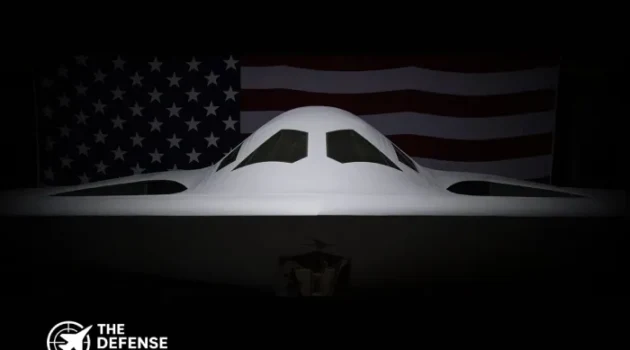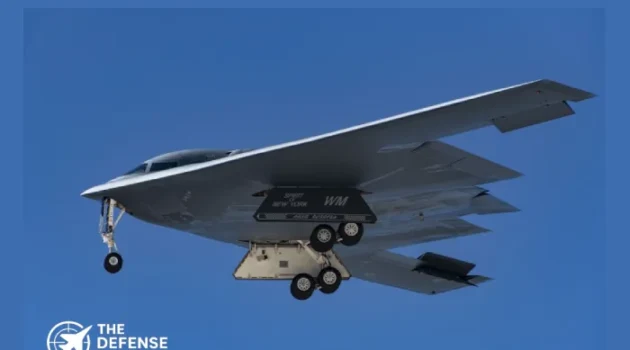
- ► The U.S. Air Force and Northrop Grumman signed a deal on February 23, 2026 at the AFA Warfare Symposium to increase B-21 Raider annual production by 25%.
- ► The acceleration is backed by $4.5 billion in reconciliation funding approved by Congress as part of the “One Big Beautiful Bill” signed in 2025.
- ► Northrop Grumman has invested more than $5 billion in digital engineering and manufacturing infrastructure to support faster production cycles.
- ► The first operational B-21 Raider is scheduled to arrive at Ellsworth Air Force Base, South Dakota, in 2027.
- ► At least two B-21 aircraft are currently conducting flight testing at Edwards Air Force Base, California, with performance reported to exceed digital model predictions.
- ► Northrop’s Palmdale facility currently produces an estimated seven to eight aircraft annually; the exact accelerated rate remains classified.
- ► The B-21 program employs more than 8,000 personnel and over 400 suppliers across 40 U.S. states, making it one of the most broadly distributed defense industrial programs in the country.
B-21 Raider Production Acceleration Marks a Strategic Inflection Point for U.S. Airpower
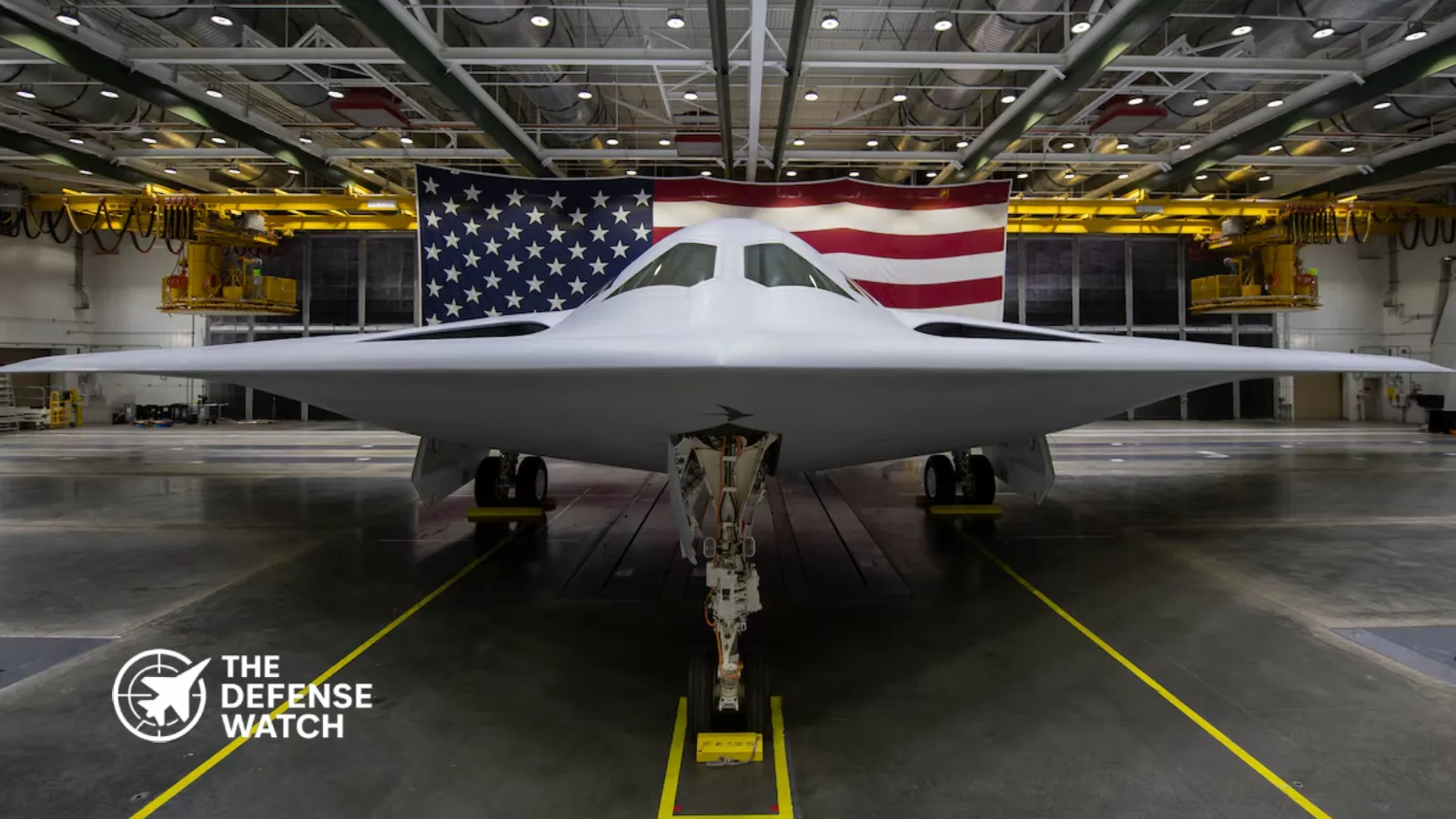
The B-21 Raider production acceleration, formalized at the Air & Space Forces Association Warfare Symposium on February 23, 2026, is not simply a procurement contract milestone. It reflects a deliberate choice by Pentagon leadership to close what it perceives as a widening window of strategic vulnerability — one defined by an aging bomber fleet, accelerating Chinese and Russian air defense modernization, and the operational lessons drawn from 2025’s Operation Midnight Hammer.
The deal pairs $4.5 billion in already-appropriated reconciliation funding with a new production agreement raising Northrop Grumman’s annual B-21 output by 25 percent. The practical result: the Air Force’s nuclear-capable, penetrating long-range strike capacity reaches operational units faster. The strategic result is more complex — and worth examining carefully.
The Industrial Foundation Behind the Deal
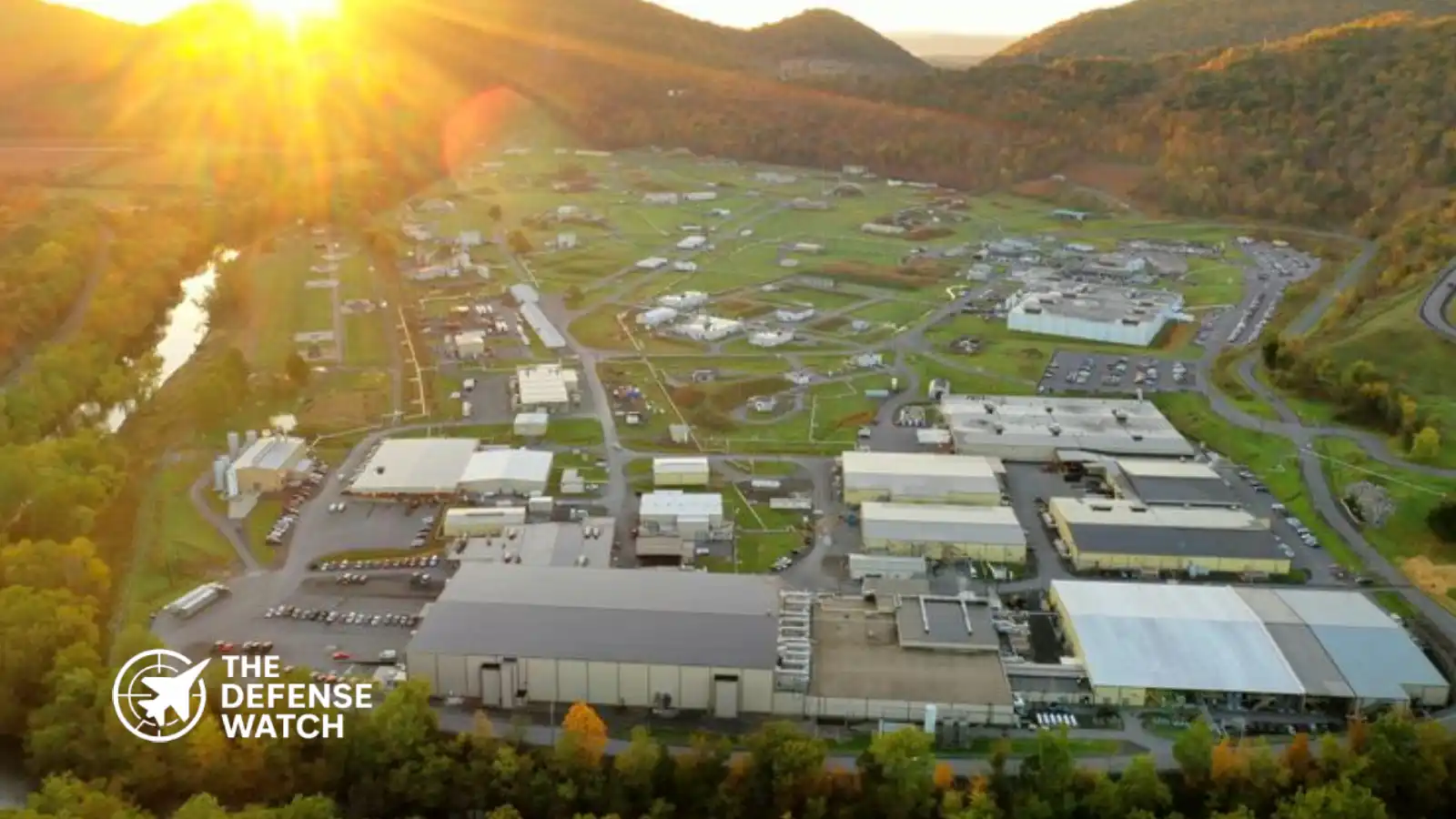
Northrop Grumman’s willingness to commit to faster production is not corporate optimism. It rests on a documented infrastructure investment that, by the company’s own accounting, exceeds $5 billion in digital engineering and advanced manufacturing tools at its Plant 42 facility in Palmdale, California.
The company reports that its digital environment supports flight test planning and real-time performance analysis, enabling increased test cadence — with maintainers able to service aircraft for another test flight the following day. That kind of rapid turnaround in testing is significant because it translates directly to what the Air Force can expect from operational sorties. If the combined test force can regenerate a B-21 overnight under test conditions, the operational maintenance model should track closely with that performance baseline.
(adsbygoogle = window.adsbygoogle || []).push({});Northrop has also reduced software certification time by 50 percent, using advanced manufacturing tools including digital and augmented reality technologies to improve efficiency and scale production across facilities nationwide.
This is not small-batch artisan production. The program involves more than 400 suppliers across 40 states, a supply chain architecture deliberately designed to build political durability into the program budget line — and to reduce single-point-of-failure risk in the production base.
Why the Timing Matters
The Pentagon currently fields only 20 Northrop Grumman B-2 Spirit bombers — the Western world’s only low-observable, nuclear-capable heavy bomber — a fleet that played a central role in 2025’s Operation Midnight Hammer, the U.S. operation to destroy Iran’s underground nuclear enrichment sites.
That mission exposed both the B-2’s irreplaceable value and the acute danger of depending on a 20-aircraft fleet for the nation’s most demanding strike missions. The B-2 is aging, difficult to sustain, and expensive to fly. Its stealth coatings require intensive maintenance. Its radar cross-section management systems, while still effective, were designed against threat environments that have since evolved considerably.
(adsbygoogle = window.adsbygoogle || []).push({});The B-21 Raider program was built with those realities in mind. Its design incorporates modernized low-observable materials and manufacturing processes intended to reduce maintenance burden compared to the B-2. The open-systems architecture allows avionics and mission system upgrades without major airframe modifications — a lesson learned the hard way across the B-2’s operational life. The aircraft can carry both conventional and nuclear payloads, and is designed for manned or optionally unmanned operation, providing flexibility that no current U.S. bomber offers.
Air Force Secretary Troy Meink, speaking at the symposium, stated that “the B-21 is foundational to our long-range strike capability and to credible deterrence,” and that accelerating production ensures delivery to combatant commanders faster, strengthening the ability to “outpace, deter, and, if necessary, defeat emerging threats.”
That language is deliberate. Deterrence credibility in the nuclear domain depends not only on capability but on demonstrated capacity — adversaries need to believe the United States can field sufficient penetrating strike assets to hold their highest-value, hardened targets at risk. Twenty B-2s do not provide that assurance at scale. One hundred or more B-21s, delivered on a compressed timeline, begins to rebuild it.
The Financial Architecture of Acceleration
The $4.5 billion reconciliation injection is not discretionary — it was specifically designated by Congress for B-21 production capacity expansion. Northrop CEO Kathy Warden indicated that Northrop plans to invest between $2 to $3 billion over multiple years in facility upgrades to support the acceleration. That private industrial investment, layered on top of the government funding, suggests both parties have committed to a production rate increase that cannot easily be unwound by future budget volatility.
(adsbygoogle = window.adsbygoogle || []).push({});That said, the financial trajectory has not been smooth. As of early 2026, Northrop had absorbed roughly a $2 billion hit trying to accelerate the program and cover material costs — a reminder that fixed-price contracts in development-phase programs carry real risk for the prime contractor. The new deal should provide more favorable terms for the accelerated lots, though the Pentagon has not disclosed pricing details.
The per-unit cost of the B-21 currently sits near $700 million per aircraft at current production rates. Increased volume should drive per-unit costs down through learning-curve economics, though stealth manufacturing is labor-intensive enough that cost reduction will be gradual rather than dramatic.
Comparing the Industrial Baseline to Competitors
It is worth placing this production decision in comparative context. China’s H-20 stealth bomber has been in development for years but has not entered series production or been confirmed as operationally deployed. Russia’s PAK DA program remains mired in development, with no credible timeline for fielding. Neither adversary currently operates a penetrating stealth bomber comparable to the B-2, and neither is likely to field one on a timeline that matches the B-21’s accelerated delivery schedule.
This matters because the accelerated B-21 production is not a symmetric arms race response — it is an effort to lock in an asymmetric advantage before competitors can close the gap. Long-range strike penetration capability is among the hardest military attributes to replicate quickly. The industrial knowledge, materials science, and systems integration experience required cannot be acquired on short notice.
(adsbygoogle = window.adsbygoogle || []).push({});The United Kingdom and Australia, both close intelligence partners operating within AUKUS, have no equivalent penetrating bomber program. The B-21 effectively makes the United States the sole Western power with this capability for at least the next two decades, reinforcing Washington’s role as the alliance’s indispensable long-range strike backstop.
Program of Record and the 100-Aircraft Question
The current B-21 program of record calls for a minimum of 100 aircraft. Some officials have called for expanding the program of record beyond that number, though Air Force Secretary Meink did not address whether the overall buy would change.
The case for expanding the buy is straightforward: with a fleet of 100, accounting for depot maintenance cycles, training aircraft, testing attrition, and forward deployment requirements, actual mission-capable aircraft available at any given time could be well under 70. For a force designed to hold at-risk a large and geographically dispersed set of hardened targets across China or Russia, that may prove insufficient.
(adsbygoogle = window.adsbygoogle || []).push({});Conversely, at $700 million per aircraft and with the Air Force simultaneously funding the B-52J re-engine program, the Sentinel ICBM (itself under significant cost pressure), and LRSO cruise missile development, budget competition is fierce. The reconciliation funding provides short-term relief, but sustained production acceleration beyond 100 aircraft would require additional appropriations that are not yet committed.