

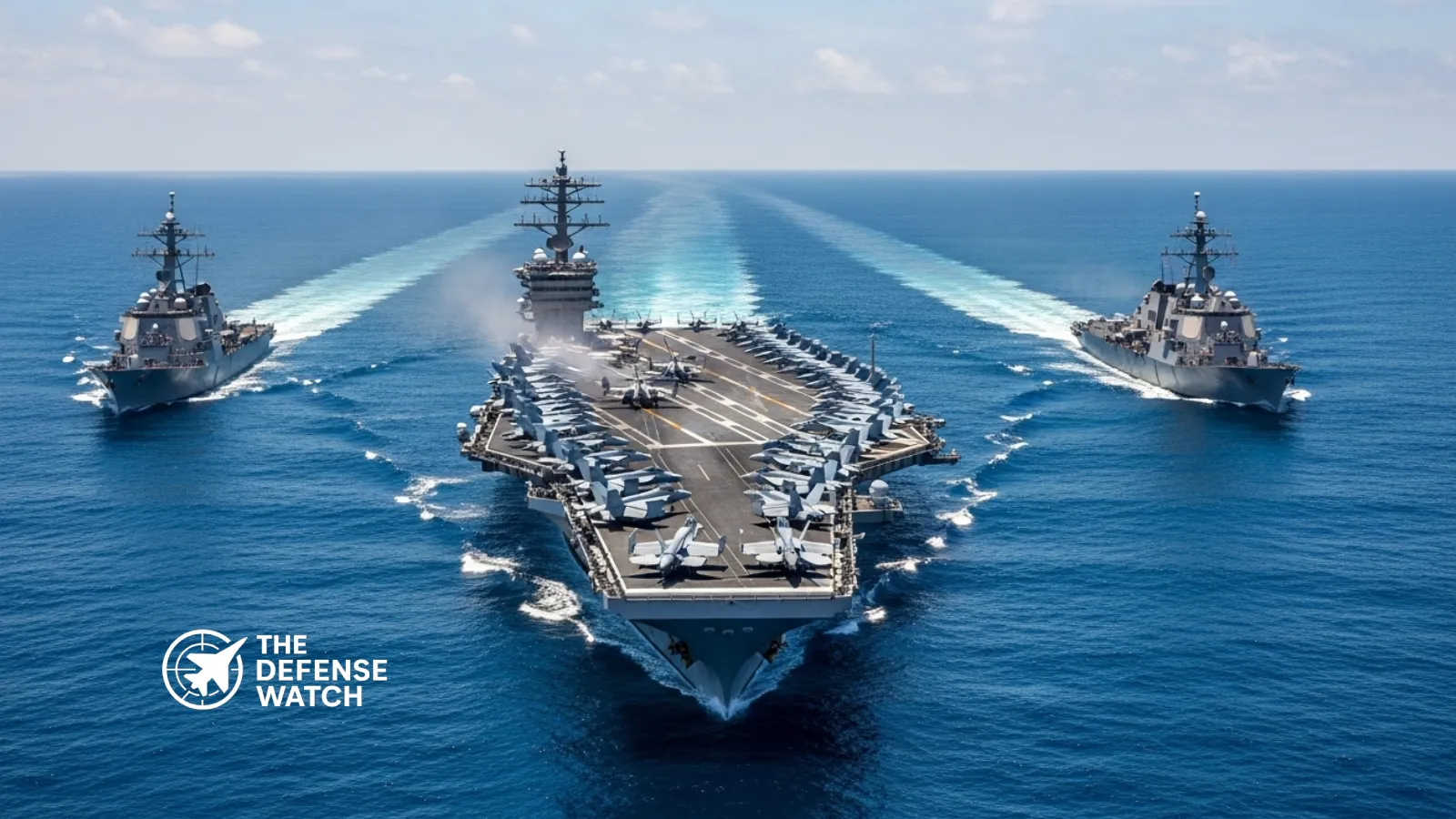
The United States has deployed a major naval force toward Iran as President Donald Trump signals possible military action, marking one of the most serious escalations in U.S. Iran tensions in years. The movement of U.S. Navy assets into the Middle East reflects heightened concern in Washington over regional stability, maritime security, and Iranian military activity.
According to reporting from Army Recognition and U.S. defense officials, the deployment includes carrier strike group elements, guided missile destroyers, and support vessels moving toward key maritime chokepoints near the Persian Gulf and Arabian Sea. The buildup follows a series of public statements by President Trump indicating that military options are under active consideration.
Composition of the U.S. Naval Force
U.S. Navy movements include surface combatants equipped with advanced air and missile defense systems, long range strike capabilities, and integrated command and control networks. Carrier based aircraft provide strike, surveillance, and electronic warfare capabilities that significantly expand U.S. operational reach in the region.
While the Pentagon has not released full details on the force package, officials confirmed that the deployment is intended to deter Iranian aggression, protect U.S. and allied interests, and ensure freedom of navigation in international waters.
The U.S. Fifth Fleet, headquartered in Bahrain, continues to coordinate maritime operations across the Gulf, Red Sea, Arabian Sea, and parts of the Indian Ocean. See also: U.S. Navy expands maritime patrols in the Red Sea.
Trump Signals Possible Military Action
President Trump has publicly stated that Iran must change its behavior or face serious consequences, including the potential use of military force. While stopping short of announcing specific actions, Trump emphasized that all options remain on the table.
Administration officials have linked the naval deployment to concerns over Iranian missile activity, naval harassment incidents, and support for regional proxy forces. The White House has framed the move as defensive, but the scale and timing signal readiness for rapid escalation if conditions deteriorate.
Defense analysts note that naval deployments offer flexible response options, allowing the U.S. to apply pressure without immediate ground involvement.
Strategic Importance of Maritime Posture
Naval power remains a central tool in U.S. strategy toward Iran. The Strait of Hormuz, through which roughly one fifth of global oil supply transits, remains a critical vulnerability. Any disruption could have global economic consequences.
By positioning major naval assets near Iran, the U.S. enhances its ability to conduct maritime security operations, missile defense, and precision strikes. The presence of Aegis equipped destroyers also strengthens regional missile defense coverage for U.S. forces and partners.
This posture aligns with long standing U.S. naval doctrine emphasizing forward presence and deterrence through visible capability.
Iranian Response and Regional Impact
Iranian officials have criticized the U.S. deployment, calling it provocative and destabilizing. Tehran has stated that it will defend its sovereignty and warned against foreign military presence near its waters.
Regional allies, including Gulf states, are closely monitoring the situation. Many rely on U.S. naval power for security assurances, particularly against missile and drone threats.
At the same time, regional actors are urging restraint, concerned that miscalculation at sea could rapidly escalate into a broader conflict.
Implications for U.S. Military Strategy
The deployment highlights the continued centrality of naval forces in U.S. power projection. Carrier strike groups provide unmatched flexibility, allowing rapid shifts between deterrence, signaling, and combat operations.
For the U.S. Navy, sustained operations in the Middle East also place pressure on force readiness and deployment cycles, especially as competition with China and Russia intensifies elsewhere.
Pentagon officials have emphasized that the deployment does not signal abandonment of other theaters, but rather reflects the Navy’s ability to operate globally.
Outlook
While no direct military action has been announced, the presence of a major U.S. naval force near Iran significantly raises the stakes. Diplomatic channels remain active, but the margin for error is narrowing.
Defense planners and regional partners will be watching closely for signs of de escalation or further military signaling in the days ahead.
