• Home
  • About
  • Defense Systems
  • Manufacturer
  • Comparisons
  • Compare 
  • Tools
TheDefenseWatch.com
  • Aerospace & Aviation
  • Military & Ordnance
  • Naval & Maritime
  • Cyber & Space Defense
  • Policy & Strategy
  • Global News
  • Tools Library
    • Smart Calculator
    • Drone Flight Time Calculator
    • Drone Range Calculator
    • Counter-Drone Jammer Effective Range Calculator
    • Counter-Battery Radar Detection Calculator
    • Artillery Fire Correction Calculator
    • Thermal Camera Detection Range Calculator
    • Missile Range & Time-of-Flight Calculator
    • Radar Detection Range Calculator
    • FPV Strike Drone Payload vs Range Calculator
    • Loitering Munition Endurance Calculator
    • Sniper Ballistic Drop & Windage Calculator
    • Bullet Drop Calculator
    • U.S. Army Combat Fitness Test (ACFT) Calculator
    • Military Pension Calculator
    • Military Retirement Calculator
    • Military Pension Calculator
    • Large Number Calculator
Font ResizerAa

TheDefenseWatch.com

The Defense Watch | U.S. & Global Defense News, Analysis & Military Updates

Search
  • Home
  • About
  • Defense Systems
  • Manufacturer
  • Comparisons
  • Compare 
  • Tools

Stay Updated

Get the latest update

Subscribe

Explore

  • Drone
  • Fighter Jets & Military Aircraft
  • Hypersonic Weapons
  • Aircraft Carriers
  • Strategic History & Missions
  • Tools Library
Home » US KC-135 Tanker Crash In Iraq During Operation Epic Fury Raises Questions About Air Campaign Tempo
Global News

US KC-135 Tanker Crash In Iraq During Operation Epic Fury Raises Questions About Air Campaign Tempo

Daniel Mercer / Defense & Aerospace Analyst
Last updated: September 7, 2026 5:20 pm
Daniel Mercer / Defense & Aerospace Analyst
Share
3 Min Read
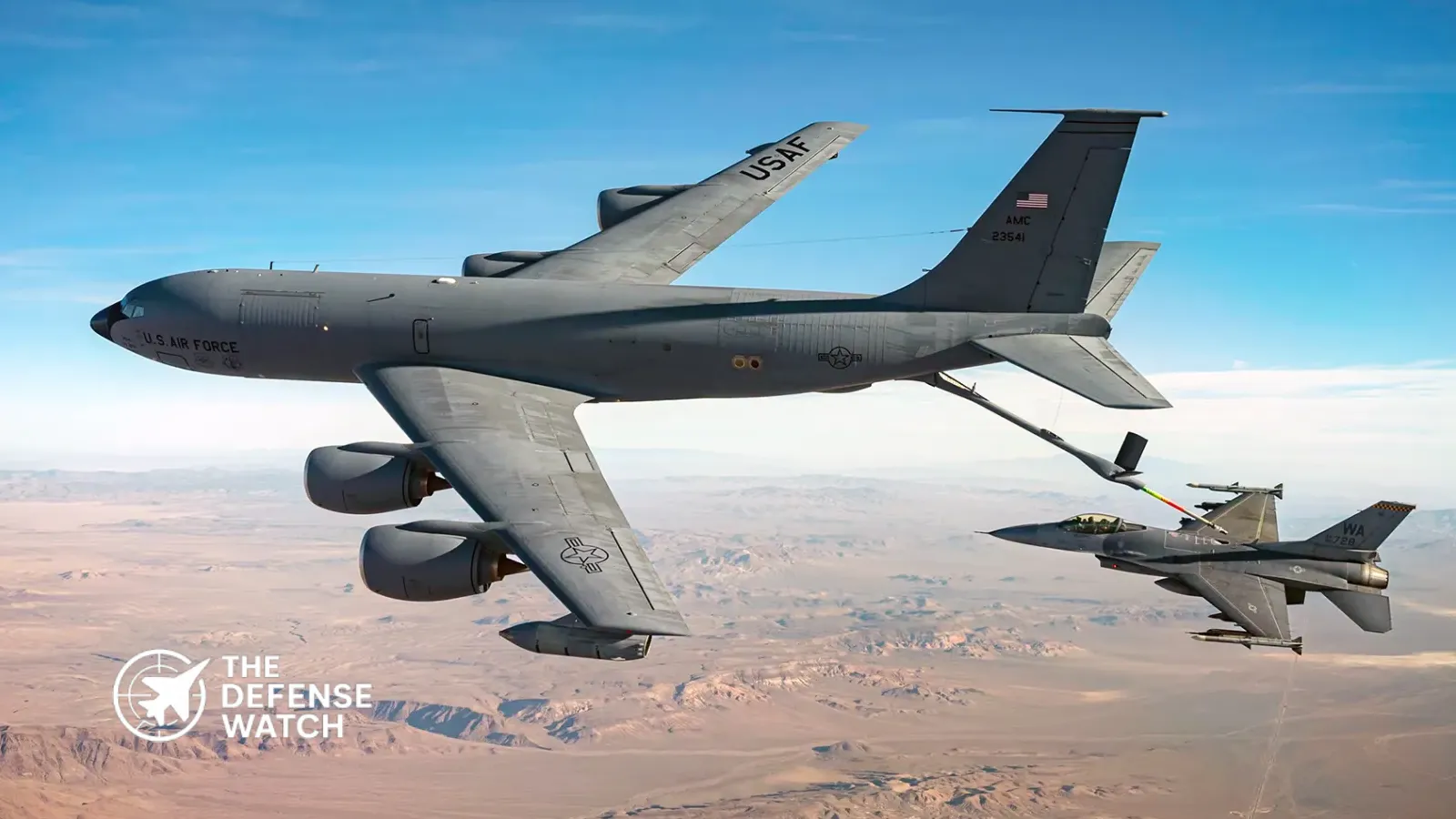
KC-135 tanker crash Iraq
Image : USAF
SHARE
¦ KEY FACTS AT A GLANCE
  • A US Air Force KC-135 Stratotanker crashed in western Iraq on March 12, 2026 while supporting Operation Epic Fury.
  • US Central Command confirmed two aircraft were involved in the incident, with one tanker lost and another landing safely.
  • Officials stated the crash occurred in friendly airspace and was not caused by hostile or friendly fire.
  • Search and rescue operations were launched for the crew as the Pentagon investigates the cause of the incident.
  • The loss highlights the operational risks facing aerial refueling forces supporting high tempo combat operations.

KC-135 Tanker Crash In Iraq

The KC-135 tanker crash in Iraq occurred on March 12, 2026 when a US Air Force aerial refueling aircraft supporting Operation Epic Fury went down in western Iraq during a mission linked to ongoing military operations against Iran.

Contents
  • KC-135 Tanker Crash In Iraq
  • The Big Picture
  • What’s Happening
  • Why It Matters
  • Strategic Implications
  • Competitor View
  • What To Watch Next
  • Capability Gap
  • The Bottom Line

US Central Command confirmed that two aircraft were involved in the incident and that one KC-135 Stratotanker was lost while the second aircraft landed safely. Officials emphasized the crash took place in friendly airspace and was not caused by hostile or friendly fire. Rescue efforts were launched to locate the crew while investigators began assessing what led to the accident.

The Big Picture

The KC-135 tanker crash in Iraq comes during an intense phase of US air operations in the Middle East tied to the broader campaign against Iran. Operation Epic Fury has involved large scale deployments of US aircraft, naval assets, and personnel across the region.

  • KC-135 Air Refueling Tanker

    KC-135 Air Refueling Tanker

    • Maximum Speed: 530 mph
    • Range: 1500 miles with refueling mission
    • Payload Capacity: 90000 lb fuel
    • Crew: 3 to 4
    • View Details →
    6.6

    Aerial refueling aircraft are a central component of these operations. Tankers allow strike fighters, bombers, surveillance aircraft, and electronic warfare platforms to remain airborne for extended periods, enabling long range missions and sustained combat sorties.

    The US Air Force relies heavily on the KC-135 fleet for this mission. First introduced in the late 1950s, the aircraft remains one of the backbone platforms of US aerial refueling operations, supporting combat missions across multiple theaters worldwide.

    High sortie rates during large scale operations place significant demands on tanker units. Aircraft must often fly multiple missions per day while coordinating with numerous receivers such as fighters and bombers operating across wide geographic areas.

    What’s Happening

    US Central Command confirmed that the tanker crash occurred during a sortie connected to Operation Epic Fury.

    Officials stated that:

    Two aircraft were involved in the incident.
    One KC-135 tanker went down in western Iraq.
    The second aircraft landed safely after the event.

    Initial statements from CENTCOM stressed that the accident did not result from hostile action or friendly fire.

    Authorities have not publicly disclosed the precise cause of the incident. Search and rescue operations were initiated shortly after the crash as military officials worked to locate and recover the crew.

    The KC-135 typically carries multiple crew members depending on mission configuration, including pilots and a boom operator responsible for controlling the refueling system.

    Why It Matters

    The KC-135 tanker crash in Iraq highlights the operational importance and inherent risk associated with aerial refueling missions.

    Mid air refueling remains one of the most complex and demanding tasks in military aviation. Tankers must maintain extremely precise flight paths while receiver aircraft maneuver within close proximity to connect to the refueling boom.

    These operations frequently occur at night, over long distances, and in congested operational environments involving multiple aircraft.

    • KC-135 Air Refueling Tanker

      KC-135 Air Refueling Tanker

      • Maximum Speed: 530 mph
      • Range: 1500 miles with refueling mission
      • Payload Capacity: 90000 lb fuel
      • Crew: 3 to 4
      • View Details →
      6.6

      During high intensity campaigns such as Operation Epic Fury, the number of refueling sorties increases dramatically. Tankers become essential enablers for combat aircraft conducting strike missions, intelligence flights, and air defense patrols.

      A loss of a tanker aircraft therefore represents more than an aviation accident. It directly affects operational capacity and sortie generation across the entire air campaign.

      Strategic Implications

      Aerial refueling assets represent one of the most critical enablers of US global airpower. Tankers extend the reach of combat aircraft and allow the United States to project force far beyond the range of forward bases.

      Operations connected to the conflict with Iran rely heavily on this capability. Fighters and bombers often operate from distant bases or aircraft carriers, requiring multiple refueling cycles to complete long range strike missions.

      The KC-135 tanker crash in Iraq therefore underscores the central role these aircraft play in sustaining US air operations in the Middle East.

      Even a single aircraft loss can temporarily reduce available refueling capacity, particularly during periods of sustained combat operations.

      The incident also highlights the logistical complexity of modern air campaigns. Tanker scheduling, airspace management, and mission coordination must function seamlessly to support dozens of aircraft operating simultaneously across large regions.

      Competitor View

      Strategic competitors will closely monitor operational incidents such as the KC-135 tanker crash in Iraq.

      Iran and allied regional militias are likely to examine the event for indications of operational strain within the US air campaign. Even accidents unrelated to hostile action can influence perceptions of operational sustainability.

      • KC-135 Air Refueling Tanker

        KC-135 Air Refueling Tanker

        • Maximum Speed: 530 mph
        • Range: 1500 miles with refueling mission
        • Payload Capacity: 90000 lb fuel
        • Crew: 3 to 4
        • View Details →
        6.6

        Russia and China also track US tanker operations closely. Both countries have invested heavily in long range strike capabilities and aerial refueling fleets to replicate similar expeditionary airpower capabilities.

        Operational mishaps therefore provide insight into the complexity and demands associated with sustaining global air operations.

        What To Watch Next

        Investigators from the US Air Force and US Central Command will conduct a detailed accident investigation to determine the cause of the crash.

        Key factors that investigators typically examine include:

        Aircraft mechanical performance
        Crew actions and procedures
        Flight data and communications
        Environmental conditions
        Interaction between aircraft involved in the incident

        Additional details about the aircraft, crew status, and operational context are expected to emerge as recovery operations continue.

        The Pentagon may also review tanker mission procedures or operational tempo if the investigation identifies contributing factors related to operational stress or coordination.

        Capability Gap

        The loss of a KC-135 tanker also highlights the long term transition underway within the US aerial refueling fleet.

        The Air Force is gradually replacing aging KC-135 aircraft with the newer KC-46 Pegasus tanker. However, the legacy fleet continues to carry a large portion of the operational workload.

        • KC-46 Pegasus Aerial Refueling Aircraft

          KC-46 Pegasus Aerial Refueling Aircraft

          • Maximum Speed: Mach 0.86
          • Range: Long
          • Payload Capacity: High fuel offload and cargo
          • Crew: 3
          • View Details →
          7.2

          Many KC-135 aircraft remain in service despite decades of use. Although they have undergone extensive upgrades, the aircraft’s age increases maintenance demands and operational complexity.

          Until the KC-46 fleet reaches full operational capacity, the KC-135 will remain a critical component of US global airpower.

          The Bottom Line

          The KC-135 tanker crash in Iraq underscores both the central importance and operational risk of aerial refueling aircraft that sustain US combat operations across the Middle East.

TAGGED:aerial refuelingIraq conflictKC-135Operation Epic Furyus air force
Share This Article
Facebook Copy Link Print
ByDaniel Mercer / Defense & Aerospace Analyst
Follow:
Daniel Mercer is a defense and aerospace analyst at TheDefenseWatch.com covering military aviation, aerospace technology, unmanned systems, air warfare, and defense procurement. His reporting uses official documents, government and military statements, company announcements, and other public sources.
Leave a Comment

Leave a Reply Cancel reply

Your email address will not be published. Required fields are marked *

Latest Defense Systems

  • RUTA B1 Cruise Missile RUTA B1 Cruise Missile
  • XQ-67A Drone XQ-67A Drone
  • B-25 Mitchell Bomber B-25 Mitchell Bomber
  • F-100 Super Sabre F-100 Super Sabre
  • North American F-86 Sabre North American F-86 Sabre
  • North American XB-70 Valkyrie North American XB-70 Valkyrie
  • Northrop YF-23 Fighter Northrop YF-23 Fighter
  • P-51 Mustang Fighter Aircraft P-51 Mustang Fighter Aircraft
  • Rafale F5 Fighter Rafale F5 Fighter

Recent Compares

  • J-10C vs JF-17 Thunder: Which Fighter Is More Capable? J-10C vs JF-17 Thunder: Which Fighter Is More Capable? View Comparison →
  • Tejas vs Gripen: Key Differences and Capabilities Tejas vs Gripen: Key Differences and Capabilities View Comparison →
  • Tejas vs MiG-21 Bison: How India Replaced Its Iconic Supersonic Fighter Tejas vs MiG-21 Bison: How India Replaced Its Iconic Supersonic Fighter View Comparison →
  • F-35 vs F-16: Stealth, Sensors and Combat Roles F-35 vs F-16: Stealth, Sensors and Combat Roles View Comparison →
  • Tejas Fighter Jet vs F-16 Fighting Falcon: Capability Compared Tejas Fighter Jet vs F-16 Fighting Falcon: Capability Compared View Comparison →
  • Rafale Fighter Jet vs F-16 Fighting Falcon : Which Fighter Has the Edge? Rafale Fighter Jet vs F-16 Fighting Falcon : Which Fighter Has the Edge? View Comparison →
  • Su-57 Fighter Jet vs J-20 Fighter Jet: Stealth and Air Combat Compared Su-57 Fighter Jet vs J-20 Fighter Jet: Stealth and Air Combat Compared View Comparison →
  • Mirage 2000 vs Tejas Mk1A: Legacy Combat Power vs Indigenous Modernization Mirage 2000 vs Tejas Mk1A: Legacy Combat Power vs Indigenous Modernization View Comparison →
  • Rafale Fighter Jet vs F-22 Raptor: Which Air Dominance Fighter Has the Edge? Rafale Fighter Jet vs F-22 Raptor: Which Air Dominance Fighter Has the Edge? View Comparison →
  • Tejas Fighter Jet vs. Rafale Fighter Jet: India’s Indigenous Fighter Meets France’s Proven Multirole Combat Aircraft Tejas Fighter Jet vs. Rafale Fighter Jet: India’s Indigenous Fighter Meets France’s Proven Multirole Combat Aircraft View Comparison →

Recent Posts

  • Destinus Produces 1,750 Ruta B1 Cruise Missiles as European Output Expands
  • Boeing Wins $11.1 Million Contract Modification for Kuwait F/A-18 Training Support
  • U.S. Navy Awards $23.1 Million Contract for Cybersecurity of Shipboard Power Systems
  • Lockheed Martin Wins $43.7 Million F-35 Reprogramming Lab Upgrade Contract
  • USS Colorado Arrives in Australia for AUKUS Submarine Maintenance

You Might Also Like

Egypt Turkey defense deal
Global News

Egypt, Turkey Sign $350 Million Defense Deal Covering Drones and Arms Production

September 7, 2026
US A-10 live fire Gulf
Global News

US A-10 Aircraft And Littoral Combat Ship Fire Weapons Together In Gulf Drill

September 7, 2026
Ferguson Marine permanent Chair
Global News

Ferguson Marine Names Duncan Anderson Permanent Chair As Shipyard Pushes For Stability

February 16, 2026
Houthi missile attack
Global News

Houthi Missile Barrage Forces Mocha Port Shutdown After $16 Million Damage

August 16, 2026

Logo

Copyright © 2026 TheDefenseWatch.com

Helpful Links

  • Home
  • About Us
  • Privacy Policy
  • Terms of Use / Disclaimer
  • U.S. Privacy Notice – CCPA Compliance

Defense Systems

  • Defense Systems
  • Comparisons 
  • Manufacturer
  • Tactical Calculators

Popuplar

Which 5 Air Forces Possess the Costliest Fighter Jet Fleets in the World
Evolving Strategic Value: Carrier Strike Groups in the Indo-Pacific’s Future Security Architecture
Autonomous Weapon Systems Spark U.S. Ethics Debate Amid Rapid Military AI Integration

We report on developments involving military forces, governments, defense companies, research organizations, and security institutions around the world. 

Welcome Back!

Sign in to your account

Username or Email Address
Password

Lost your password?