

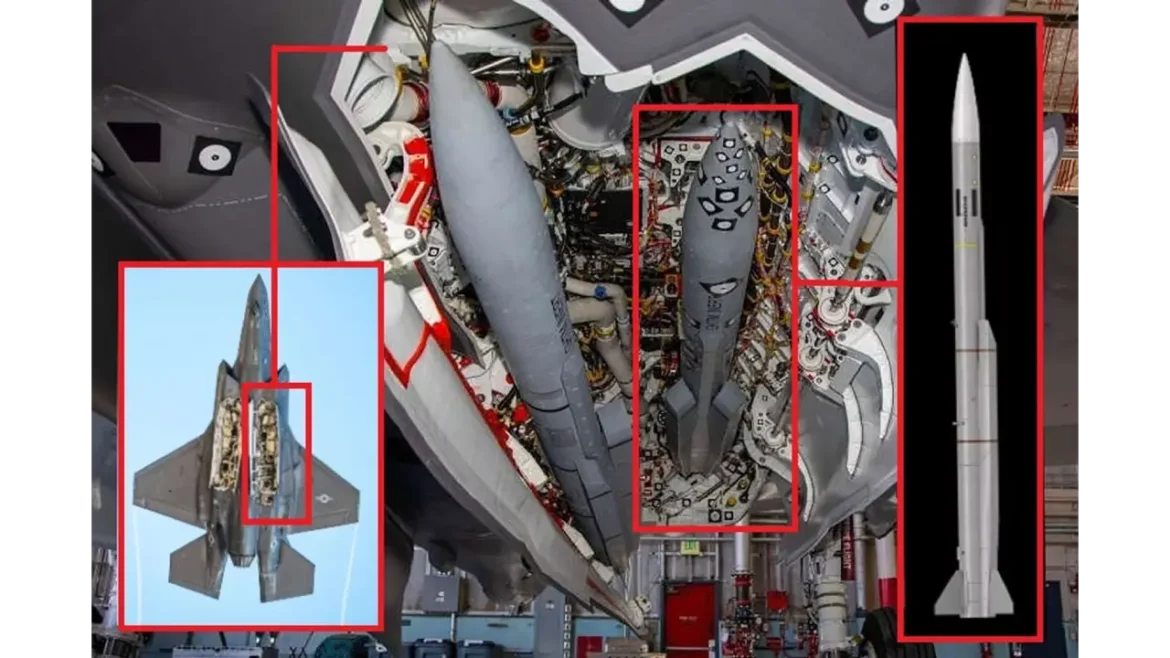
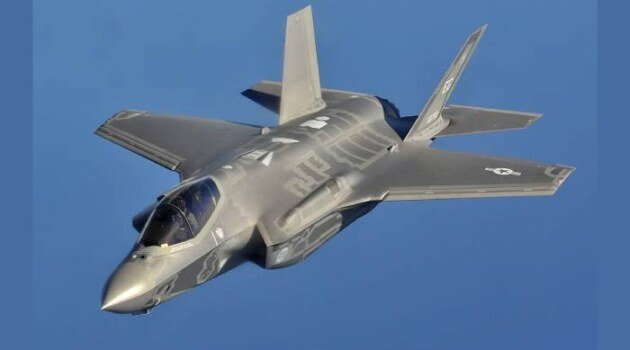
Officials from MBDA, Lockheed Martin and the F-35 Joint Program Office announced that the fifth-generation stealth fighter F-35A Lightning II has successfully passed a key series of ground-based integration tests with the long-range air-to-air missile MBDA Meteor. The trials were conducted at Edwards Air Force Base, California. The ground vibration testing and fit checks confirmed that Meteor can be securely carried and released from the F-35A’s internal weapons bay — preserving the aircraft’s stealth profile.
This achievement brings the F-35A and Meteor pairing a step closer to actual flight testing — with only one ground test remaining before airborne evaluations begin.
Why It Matters: Context for F-35 and Meteor
The MBDA Meteor missile is a ramjet-propelled beyond-visual-range air-to-air missile (BVRAAM) developed by a six-nation European consortium. It provides extended range, high endgame kinematics, and a “no-escape zone” that significantly improves interception probabilities compared with traditional boost-glide missiles.
Meteor is already operational on multiple European fighters (e.g., Eurofighter Typhoon, Saab Gripen, Dassault Rafale), and integrating it on F-35 significantly enhances the jet’s long-range air combat capability.
Earlier this year — on 28 February 2025 — a short-takeoff/vertical-landing (STOVL) variant, F-35B Lightning II, conducted the first test flights carrying an inert Meteor missile, flown by the U.S. Marine Corps out of Naval Air Station Patuxent River in Maryland. That exercise helped collect environmental and fit data as part of the broader effort to integrate the missile across F-35 variants.
For F-35A — a conventional takeoff and landing variant — integration has been sponsored by Italy, while the UK leads the F-35B campaign.
What the Ground Tests Showed
- Structural fit and clearance: Engineers verified that the Meteor missile can be safely housed within the F-35A’s internal weapons bay, ensuring no compromise to stealth features during carriage.
- Vibration and mechanical integrity: Through ground vibration testing, the structural and mechanical response of the missile-aircraft combination under various stress conditions was validated — a prerequisite for safe carriage and release under operational flight loads.
- Release mechanism verified: Fit checks confirmed that the missile launch rails, ejection clearance, and geometry are compatible with internal carriage and expected launch envelope.
According to the joint statement from MBDA and Lockheed Martin, only one more ground test remains before certification to begin flight trials with the Meteor on F-35A.
Meteor’s Capabilities: Why It’s Significant
Meteor’s ramjet propulsion allows the missile to maintain thrust throughout its flight — rather than relying solely on a quick boost phase followed by an unpowered glide (as with many traditional missiles). This ensures high speed, sustained energy, and superior maneuverability until intercept.
The missile uses inertial midcourse navigation updated via two-way data link, combined with an active radar seeker for terminal guidance. Dual fusing — proximity and impact — enhances lethality against manoeuvring aerial targets.
With these features, Meteor provides a “large no-escape zone,” making it far more difficult for potential adversaries to evade — a capability that aligns with modern air-to-air combat requirements of fifth-generation fighters.
What This Means for Operators: Strategic and Operational Impact
- Extended reach and lethality: Once operational, F-35As equipped with Meteor will gain a long-range BVR capability — enabling them to engage threats at greater standoff distances while leveraging their stealth to avoid detection.
- Interoperability between allies: With both UK (F-35B) and Italy (F-35A) spearheading integration, allied air forces operating F-35 may standardize on the Meteor missile, simplifying logistics and shared operations.
- Modernizing air force arsenals: For nations using European air-to-air munitions, integrating Meteor onto a widely fielded platform like F-35 enhances deterrence and parity against high-end threats.
What Comes Next: Flight Testing and Future Timeline
With ground integration tests now complete — save for one final ground test — the next phase is to begin flight tests of the Meteor missile on F-35A. These trials will validate safe separation, aerodynamics, release dynamics, and system performance under real-world flight conditions.
If successful, operational deployment could follow — allowing air forces operating F-35A to add Meteor as part of their combat loadout. The exact timeline remains unspecified.
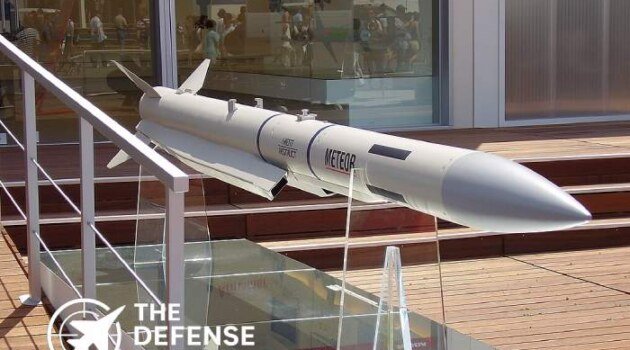

The European-built MBDA Meteor beyond-visual-range air-to-air missile (BVRAAM) has become a benchmark in long-range air-combat weaponry—not just in performance but in acquisition cost. Publicly available data place the unit cost around €2 million (approximately US$2.2 million) for 2019-era production. This figure highlights the premium nature of the weapon while also offering a useful comparator for air-arms budgeting and missile-procurement decisions.
Performance profile of the Meteor missile
Technical highlights
Developed by the multinational consortium led by MBDA Systems for six European partner nations (UK, Germany, Italy, France, Spain, Sweden), the Meteor is designed for air-superiority in highly contested environments.
Key publicly-stated characteristics:
- Weight: ~190 kg.
- Length: ~3.65–3.7 m.
- Diameter: ~178 mm (7 in).
- Propulsion: throttle-controlled ducted-rocket/ramjet motor enabling sustained thrust to target, enhancing the “no-escape” zone compared to conventional solid-rocket missiles.
- Range: Officially rated at “in excess of 200 km” in optimum conditions; no-escape zone often quoted at ~60 km+.
- Guidance: inertial mid-course update via two-way datalink, terminal active radar homing.
Operational context
The Meteor is already in service on platforms including the Saab JAS 39 Gripen, Dassault Rafale and the Eurofighter Typhoon, with planned integration on the F‑35 Lightning II (for partner nations) in the coming years.
Given its long-range, high-kinetic-energy flight phase and ability to operate in robust ECM environments, the missile is marketed as a “game-changer” in air-combat.
Meteor Missile Full detailed Specifications
- Guidance System: Active radar seeker with two-way datalink
- Maximum Speed: Over Mach 4
- Launch Compatibility: Eurofighter Typhoon, Rafale, Gripen
- Warhead Technology: Proximity-fused fragmentation warhead
Market data: cost per unit and procurement contracts
Known unit-cost figures
Several open-source references provide insight into the Meteor’s acquisition cost:
- Wikipedia lists the unit cost at €2,000,000 in 2019.
- A 2025 article pointed to a German procurement of ~€521 million for a batch of Meteor missiles, leading to an implied cost of approximately €1.93 million per missile (≈US$2.2 million) in that contract.
- A general commentary from 2023 estimated unit costs “around €2 million” for Meteor versus roughly US$2.5 million for the US AIM‑120 AMRAAM-C-8 variant.
Example contract: Germany
In November 2024 the German Bundestag approved the latest batch of Meteor missiles valued at around €521 million. While the exact number of missiles in the batch was not specified in every public summary, earlier pieces show an approximate cost per unit close to the €2 million mark. This suggests that large-volume procurement continues to stay in that ball-park.
Why cost matters
From an air-arm’s budgeting perspective, a missile costing ~€2 million sets a high bar. For example, equipping a squadron of fighters with Meteor missiles means significant procurement costs far beyond the cost of the aircraft alone in many cases. It also affects lifecycle costs (spares, training, maintenance) and export decisions: some nations may prefer lower-cost alternatives if long-range performance is less critical.
Analysis: Strategic implications of the cost benchmark
Value proposition vs. alternatives
The Meteor’s premium cost is justified to buyers based on its advanced propulsion (ramjet), extended endgame performance and wider no-escape zone. When compared to alternatives: one article argued that despite the higher technical performance, Meteor still came in cheaper than the newer AIM-120D3 variant (approx US$3.3 million per unit for Poland’s planned purchase).
Thus, the ~€2 million unit cost of Meteor becomes a benchmark for advanced BVRAAM pricing in Western-style air forces. Buyers assessing long-range air-to-air missile alternatives can gauge whether a given missile offers “Meteor-class” performance at comparable cost, or whether they are trading down in performance (and therefore cost).
Budget and export considerations
For emerging air-forces seeking to modernize fighter fleets, the cost of high-end missiles like Meteor may challenge procurement plans. As seen in India’s case, the local BVR missile (Astra Mk I) costs around US$1 million each—significantly cheaper—though with shorter range and somewhat different performance parameters.
In export markets, cost-competitiveness matters. A missile priced at ~€2 million may be acceptable for a nation acquiring high-end fighters and seeking maximum capability, but for less capable air-arms cost may push them toward cheaper systems with shorter reach. Additionally, lifecycle and integration costs must be factored in.
Industrial-policy dimension
From an industrial perspective, the Meteor programmed represents Europe’s push for sovereign missile-capability and independence from U.S. missile exports. The cost level also reflects joint development across multiple nations, which can affect unit-cost economies (scale, overheads). As cheaper U.S. or other non-European systems come online, the cost-performance balance could shift.
Summary
The MBDA Meteor missile stands out not only for its long range and advanced propulsion but also for the high acquisition cost—roughly €2 million (~US$2.2 million) per unit based on publicly reported contracts. This figure sets a benchmark for high-end BVR air-to-air missiles and serves as a reference point for air-forces planning procurements, budgeting for missile stocks, and assessing export options. While the cost is substantial, so too is the performance—including a large no-escape zone, advanced ramjet propulsion and high resistance to counter-measures.
The real value proposition will always depend on a nation’s threat environment, the type of aircraft they field, the number of missiles they’ll stock, and how they plan to integrate such weapons into their broader air-combat capability. Nonetheless, the cost detail provides an important reality check: state-of-the-art means premium pricing, and “Meteor-class” air-to-air capability is not inexpensive.
FAQs
What is the unit cost of the MBDA Meteor missile?Public sources indicate a unit cost around €2 million (approximately US$2.2 million) per missile in 2019/2024 contracts.
Why does the Meteor cost so much?The cost reflects its advanced features—ramjet propulsion, long-range no-escape envelope, active radar homing, two-way datalink, integration into high-end fighters, and European industrial development across multiple nations.
How does this cost compare with other missiles?For comparison, one article notes the U.S. AIM-120D3 missile unit cost for Poland is about US$3.3 million, making Meteor somewhat cheaper in that context.
Does the cost include aircraft integration and training?The published “unit cost” typically refers to the missile itself and likely excludes full integration, training, support infrastructure and lifetime maintenance; those additional costs can be substantial.
How many countries use the Meteor missile?The Meteor is in service with several European air forces and is selected for multiple fighter platforms.