Executive Summary
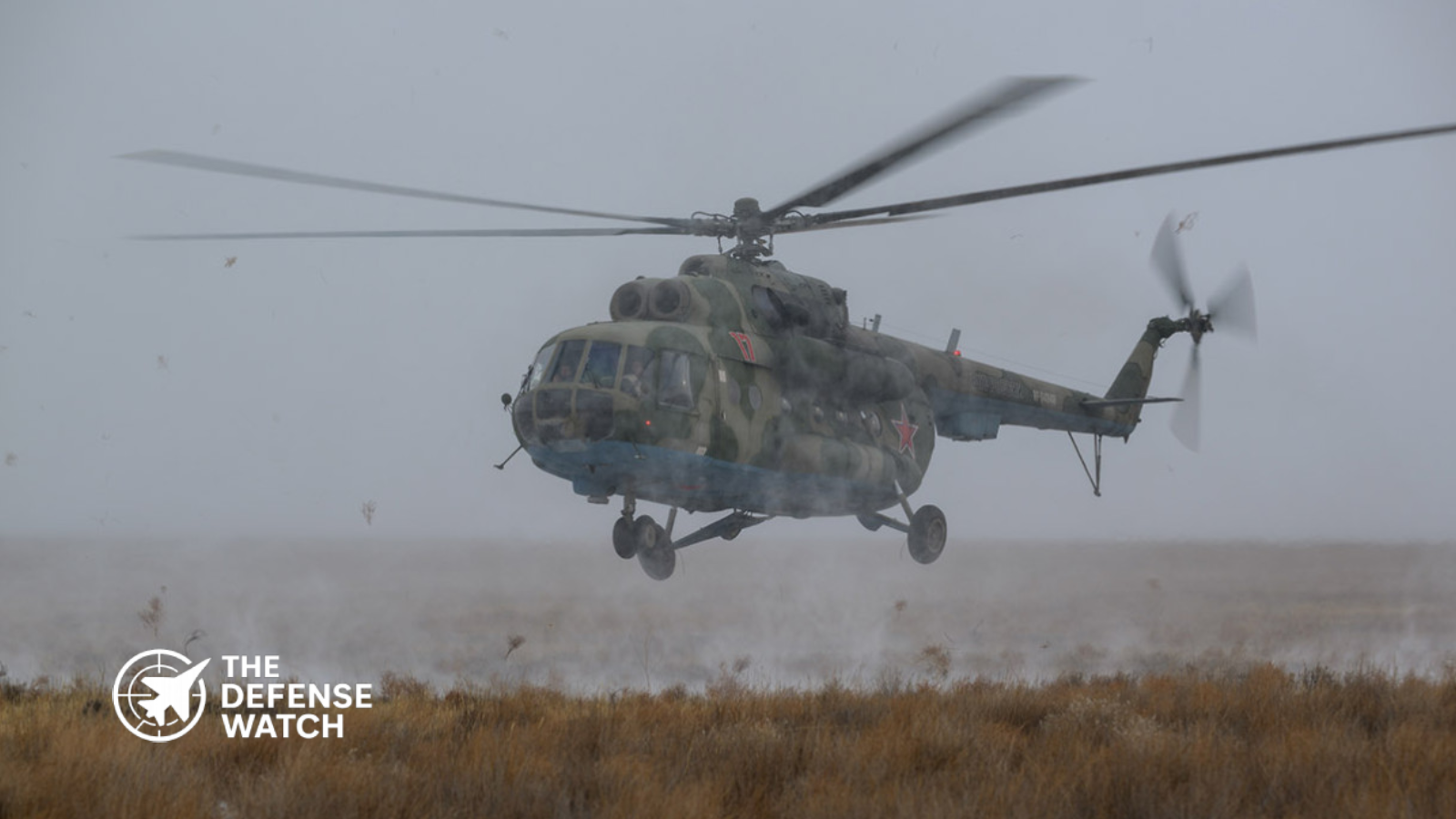
- A Russian Mi-8 military helicopter briefly entered Polish airspace from Kaliningrad on September 23, remaining inside Poland for 42 seconds and penetrating approximately 300 meters, according to Poland’s Armed Forces Operational Command.
- Polish radar tracked the helicopter, fighter aircraft were scrambled, and ground-based air defense forces remained on standby. Poland did not publicly identify the fighters or say that they engaged the helicopter.
- The incident comes as NATO maintains an enhanced eastern-flank posture through Eastern Sentry, combining fighters, surveillance aircraft, air defenses and other assets following repeated Russian airspace violations since 2025.
A Russian military Mi-8 helicopter briefly crossed into Polish airspace from Russia’s Kaliningrad exclave on September 23, prompting Poland to scramble fighter aircraft and place ground-based air defense forces on standby. Poland’s Armed Forces Operational Command said the helicopter entered Polish territory to a maximum depth of about 300 meters and remained there for 42 seconds before leaving the airspace.
The event occurred near Poland’s northern border with Kaliningrad, a strategically sensitive area where very short flight times and the proximity of Russian forces place particular demands on radar coverage, command-and-control networks and quick reaction alert forces.
Polish authorities characterized the incident as an indication that Russia was again testing the readiness of Polish air defenses. That assessment is an official Polish interpretation. The Russian Embassy in Warsaw had not immediately provided a response to Reuters when the incident was reported.
Mi-8 Incursion Triggered a Rapid Polish Response
According to Poland’s Operational Command, the helicopter entered Polish airspace at about 11:08 a.m. local time on September 23 after flying from Kaliningrad. Polish military radar tracked its movement, while fighter aircraft were scrambled and ground-based forces remained at readiness.
The publicly available Polish statement does not identify the fighter aircraft involved. It also does not state that weapons were used, that the helicopter was fired upon, or that Polish aircraft established a particular type of intercept.
Those distinctions matter. A rapid fighter scramble demonstrates that Poland’s air surveillance and air policing architecture detected the aircraft and generated a response, but the available information does not establish what happened between the scrambled fighters and the Russian helicopter.
| Detail | Reported information |
|---|---|
| Aircraft | Russian Mi-8 military helicopter |
| Origin | Kaliningrad, Russia |
| Location | Northern Poland, near the Kaliningrad border |
| Date | September 23, 2026 |
| Time | About 11:08 a.m. local time |
| Time inside Polish airspace | 42 seconds |
| Maximum penetration | About 300 meters |
| Detection | Polish military radar |
| Response | Fighter aircraft scrambled |
| Ground response | Air defense forces placed on standby |
| Weapons engagement | Not reported |
The relatively shallow penetration and short duration do not by themselves establish the aircraft’s intent. The important operational issue for Poland is that even a short border crossing can require a rapid identification and response cycle.
Why the Kaliningrad Border Matters
Kaliningrad creates a distinct air defense problem for Poland because Russian military forces are positioned immediately across the border and close to NATO territory.
For Polish air defense planners, the challenge is not limited to detecting conventional fighter aircraft. The same surveillance network must distinguish between civilian traffic, helicopters, drones, cruise missiles and other airborne objects while maintaining enough reaction time for a possible interception.
NATO describes Air Policing as part of its broader Integrated Air and Missile Defence architecture. The system combines continuous air surveillance with fighter aircraft and ground-based air defense capabilities.
That layered structure becomes particularly important on the eastern flank, where an airspace violation can develop rapidly and where the difference between an accidental crossing, navigational error and deliberate action may not be immediately clear.
Eastern Sentry Remains Central to NATO’s Response
The Mi-8 incident comes against the background of NATO’s continuing Eastern Sentry activity.
NATO established Eastern Sentry in September 2025 following major Russian drone incursions into Polish airspace. The activity expanded the Alliance’s eastern-flank posture by integrating additional fighter aircraft, surveillance aircraft, air defense systems and other capabilities.
NATO says Eastern Sentry is designed to strengthen vigilance across the eastern flank and improve coordination between allied capabilities. Its architecture includes both conventional air defense assets and technologies intended to address the growing drone threat.
The distinction is important because the Russian Mi-8 incident is different from the large-scale drone incursions that drove the creation of Eastern Sentry.
A helicopter is a comparatively large, crewed aircraft with different detection and interception characteristics. A low-cost drone can present a different problem because defenders must detect and classify potentially numerous targets while considering the cost and availability of the weapons used to defeat them.
Poland’s Air Defense Is Being Tested Across Multiple Threat Types
The immediate response to the Mi-8 demonstrates one part of the broader NATO air defense problem: maintaining a continuous ability to detect and react to aircraft approaching or crossing allied airspace.
NATO’s response architecture has increasingly combined fighter aircraft with ground-based air defenses and airborne surveillance. During the September 2025 Polish airspace violations, NATO reported the involvement of Polish F-16s, Dutch F-35s, an Italian AWACS aircraft, a NATO tanker and German Patriot systems.
That combination reflects the basic logic of modern integrated air defense.
Sensors provide detection and tracking.
Command and control determine the nature of the threat and coordinate the response.
Fighter aircraft provide a flexible interception capability.
Ground-based air defenses provide another layer when an airborne threat cannot be handled through fighter interception or when multiple simultaneous targets create a saturation problem.
The September 23 helicopter incident therefore offers a small but concrete test of the same broader architecture.
Romanian Alert Highlights a Wider Eastern-Flank Problem
The Polish incident was accompanied by renewed aerial activity near Romania.
On the night of September 23 to 24, Romania detected a group of aerial targets north of Chilia Veche in Ukrainian territory near the Romanian border. Two Spanish F-18 aircraft operating in an enhanced air policing role scrambled from Mihail Kogălniceanu Air Base to monitor the situation. Romania later issued a public alert for northern Tulcea County.
Romania’s Defense Ministry also reported on September 24 that its radar detected another aerial target near Ukraine’s border in Botoșani County, prompting two Romanian F-16s from Borcea Air Base to scramble. The ministry’s statement said the target entered Romanian national airspace, although the circumstances and subsequent assessment were still developing at the time of publication.
These incidents illustrate the geographic breadth of the eastern-flank air surveillance problem. Poland faces activity around Kaliningrad and Belarus, while Romania operates close to the Black Sea and the Ukrainian battlefield.
For NATO, that means air policing cannot be treated as a single national mission. It increasingly depends on shared surveillance, allied fighter deployments and the ability to transfer information rapidly between national and NATO command structures.
The Readiness Question Is More Important Than the 42-Second Crossing
The most significant aspect of the Polish incident is not necessarily the distance traveled inside Polish territory. It is the response chain.
A modern air defense system must complete several tasks within a short period:
- Detect the airborne track.
- Establish whether it is inside or approaching national airspace.
- Classify the aircraft.
- Determine whether the flight represents a threat.
- Generate an appropriate response.
- Direct fighter or ground-based assets.
- Maintain a common operational picture as the aircraft leaves the area.
Poland’s statement indicates that radar detection led to a fighter scramble and the readiness of ground-based forces. That provides evidence that the national response mechanism was activated, although the publicly released information does not provide enough detail to assess every part of the engagement sequence.
This is also why repeated small incursions can have an outsized operational effect. They require aircraft, radar operators, command personnel and air defense crews to remain ready even when no weapons engagement occurs.
Russia’s Air Activity Has Increased NATO’s Focus on Airspace Protection
NATO’s eastern members have experienced a series of airspace incidents connected to the wider Russia-Ukraine war.
NATO says Russian drones and aircraft violated the airspace of several Allied countries in September 2025, including Poland, Estonia, Finland, Latvia, Lithuania, Norway and Romania. The Alliance responded by strengthening its eastern-flank posture through Eastern Sentry.
NATO’s current air policing framework therefore operates within a much broader Integrated Air and Missile Defence structure. The Alliance says that framework is intended to maintain control of Allied airspace during peacetime, crisis and conflict.
The continuing requirement is not simply to put more fighter aircraft into the sky. NATO also needs persistent sensors, reliable data links, interoperable command systems and appropriate ground-based defenses.
That combination becomes increasingly important as the range of airborne threats expands from conventional aircraft to cruise missiles and large numbers of inexpensive drones.
What the Incident Does Not Establish
The available evidence does not establish why the Mi-8 crossed the Polish border.
Poland’s Operational Command said the incident indicated Russia was testing Polish air defense readiness. That is the Polish military’s assessment, rather than an independently established fact about Russian intent.
There is also no publicly reported evidence in the available sources that Polish fighters engaged the helicopter with weapons.
The short duration of the incursion also makes it difficult to draw conclusions about a larger Russian operational objective from this incident alone. Its significance is better understood within the wider pattern of airspace incidents and NATO’s ongoing efforts to maintain rapid-response capability along its eastern flank.
Strategic Implications for NATO
The incident reinforces three operational priorities for NATO.
First, persistent surveillance remains essential. A border violation lasting less than a minute still requires accurate detection and tracking.
Second, layered defenses reduce dependence on any single system. Fighter aircraft, ground-based air defenses, airborne surveillance and national command centers perform different functions and can provide overlapping coverage. NATO’s Eastern Sentry model explicitly combines these capabilities.
Third, readiness has a cost. Frequent scrambles consume flight hours, fuel, maintenance capacity and personnel availability. At the same time, keeping fighters and ground systems at high readiness can limit the ability to sustain the posture indefinitely.
For Poland, the challenge is particularly important because the country sits directly on NATO’s northeastern security boundary and has to maintain surveillance across a complex regional airspace environment.
The Mi-8 incident therefore represents more than a brief border crossing. It is another real-world test of whether NATO’s eastern air defense architecture can detect, classify and respond to airborne activity before a limited incident develops into a larger security crisis.