
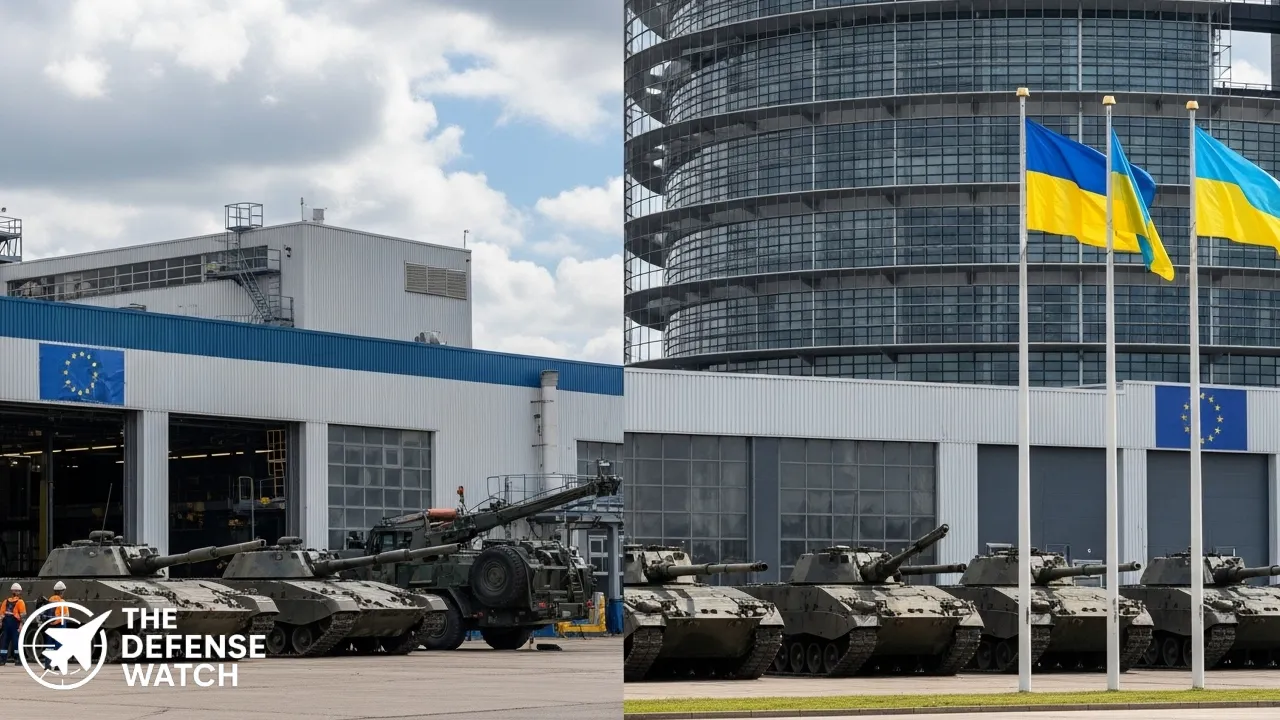
EU Votes to Deepen Defense Industry Ties with Ukraine
The European Union has approved a new initiative to expand defense industrial cooperation with Ukraine, marking a significant policy step aimed at strengthening joint production, procurement channels, and long-term security collaboration. The decision was finalized on November 25 during a legislative session in Brussels, reflecting a growing push among member states to reinforce Ukraine’s domestic defense capabilities amid ongoing security pressures.
Background: Strengthening Defense Integration
The vote follows months of discussions within EU institutions over how to shift support for Kyiv from short-term military assistance toward a sustainable, long-term industrial partnership model. Since the start of Russia’s full-scale invasion, Ukraine has relied heavily on European weapons, ammunition, and spare parts. European leaders have increasingly emphasized the need to expand Ukraine’s own manufacturing capacity to reduce dependency and ensure continuity of supply.
The initiative aligns with previous EU defense frameworks, including joint procurement programs and coordinated industrial investment measures launched since 2022. It also supports broader European ambitions to streamline defense production, improve interoperability, and reduce fragmentation among national defense sectors.
Policy Details and Objectives
EU officials stated that the measure is designed to enhance cooperation across several core areas:
- Co-production agreements between Ukrainian and European defense firms
- Supply chain integration for critical components and materials
- Standardization to improve equipment compatibility
- Investment pathways for rebuilding Ukrainian industrial infrastructure
- Regulatory coordination to ease technology transfer
European Commission defense representatives noted that Ukraine’s participation in select EU defense programs would expand under the new policy framework. While full membership access remains restricted, officials emphasized that deeper coordination would improve planning and accelerate development timelines.
The decision also comes amid intensified European debate over defense readiness, ammunition shortages, and production gaps that became more visible after sustained support to Ukraine. Several member states have advocated that cooperation with Ukrainian manufacturers could expand overall capacity and innovation.
Strategic and Security Context
The move highlights shifting European defense postures as governments reassess long-term risk exposure and industrial resilience. Analysts note that integrating Ukrainian production could benefit both sides—Ukraine gains industrial reinforcement, while Europe gains access to experienced, rapidly scaling manufacturers familiar with high-intensity warfare requirements.
EU policymakers have also framed the initiative as part of a broader strategic effort to counter external pressure and reinforce the continent’s defense autonomy. Discussions within the European Parliament have referenced concerns about supply limitations and overreliance on non-European defense imports.
Expert and Policy Reactions
Security policy experts cited the decision as a notable milestone in restructuring European defense cooperation frameworks. Defense analysts emphasized that the initiative signals a long-term commitment rather than a temporary crisis response, suggesting that Ukraine’s defense sector could become formally tied to European industrial planning for years ahead.
Industry representatives have also acknowledged potential economic impacts, including joint investment, technology development, and employment growth tied to reconstruction and modernization. However, officials cautioned that implementation phases will require regulatory coordination and member state alignment.
What Comes Next
EU agencies are expected to outline specific funding mechanisms, co-production guidelines, and implementation structures in the coming months. Member states will also coordinate with Kyiv to identify priority sectors, including ammunition production, armored systems, air defense components, and repair logistics.
The initiative is expected to influence future EU defense planning cycles, with officials suggesting that Ukraine could participate in additional industrial cooperation programs as policy frameworks evolve. Monitoring and evaluation measures will accompany the rollout to track progress and capability impacts.
The development marks a continued shift toward institutionalized defense cooperation between the EU and Ukraine, reflecting long-term strategic alignment and industrial interdependence that is expected to expand further in the coming years.
Get real time update about this post category directly on your device, subscribe now.

13 comments
[…] The NSS warns that unchecked migration could lead to “civilizational erasure,” claiming some NATO members may become majority non-European in the coming decades. It accuses the European Union and other transnational bodies of undermining sovereignty, suppressing free expression, and censoring speech. The strategy voices support for “patriotic” or nationalist parties in Europe — a signal that political alignment now matters as much as military cooperation. […]
[…] Reports from the Belgian aviation authority, Skeyes, indicate that nearly 90 percent of drone flights over sensitive areas last year did not have official authorization. Operators of larger or heavier drones are subject to registration rules, but many flights detected lacked any approved flight plan. […]
[…] deployment of UK troops under the current plan would require approval by the UK Parliament before it could proceed, Defence Ministry ministers […]
[…] Hermione trials fit within France’s Scorpion program and its long term military planning framework, which prioritizes digitalization, networking, and automation across the force. Results […]
[…] GCAP’s progress also strengthens international military cooperation, with the UK and Japan advancing complementary commitments to the joint program. Future discussions […]
[…] While Trump remarks on NATO troops in Afghanistan do not reflect current US policy, they underscore persistent divisions over alliance roles, overseas interventions, and the future shape of Western military cooperation. […]
[…] planning. In related congressional actions, the Defense Department has been asked to explain how it plans to spend billions already approved for the effort, with appropriators seeking detailed cost, schedule and performance data within set […]
[…] AI cloud provider CoreWeave. This initiative is part of the UK’s broader AI Opportunities Action Plan and the government’s Modern Industrial Strategy, aimed at expanding AI computing capacity and regional economic […]
[…] and military stakeholders have pointed to this record as evidence of sustained industrial cooperation and technical performance across multiple decades of […]
[…] with Canadian firms on steel, shipbuilding infrastructure, and defense-related systems. These industrial cooperation frameworks are intended to align with Ottawa’s desire for domestic economic benefits alongside […]
[…] This allows UK firms to participate in SAFE contracts with certain content limits, bolstering industrial cooperation with EU […]
[…] worth about $40 billion that would fund advanced U.S. weapons packages and other systems. Delays in budget approval risk slowing or stalling planned acquisitions, officials […]
[…] The move reflects deepening military cooperation between Tehran and […]