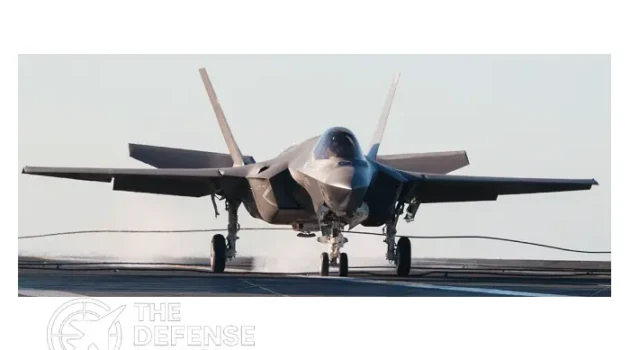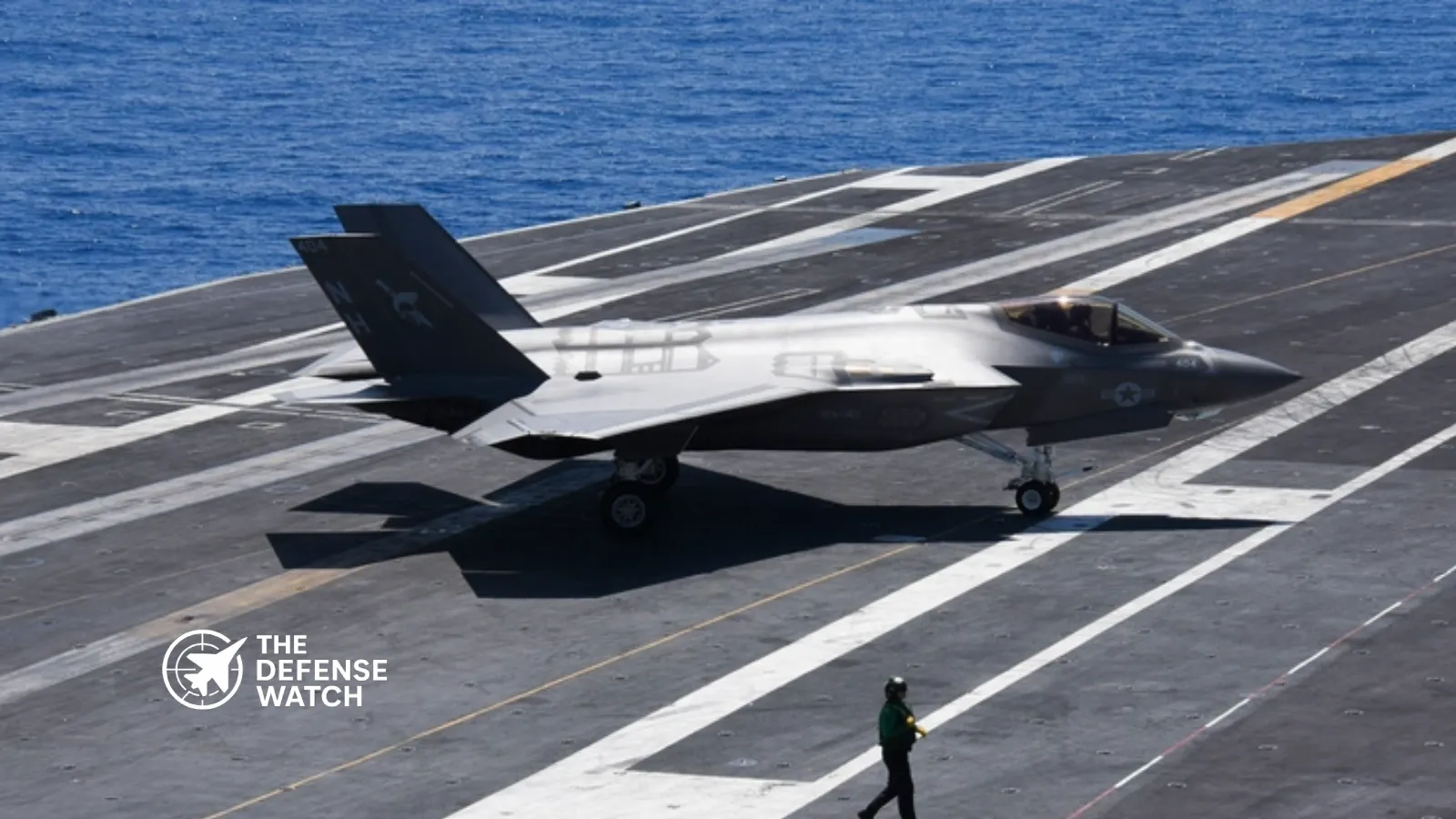
- F-35C enables carrier-based deep strike missions into contested airspace.
- Combines stealth, sensor fusion, and precision-guided munitions.
- Expands U.S. naval reach against integrated air defense systems.
- Operates from aircraft carriers without reliance on regional bases.
- Strengthens deterrence and rapid response in Middle East scenarios.
F-35C Carrier-Based Deep Strike Capability Expands U.S. Operational Reach
F-35C carrier-based deep strike capability is reshaping how the U.S. Navy conducts operations against heavily defended targets such as those in Iran. The aircraft combines stealth, advanced sensors, and carrier-based flexibility to penetrate sophisticated air defense networks without relying on forward-deployed airbases.
Recent analysis highlights how the F-35C enhances the ability of carrier strike groups to execute long-range precision strikes in contested environments, particularly in scenarios similar to a hypothetical “Epic Fury” operation targeting Iranian military infrastructure.
The Big Picture
The U.S. military continues to prioritize distributed, survivable strike capabilities that reduce reliance on vulnerable regional bases. Carrier-based aviation plays a central role in this shift.
The F-35C, the carrier variant of the Joint Strike Fighter program led by Lockheed Martin, supports this strategy by enabling stealth operations directly from the sea. This approach aligns with broader U.S. efforts to counter advanced anti-access, area denial (A2/AD) systems deployed by countries such as Iran and China.
Naval aviation now serves not only as a power projection tool but also as a first-day-of-war capability against integrated air defense systems.
What’s Happening
The F-35C carrier-based deep strike capability allows U.S. Navy aircraft carriers to launch stealth fighters capable of penetrating Iranian airspace without early detection.
The aircraft features:
- Low observable design for reduced radar signature
- Advanced sensor fusion integrating radar, infrared, and electronic warfare data
- Internal weapons carriage for stealth strike missions
- Extended range compared to other F-35 variants
Operating from U.S. Navy aircraft carriers positioned in international waters, F-35Cs can conduct precision strikes on high-value targets such as air defense nodes, command centers, and missile launch sites.
This capability reduces the need for land-based aircraft operating from regional partners, which may face political or operational constraints.
Why It Matters
The F-35C introduces a significant shift in how deep strike missions are executed in contested environments.
Traditional strike operations often relied on large formations, electronic warfare support, and suppression of enemy air defenses. The F-35C reduces this burden by combining these functions within a single platform.
Its ability to gather and share real-time battlefield data enhances situational awareness across the entire carrier strike group. This networked capability improves targeting accuracy and reduces mission risk.
In a scenario involving Iran, where layered air defenses include radar systems and surface-to-air missiles, stealth becomes critical for mission success.
Strategic Implications
The F-35C carrier-based deep strike capability strengthens U.S. deterrence by demonstrating the ability to strike high-value targets without warning.
Carrier strike groups equipped with F-35Cs can operate flexibly across the Middle East, reducing predictability and increasing survivability. This mobility complicates adversary planning and forces defensive resource allocation across a wider area.
The system also reinforces the credibility of U.S. commitments to regional allies by ensuring rapid response capability without dependence on host nation infrastructure.
Competitor View
Iran is likely to view the F-35C as a direct challenge to its air defense strategy, which relies on layered systems including domestically developed and imported surface-to-air missile platforms.
The aircraft’s stealth and electronic warfare capabilities could undermine Iran’s ability to detect and intercept incoming threats, particularly during the early stages of a conflict.
Russia and China, both developers of advanced air defense systems, will likely monitor F-35C operational use closely. Lessons learned from potential deployments could inform their own counter-stealth strategies and air defense modernization efforts.
What To Watch Next
Future developments will focus on expanding the operational integration of the F-35C within carrier strike groups.
Key areas include:
- Increased deployment cycles aboard U.S. Navy carriers
- Integration with unmanned systems and carrier-based drones
- Upgrades to software and sensor capabilities under ongoing modernization programs
- Expanded weapons compatibility, including next-generation precision munitions
Operational testing and real-world deployments will continue to validate the aircraft’s effectiveness in contested environments.
Capability Gap
The F-35C addresses a critical gap in penetrating advanced air defense systems from sea-based platforms.
Before its introduction, carrier air wings relied on legacy aircraft such as the F/A-18, which require greater support from electronic warfare assets and tanker aircraft to survive in high-threat environments.
However, limitations remain. The F-35C still depends on aerial refueling for extended missions and carries a limited internal weapons load when operating in stealth configuration. These constraints require careful mission planning and integration with other assets.
The Bottom Line
The F-35C carrier-based deep strike capability gives the U.S. Navy a survivable, flexible tool to penetrate defended airspace and hold high-value targets at risk from the sea.
Get real time update about this post category directly on your device, subscribe now.