
Table of Contents
U.S. Army Deploys First Operational Hypersonic Strike System
The United States Army achieved a critical milestone in hypersonic weapons development with the 2025 deployment of the Dark Eagle hypersonic missile system, marking America’s entry into operational hypersonic warfare alongside China and Russia. Formally designated in April 2025, the Long-Range Hypersonic Weapon (LRHW) represents a decade-long effort to field ground-based hypersonic strike capabilities that can defeat advanced air defense systems through extreme speed and maneuverability.
The Dark Eagle system features a reported operational range exceeding 1,725 miles and uses boost-glide technology to deliver precision strikes against time-critical targets. The weapon system entered service with the 5th Battalion, 3rd Field Artillery Regiment at Joint Base Lewis-McChord, Washington, part of the Army’s 1st Multi-Domain Task Force—a unit specifically designed for operations across cyber, space, air, land, and sea domains.
Technical Specifications and Hypersonic Speed Capabilities
The Dark Eagle employs a two-stage solid rocket booster that accelerates the Common-Hypersonic Glide Body (C-HGB) to extreme velocities before releasing the unpowered glide vehicle. Once separated from the booster, the glide body travels at speeds exceeding 3,800 miles per hour—defined as Mach 5 or greater—while maintaining the ability to maneuver toward its target.
What distinguishes hypersonic glide vehicles from traditional ballistic missiles is their unpredictable flight profile. Modern hypersonic weapons combine speed beyond Mach 5 with significant maneuverability during atmospheric flight, making them exceptionally difficult for existing missile defense systems to detect, track, and intercept. The C-HGB can adjust its trajectory in flight, potentially changing targets mid-course while flying at lower altitudes than ballistic missile warheads.
The technology traces its lineage to earlier defense programs. The C-HGB design draws from the Alternate Re-Entry System developed during the Army’s Advanced Hypersonic Weapon program in the early 2010s, which itself built upon Sandia National Laboratories’ Winged Energetic Reentry Vehicle Experiment from the 1980s. Dynetics, a Leidos subsidiary, manufactures the hypersonic glide body, while Lockheed Martin produces the booster system and handles final assembly.
Hypersonic Technology Testing and Development Timeline
The Dark Eagle program experienced significant challenges before achieving operational readiness. Initial Army plans called for fielding the first battery by late 2023, but testing failures from 2021 through 2023 delayed deployment until September 2025. Issues centered on the ground-based launcher system rather than the missile itself, requiring extensive redesign and validation work.
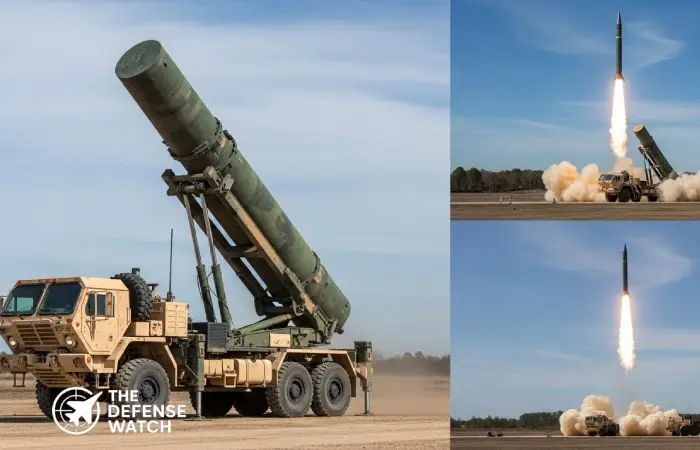
The program achieved critical breakthroughs in 2024. The first successful end-to-end flight test occurred in June 2024 from the Pacific Missile Range Facility in Kauai, Hawaii, followed by a second successful test in December 2024 from Cape Canaveral Space Force Station in Florida. The December test proved particularly significant as it marked the first live-fire demonstration using the complete battery operations center and transporter-erector-launcher configuration that soldiers would employ in actual operations.
The December 2024 Cape Canaveral test represented the second successful end-to-end flight demonstration of the All Up Round during 2024, validating the integrated weapon system from launch through target engagement. This successful testing campaign cleared the path for operational fielding to the designated Army unit.
Dark Eagle Battery Configuration and Deployment
A complete Dark Eagle battery comprises sophisticated ground-based infrastructure designed for rapid deployment and sustained operations. Each battery includes four M983 truck-mounted transporter-erector-launchers, with each TEL carrying two missiles in launch canisters for a total loadout of eight All Up Round plus Canister missiles, along with a battery operations center for command and control and a support vehicle.
The system integrates with the Army’s existing command networks through the Advanced Field Artillery Tactical Data System, enabling coordination with other long-range fires assets and multi-domain operations. The road-mobile configuration provides strategic flexibility, allowing the battery to relocate rapidly to avoid detection and counterattack—a critical capability given the high-value nature of the system.
Cost considerations remain substantial. The Army’s FY2025 budget request included $744 million for missile procurement and $538 million for research, development, testing, and evaluation, with the cost of fielding just the first prototype battery increasing by $150 million in a single year to reach $2.69 billion. Congressional Budget Office estimates place individual missile costs at approximately $41 million in 2023 dollars, though Army officials indicate initial procurement costs may exceed these projections before economies of scale reduce unit prices.
Navy’s Conventional Prompt Strike: Sea-Based Hypersonic Variant
The U.S. Navy is developing a parallel hypersonic capability using the same Common-Hypersonic Glide Body in its Conventional Prompt Strike (CPS) program. The Navy plans to field CPS aboard Zumwalt-class destroyers beginning in 2025, with later deployment to Block V Virginia-class submarines scheduled for 2028. Each destroyer will carry twelve CPS missiles in Advanced Payload Modules holding three missiles apiece.
In May 2025, the Navy conducted a successful end-to-end flight test utilizing a cold-gas launch approach, which ejects the missile from the launch cell before first-stage ignition occurs—a critical safety feature for shipboard operations. This technological achievement brings the Navy closer to operational deployment of sea-based hypersonic strike capabilities.
The joint Army-Navy development approach leverages shared technology and resources while creating complementary capabilities. The Navy leads design efforts for the Common Hypersonic Glide Body while the Army manages production, creating efficiencies in development costs and deployment timelines. This collaborative model allows both services to field hypersonic capabilities more rapidly than independent programs would permit.
In June 2025, the Department of Defense awarded Lockheed Martin a $1 billion contract modification covering program management, engineering development, systems integration, and procurement of long-lead materials for the CPS program through August 2028, demonstrating sustained commitment to naval hypersonic capabilities.
Global Hypersonic Competition: China and Russia Lead Development
The Dark Eagle deployment occurs against a backdrop of intensive international hypersonic weapons competition. China’s DF-17 missile system, unveiled in 2019 and now operational with the PLA Rocket Force, features a hypersonic glide vehicle designed to penetrate advanced air defenses with a reported range of 1,500-2,000 kilometers, while the PLA Navy has begun fielding the YJ-21 ship-launched hypersonic anti-ship missile.
Russia has aggressively advanced its hypersonic programs, fielding the Avangard hypersonic glide vehicle capable of speeds up to Mach 20 while performing evasive maneuvers, mounted on intercontinental ballistic missiles, and deploying the Kinzhal air-launched ballistic missile in real-world combat operations. These Russian systems significantly altered strategic deterrence calculations and added complexity to NATO defense planning.
Beyond the major powers, hypersonic development has proliferated globally. France, cooperating with the European Space Agency, tested the V-MaX hypersonic demonstrator vehicle with a successful first flight in 2024, while Iran unveiled its Fattah missile in 2023 claiming speeds of Mach 13-15, though international analysts remain skeptical due to limited verifiable data. Israel is reportedly researching advanced interception technologies to counter hypersonic threats.
The United States adopted a more measured development approach compared to its competitors, prioritizing technical maturity and testing rigor over rapid fielding. Years of delays and budgetary constraints slowed initial progress, but successful 2024 testing demonstrated that American hypersonic capabilities are now reaching operational maturity across multiple service branches.
Strategic Implications for Multi-Domain Operations
Dark Eagle provides the Army with capabilities previously unavailable in its long-range fires portfolio. The system enables strikes against heavily defended, high-value targets deep within contested areas—including command and control nodes, air defense systems, naval assets, and mobile missile launchers—with flight times measured in minutes rather than hours.
This rapid-strike capability proves particularly valuable in potential Indo-Pacific contingencies where vast distances and sophisticated adversary air defense networks pose significant challenges. The hypersonic weapon’s combination of speed, range, and unpredictable flight path creates dilemmas for enemy planners who must allocate defense resources without knowing the weapon’s intended target until moments before impact.
The weapon system also enhances deterrence through its demonstrated capability to hold at-risk targets that were previously considered safe from ground-based conventional strikes. By extending the Army’s reach to theater-strategic ranges, Dark Eagle enables land forces to contribute to anti-access/area denial operations and support joint force objectives across multiple domains simultaneously.
Integration with the 1st Multi-Domain Task Force underscores the weapon’s role in emerging operational concepts. These specialized units synchronize operations across cyber, space, electronic warfare, and traditional fires domains, creating converging effects that overwhelm adversary decision-making cycles. Dark Eagle provides the kinetic strike component of this integrated approach.
Technical Challenges and Future Development
Despite recent successes, hypersonic weapons development faces ongoing technical hurdles. At hypersonic speeds, vehicle exterior temperatures can exceed 2,000 degrees Fahrenheit, requiring advanced heat-tolerant materials that protect interior electronics while maintaining mechanical strength and aerodynamic efficiency. Material science advances remain critical to improving system reliability and extending operational envelopes.
The United States has limited ground testing and flight testing infrastructure for hypersonic systems, with few wind tunnel facilities capable of running propulsion tests at relevant velocities, constraining the pace of development and validation. Expanding this testing capacity represents a strategic priority for maintaining competitive positioning.
The Government Accountability Office has highlighted areas requiring attention. GAO assessments note that four of six Defense Department hypersonic programs are not adequately soliciting user feedback to determine capabilities for minimum viable products, and several efforts have not adopted leading practices for digital engineering tools. Addressing these programmatic issues could reduce future cost growth and schedule risks.
Cost estimation remains challenging given limited historical data for hypersonic weapons production and operation. The Navy’s Conventional Prompt Strike cost estimate—among the most mature available—relies heavily on subject matter expert opinions due to lack of quality historical data, an approach that can introduce bias unless carefully analyzed and compensated. As production quantities increase and operational experience accumulates, cost projections should gain accuracy.
Hypersonic Defense and Arms Control Considerations
The proliferation of hypersonic weapons raises significant defense and policy challenges. Current missile defense architectures were designed primarily to counter ballistic missiles with predictable trajectories, not maneuvering hypersonic glide vehicles that can change course during flight while approaching at extreme speeds and lower altitudes.
The hypersonic glide vehicle’s novel trajectory and maneuverability complicate efforts to detect, track, and defend against attacks—while the United States would likely detect the booster launch, it cannot predict the glide body’s flight path or intended target until late in the engagement. This compressed decision timeline creates crisis stability concerns, particularly in scenarios involving nuclear-capable delivery systems.
Some policy experts advocate for arms control mechanisms to ban or limit hypersonic weapon deployment to avoid the crisis instabilities created by short flight times. However, nations may prove unwilling to accept such limitations without corresponding restrictions on missile and air defense systems—the very capabilities that motivated hypersonic development programs.
The Defense Department is investing in defensive systems designed to track and engage hypersonic threats, though experts disagree on the cost and technological feasibility of effective point defense against these weapons. Space-based sensor architectures offer promise for detecting and tracking hypersonic vehicles during their glide phase, potentially providing sufficient warning for defensive responses.
Analysis: Dark Eagle’s Role in Great Power Competition
The Dark Eagle deployment represents more than a technological achievement—it signifies a strategic inflection point in great power military competition. For nearly two decades, Russia and China held apparent advantages in operational hypersonic capabilities while the United States pursued a deliberate, test-driven development approach that prioritized technical maturity over rapid fielding.
The 2025 Dark Eagle deployment, combined with ongoing Navy CPS integration and Air Force Hypersonic Attack Cruise Missile development, demonstrates that American hypersonic capabilities are reaching fruition across multiple domains simultaneously. This multi-service approach creates redundancy and flexibility while complicating adversary defense planning.
However, significant questions remain about long-term programmatic sustainability. At approximately $41 million per missile—potentially higher for initial low-rate production—Dark Eagle ranks among the most expensive conventional munitions in the U.S. arsenal. The Army has expressed interest in procuring 300 hypersonic boost-glide missiles, but Congressional support for such quantities at current unit costs remains uncertain.
Operational employment concepts continue evolving as commanders gain familiarity with the weapon system’s capabilities and limitations. The 1st Multi-Domain Task Force will develop tactics, techniques, and procedures for integrating Dark Eagle into joint operations, lessons that will inform future battery formations and employment doctrine.
The weapon’s deterrent value depends partly on adversaries’ perceptions of U.S. willingness to employ hypersonic strikes in conflict scenarios. Ambiguity regarding thresholds for use—particularly given the system’s potential to strike strategic targets—could either enhance deterrence or create dangerous misperceptions during crises.
International hypersonic competition shows no signs of abating. Additional nations will likely field operational systems in coming years, driven by perceptions that hypersonic capabilities are essential for maintaining military relevance in contested environments. This proliferation increases risks of miscalculation while creating new imperatives for defensive capabilities and strategic stability measures.
FAQs
What makes the Dark Eagle hypersonic missile different from traditional ballistic missiles?The Dark Eagle uses a hypersonic glide vehicle that can maneuver unpredictably during flight at speeds exceeding Mach 5, unlike ballistic missiles which follow predictable arcs. This maneuverability, combined with flight at lower altitudes than ballistic warheads, makes the weapon extremely difficult for current air defense systems to intercept.
When did the Dark Eagle hypersonic missile enter active service?The Dark Eagle was formally designated in April 2025 and entered service with the 5th Battalion, 3rd Field Artillery Regiment at Joint Base Lewis-McChord, Washington by the end of fiscal year 2025. The system experienced delays from original 2023 fielding plans due to testing challenges.
What is the operational range and speed of the Dark Eagle system?The Dark Eagle has a reported operational range exceeding 1,725 miles and travels at hypersonic speeds above Mach 5, which equates to more than 3,800 miles per hour. The Common-Hypersonic Glide Body can maneuver throughout its flight while maintaining these extreme velocities.
How does the Navy’s Conventional Prompt Strike relate to the Army’s Dark Eagle?Both systems use the same Common-Hypersonic Glide Body and share development efforts through joint Army-Navy collaboration. The Navy’s sea-based Conventional Prompt Strike variant is being integrated into Zumwalt-class destroyers and Virginia-class submarines, while Dark Eagle provides ground-based capabilities.
What countries currently have operational hypersonic weapons besides the United States?Russia and China both field operational hypersonic weapons. Russia deploys the Avangard hypersonic glide vehicle on ICBMs and the Kinzhal air-launched system. China operates the DF-17 with the PLA Rocket Force and is fielding the YJ-21 naval hypersonic missile. Additional nations including France, Iran, and Israel are pursuing hypersonic development programs.
Get real time update about this post category directly on your device, subscribe now.


2 comments
[…] reported that the missile’s use appears aimed at signaling capability rather than battlefield necessity. The strike did not indicate a shift in Russia’s […]
[…] minister also noted ongoing engagement with Gurkha representative bodies and the Government of Nepal on a range of veteran […]