
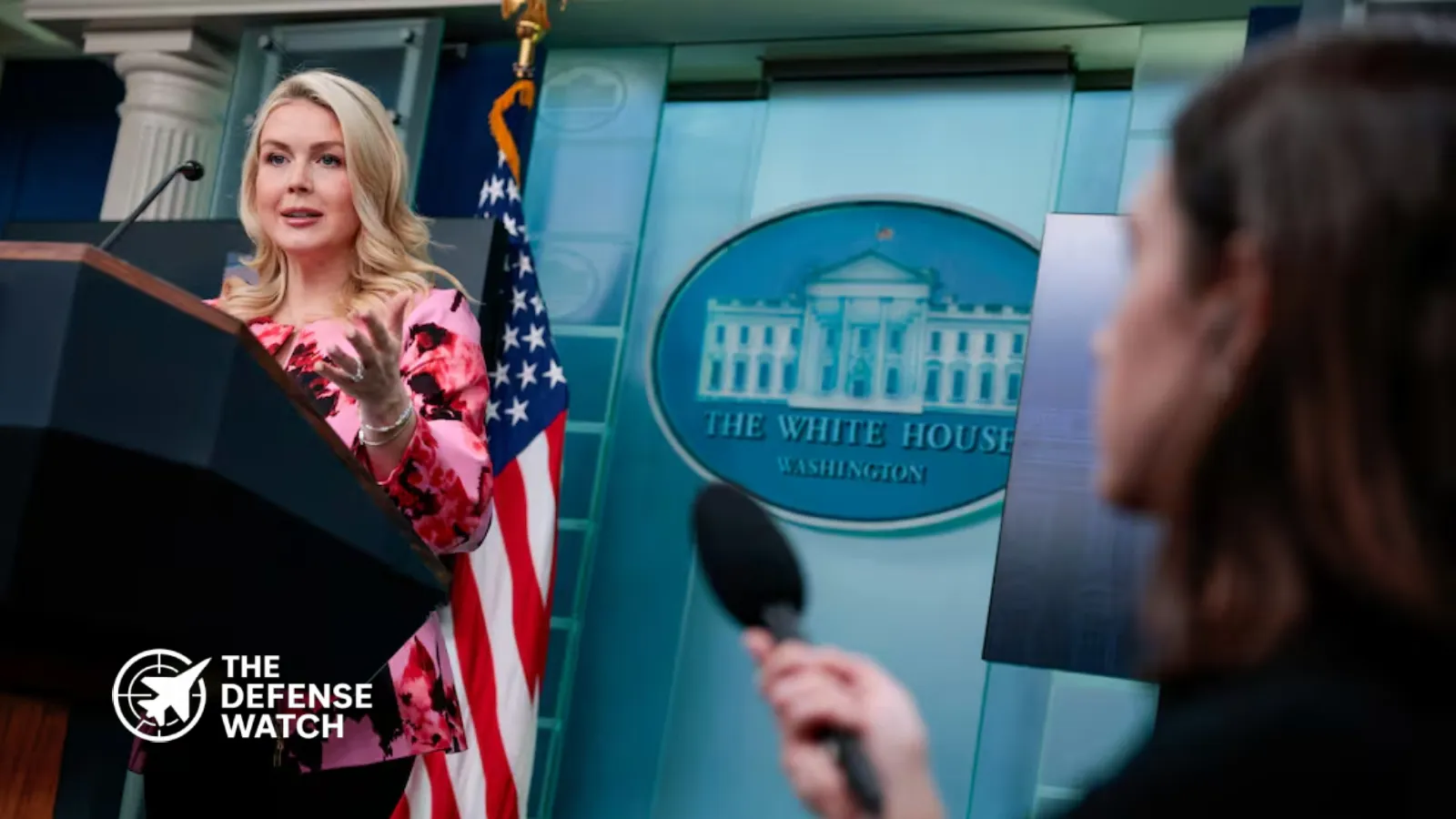
- President Trump has expressed interest in calling on Arab Gulf states to help finance the ongoing U.S.-led military campaign against Iran, according to White House Press Secretary Karoline Leavitt on March 30, 2026.
- Iran has closed the Strait of Hormuz — through which roughly 20% of the world’s daily oil supply flows — and is charging ships approximately $2 million per transit in what analysts are calling a de facto toll regime.
- U.S. crude oil has settled above $100 per barrel for the first time since July 2022; U.S. average gasoline prices have risen more than $1 per gallon since the war began.
- Trump set an April 6, 2026 deadline for Iran to fully reopen the Strait of Hormuz or face destruction of its energy plants and oil wells; the deadline has already been extended twice.
- The U.N. estimates economic losses across the Arab region from the conflict have already reached approximately $63 billion, amplifying urgency for a diplomatic resolution.
Trump Eyes Arab Cost-Sharing as Iran War Enters Critical Diplomatic Phase
The Trump administration’s Iran war cost-sharing proposal represents a sharp escalation in U.S. burden-sharing diplomacy, arriving as military operations against Tehran stretch past their 31st day and ceasefire negotiations approach a hard deadline. White House Press Secretary Karoline Leavitt confirmed on March 30 that President Trump is actively interested in calling on Arab Gulf nations to help fund the campaign — a signal that Washington is already calculating the long-term fiscal math of a conflict with no clear end date.
The Big Picture
The U.S.-led military campaign against Iran, conducted alongside Israel, began on February 28, 2026. It has rapidly reshaped the strategic landscape of the Middle East. Iran closed the Strait of Hormuz early in the conflict, triggering the most severe disruption to global energy markets in decades. U.S. crude oil settled above $100 per barrel for the first time since July 2022, and the knock-on effects are being felt across global supply chains.
The conflict has simultaneously accelerated a longstanding debate within U.S. defense policy circles: who pays for American military power projection in the Middle East? Trump’s cost-sharing signal is not an improvised remark. It reflects a coherent ideological framework the president has applied to NATO, South Korea, and Japan — the idea that nations benefiting from U.S. military power should contribute financially to sustaining it.
What’s Happening
White House Press Secretary Karoline Leavitt told reporters on March 30 that Trump would be quite interested in calling Arab countries to help cover the war’s cost, describing it as an idea the president has and something that Americans would hear more about.
Beyond the direct military price tag, the war has driven the average price of one gallon of gasoline in the U.S. to $3.99 — more than $1 higher than before the conflict began. Leavitt framed the energy price surge as a short-term cost for long-term strategic gain, arguing the campaign would ultimately eliminate the threat Iran poses to U.S. forces and regional allies.
Leavitt also stated that Trump wants to see a deal by April 6 and that the timeline is nearing its end. She confirmed that tanker movements through the Strait of Hormuz — including 10 previously announced vessels and 20 more expected — resulted from direct and indirect U.S.-Iran talks.
Simultaneously, Leavitt emphasized a significant gap between Iran’s public posture and its private communications. She said Tehran had privately agreed to some of Washington’s points, even as Iranian officials publicly described U.S. peace proposals as unrealistic.
Why It Matters
The Arab cost-sharing proposal carries strategic weight well beyond its fiscal dimension. Gulf states — particularly Saudi Arabia, the UAE, Qatar, Kuwait, and Bahrain — have benefited directly from U.S. military infrastructure in the region for decades. American bases, naval assets, and air defense systems in those countries form the backbone of Gulf security architecture. Washington is now signaling that the cost of that protection is no longer a one-way transaction.
The Gulf Cooperation Council’s secretary-general, Jasem Mohamed al-Budaiwi, has already confirmed that Iran is charging fees for safe passage through the Strait of Hormuz in violation of international law. Gulf states are thus directly exposed to Iranian economic coercion — a factor that strengthens the Trump administration’s argument that Arab nations have a direct financial stake in the outcome.
The UAE has been particularly vocal. The UAE’s ambassador to Washington, Yousef Al Otaiba, wrote in a Wall Street Journal op-ed that Iran cannot be allowed to hold the global economy hostage, and called for a conclusive outcome addressing Iran’s full range of threats. That rhetorical alignment with U.S. objectives may make formal cost-sharing agreements politically easier to negotiate.
Strategic Implications
The Arab cost-sharing concept introduces a significant variable into U.S. regional alliance management. Gulf states face a difficult calculus: contribute financially and risk deeper entanglement in a conflict that has already drawn Iranian missile strikes on UAE territory, or decline and risk U.S. withdrawal of military guarantees.
Iran has already attacked U.S. military assets and infrastructure in Bahrain, Kuwait, the UAE, and Saudi Arabia in retaliation against the U.S.-Israeli campaign. Saudi Arabia’s Ras Tanura refinery — its largest domestic oil facility — was forced to shut down after Iranian drone debris caused a fire. The Gulf states are already paying a military price; a formal financial contribution to U.S. operations would formalize what is already a de facto alliance.
However, Arab cost-sharing could complicate the diplomatic track. Iran’s ambassador to the United Nations urged the UAE, Saudi Arabia, Qatar, and Kuwait to cease allowing their territories to be used against Iran. Tehran warned that any provocative action by aggressors and their supporters, including in the UN Security Council, would only make the situation more complicated. Financial commitments from Arab states could harden Iranian negotiating positions.
Trump’s suggestion that “regime change” has effectively occurred also carries strategic risk. Secretary of State Marco Rubio cautioned that while new Iranian leadership with a more reasonable vision would be welcome, the U.S. also had to be prepared for the possibility — maybe even the probability — that that is not the case. Rubio’s hedging reflects a sober institutional assessment that contradicts the president’s more optimistic framing.
Competitor View
Beijing is watching the Hormuz situation with acute strategic interest. Lloyd’s List Intelligence reported that at least two vessels transiting the Strait paid Iran’s passage toll in yuan, China’s currency — a development with implications that extend well beyond shipping logistics. If yuan-denominated energy transactions normalize as a result of the conflict, it would directly accelerate China’s long-stated goal of eroding dollar dominance in global commodity markets.
Russia, for its part, benefits from every dollar increase in global oil prices. With Brent crude up more than 40% since the war began, Moscow’s export revenues have received an inadvertent windfall, partially offsetting the economic pressure imposed by Western sanctions. The Iran war has, paradoxically, created favorable fiscal conditions for both of Washington’s principal strategic competitors.
For regional actors like Iraq and Hezbollah-influenced factions in Lebanon, an Arab financial commitment to U.S. war operations would sharpen existing sectarian fault lines, potentially destabilizing fragile political arrangements Washington has worked to preserve.
What To Watch Next
The April 6 deadline is the immediate flashpoint. Trump has threatened to destroy Iran’s power plants if Tehran does not fully reopen the Strait of Hormuz by that date — a threat international human rights experts and UN officials have characterized as a potential war crime given the civilian impact of power infrastructure destruction.
If the deadline passes without a deal, the Pentagon is prepared. The Trump administration is sending thousands of Marines and Army troops to the region even as diplomatic channels remain nominally open through intermediaries including Pakistan.
On the diplomatic track, the next milestone will be whether Iran’s parliament formally codifies its claimed sovereignty over the Strait of Hormuz. Iranian lawmaker Mohammadreza Rezaei Kouchi confirmed that Iran’s parliament is pursuing a plan to formally establish Iranian sovereignty, control, and oversight over the strait while creating a revenue stream through the collection of transit fees. If passed into Iranian law, that legislation would dramatically complicate any ceasefire framework.
Capability Gap
The Arab cost-sharing proposal, if enacted, would address a real structural gap in U.S. Middle East strategy: the mismatch between American military commitments and the financial burden those commitments impose on U.S. taxpayers. The Gulf states collectively hold trillions in sovereign wealth and derive enormous economic value from the security umbrella Washington provides.
However, formal financial arrangements carry institutional limitations. Congressional authorization, Foreign Military Sales compliance, and allied political sensitivities would all complicate any rapid cash-transfer mechanism. The administration would likely require months of negotiation to structure a formal cost-sharing arrangement, and the April 6 deadline may arrive long before those frameworks could be established.
The more immediate limitation is diplomatic: Arab public opinion in several Gulf states is sensitive to visible alignment with U.S. military operations against a Muslim-majority country, even one governed by a deeply unpopular theocratic regime. Governments in Riyadh and Abu Dhabi may be willing to contribute quietly through logistics, basing, and intelligence — which they are already doing — but formal financial contribution to U.S. war operations carries domestic political risk.
The Bottom Line
Trump’s Arab cost-sharing signal is less a fully developed policy than a strategic pressure point — but it accurately reflects both the fiscal reality of a 31-day military campaign and the long-overdue burden-sharing conversation that the Gulf states’ security dependence on Washington has always made inevitable.
Get real time update about this post category directly on your device, subscribe now.
