
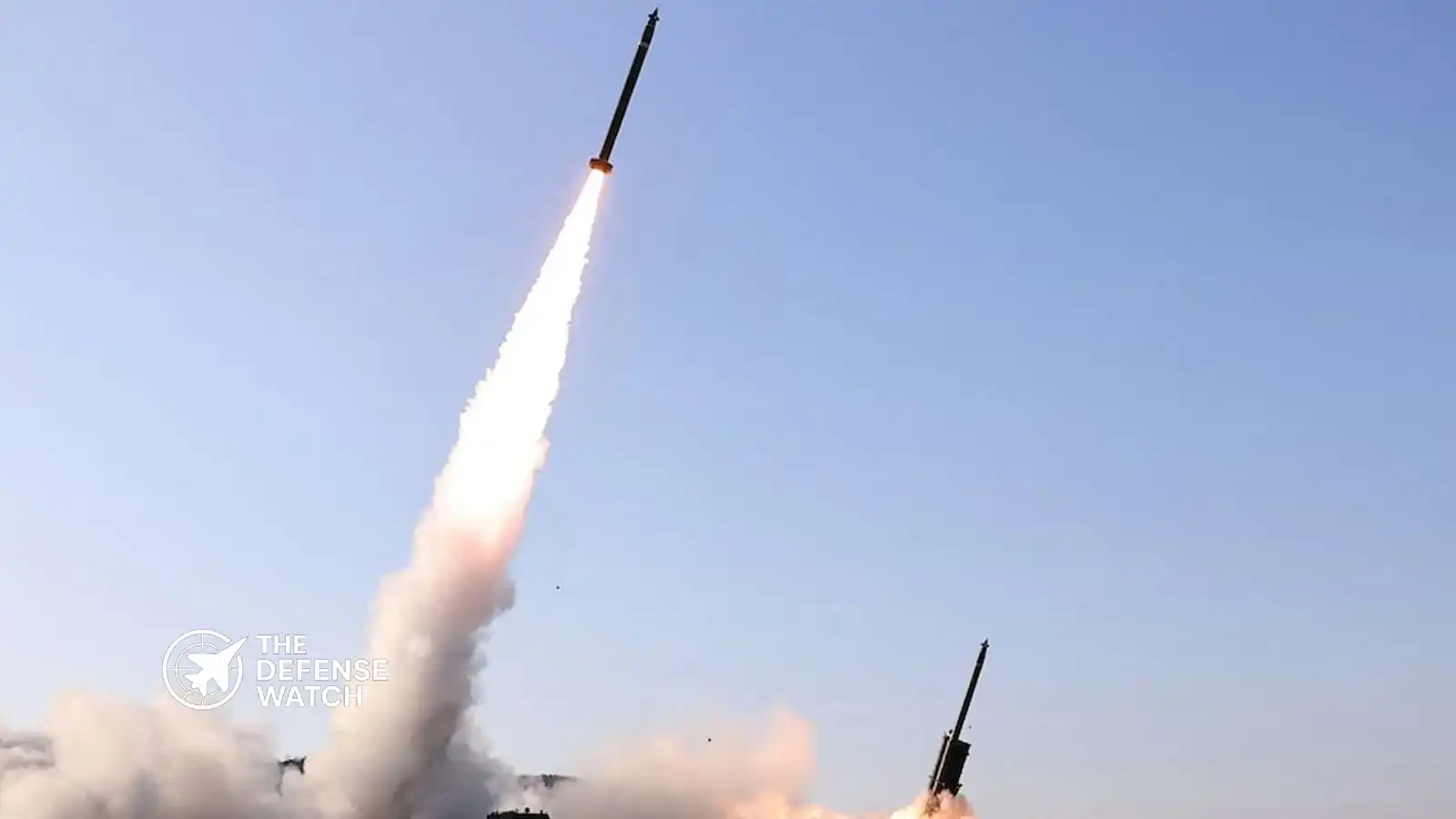
North Korea Hwasong-11 EMP Test Signals Shift Toward Electronic Warfare
The North Korea Hwasong-11 EMP strike system test marks a notable shift in Pyongyang’s approach to modern warfare, emphasizing electronic disruption alongside traditional missile capabilities. The system is designed to generate an electromagnetic pulse effect aimed at degrading or disabling critical military electronics.
Unlike conventional ballistic missile strikes, which focus on physical destruction, an EMP based system targets the digital backbone of military operations. This includes radar systems, communications networks, aircraft avionics, and command and control infrastructure. In the context of the Korean Peninsula, such a capability directly challenges the technological edge of US and South Korean forces.
- North Korea tested a Hwasong-11 missile configured for electromagnetic pulse strike roles, according to Army Recognition.
- The system is designed to disrupt or disable electronics rather than rely solely on kinetic destruction.
- The test reportedly targets US and South Korean airpower infrastructure and operational readiness.
- The Hwasong-11 platform is a short range ballistic missile already deployed within North Korea’s arsenal.
- The development signals an expanding North Korean focus on electronic warfare and asymmetric strike capabilities.
The Hwasong-11, also known as KN-23, is already a proven short range ballistic missile platform. Its adaptation into an EMP delivery system suggests North Korea is seeking to expand its operational toolkit without developing entirely new delivery vehicles.
Targeting Airpower: Strategic Implications For US And South Korea
The focus of the North Korea Hwasong-11 EMP test appears to be airpower, a cornerstone of US and South Korean military strategy in the region. Airbases, fighter aircraft, and surveillance systems depend heavily on advanced electronics, making them vulnerable to electromagnetic disruption.
An EMP strike, even if localized, could temporarily disable key systems such as:
- Air defense radars
- Runway control systems
- Aircraft onboard electronics
- Satellite communication links
This creates a window of vulnerability that could be exploited during the early stages of a conflict. In practical terms, even a short disruption could delay response times, reduce sortie generation, and complicate coordinated operations.
Defense analysts have long warned that modern militaries, while highly capable, are also increasingly dependent on interconnected digital systems. This dependence creates a potential single point of failure that adversaries like North Korea appear intent on exploiting.
Technical Context: EMP Weapons And Delivery Challenges
While the concept of EMP weapons is not new, integrating such effects into a tactical ballistic missile like the Hwasong-11 presents both opportunities and limitations.
EMP effects can be generated through nuclear or non nuclear means. Nuclear based EMP systems produce wide area effects but carry significant escalation risks. Non nuclear EMP systems, which are more likely in this case, typically produce localized disruption with reduced intensity.
The effectiveness of the North Korea Hwasong-11 EMP system will depend on several factors:
- Altitude of detonation
- Yield and design of the EMP payload
- Target hardening against electromagnetic effects
- Environmental conditions
Military systems in the US and South Korea are partially hardened against EMP threats, particularly critical infrastructure. However, not all systems are equally protected, especially forward deployed or legacy equipment.
Operational And Doctrinal Evolution In North Korean Strategy
The test underscores a broader evolution in North Korea’s military doctrine. Rather than relying solely on large scale destructive strikes, Pyongyang appears to be investing in asymmetric capabilities designed to offset technological disadvantages.
Electronic warfare, cyber operations, and precision strike systems are increasingly central to this approach. By combining these elements, North Korea can aim to disrupt, confuse, and degrade adversary forces before or during kinetic operations.
The North Korea Hwasong-11 EMP system fits into this strategy as a force multiplier. It allows for potentially high impact effects without requiring large scale missile salvos or nuclear escalation.
This aligns with observed trends in other military powers, where non kinetic capabilities are being integrated into conventional warfighting doctrines.
Regional Security Impact And Deterrence Dynamics
The introduction of an EMP capable missile system adds a new layer of complexity to deterrence on the Korean Peninsula. US and South Korean planners must now consider not only missile interception and physical defense, but also resilience against electronic disruption.
This could drive several responses:
- Increased hardening of critical systems
- Deployment of redundant communication networks
- Greater emphasis on rapid system recovery
- Expanded electronic warfare countermeasures
The North Korea Hwasong-11 EMP capability also complicates escalation dynamics. Because EMP effects can be less immediately visible than kinetic strikes, attribution and response decisions may become more challenging in a crisis scenario.
At the same time, the test reinforces North Korea’s intent to signal capability and deterrence. Demonstrating the ability to threaten high value assets like airpower infrastructure serves both military and political objectives.
Assessment: Capability Signal Or Operational Reality
While the test represents a significant development, questions remain about the operational maturity of the system. Demonstrating an EMP effect in a controlled test environment does not necessarily translate into reliable battlefield performance.
Key unknowns include:
- Actual EMP output and effectiveness
- Integration with targeting systems
- Survivability against missile defense
- Consistency across multiple launches
Nevertheless, the North Korea Hwasong-11 EMP test should be viewed as part of a broader pattern of capability development rather than an isolated event. Even a limited EMP capability could have disproportionate effects if used strategically.
Conclusion
The North Korea Hwasong-11 EMP strike system test highlights an evolving threat landscape in Northeast Asia, where electronic warfare is becoming increasingly central to military competition.
By targeting the technological foundations of US and South Korean airpower, North Korea is signaling a shift toward disruption based warfare. This approach aims to level the playing field against more advanced adversaries without relying solely on conventional or nuclear escalation.
For regional defense planners, the challenge now lies in adapting to a threat that is less visible but potentially just as disruptive.
Get real time update about this post category directly on your device, subscribe now.
