TEKEVER Acquires Flowcopter To Expand Autonomous Aircraft
TEKEVER has acquired UK aerospace engineering company Flowcopter, bringing its hydraulic transmission technology for unmanned aircraft propulsion into the company’s growing autonomous systems portfolio. TEKEVER announced the transaction on September 1, 2026, but did not disclose its financial value.
- TEKEVER Acquires Flowcopter To Expand Autonomous Aircraft
- Takeaways
- AR6 Provides The Immediate Technical Rationale
- Why Hydraulic Propulsion Matters
- From Partnership To Vertical Integration
- UK Industrial Expansion Is A Major Part Of The Deal
- Potential Military Applications
- TEKEVER’s Broader Autonomous Systems Strategy
- What The Acquisition Means For Heavy-Lift UAS
- Strategic Relevance For The United States And Europe
- Bottom Line
Takeaways
TEKEVER has acquired UK engineering company Flowcopter, bringing its hydraulic aerospace propulsion technology into the Portuguese-owned autonomous systems company.
The acquisition strengthens an existing industrial relationship between the two companies. Flowcopter has already supplied its hydraulic propulsion technology for TEKEVER’s AR6 family, a heavy-lift vertical takeoff and landing aircraft unveiled at the Farnborough International Airshow in July.
The deal also expands TEKEVER’s UK footprint. Flowcopter’s engineering operation in Edinburgh will continue under the TEKEVER brand, while the company combines its autonomy, mission systems and operational experience with Flowcopter’s propulsion engineering.
AR6 Provides The Immediate Technical Rationale
The clearest reason for the acquisition is the AR6 program.
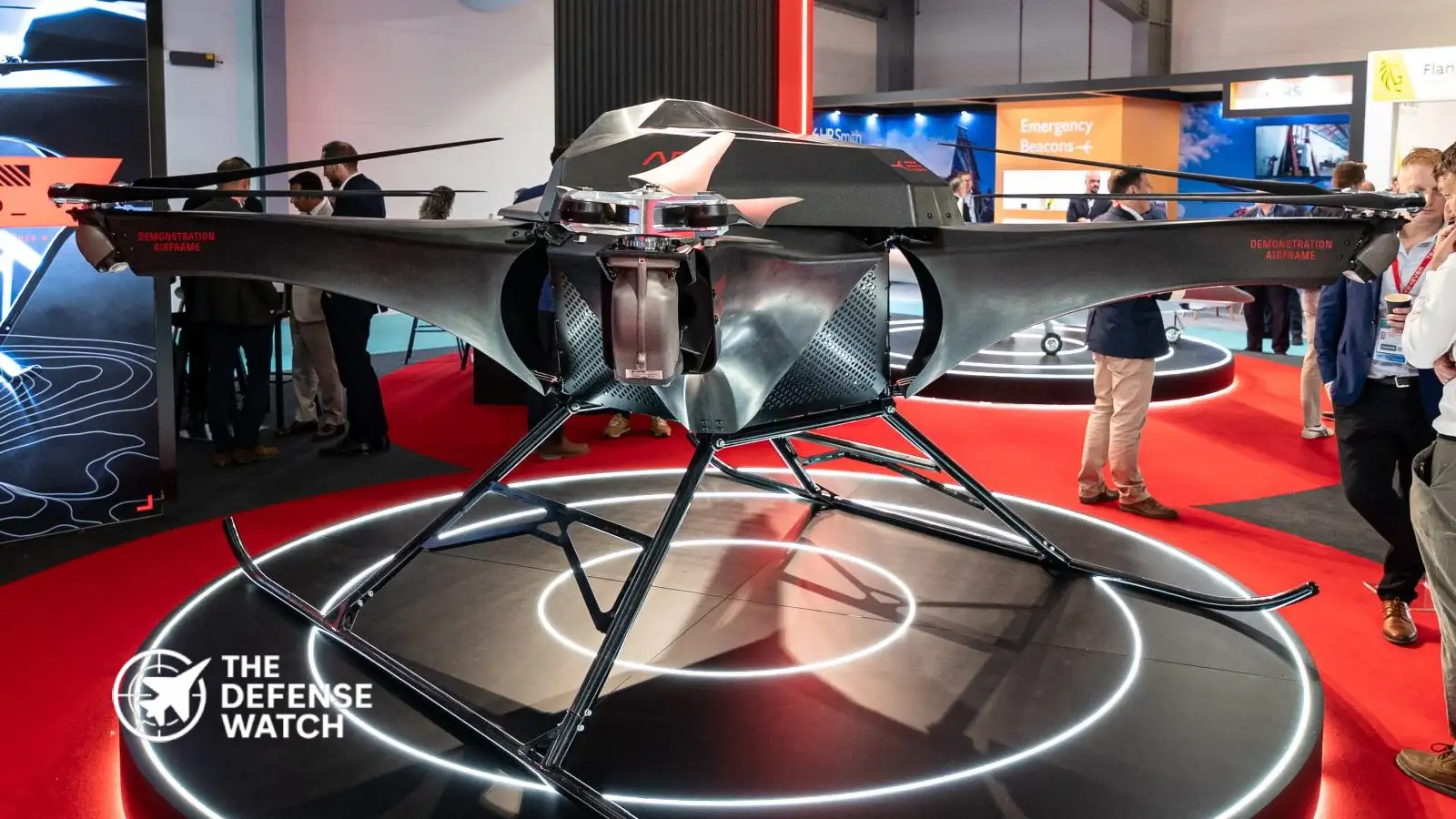
TEKEVER describes the AR6 as a new family of autonomous heavy-lift aircraft intended to address a capability gap between relatively small electric VTOL drones and much larger crewed helicopters. The company says the platform is designed to carry at least 200 kilograms over 500 kilometers.
That combination is significant because payload and endurance remain closely linked in vertical-lift unmanned aircraft. Increasing payload normally increases power requirements, while larger batteries add weight and can reduce the amount of useful cargo that can be carried.
TEKEVER and Flowcopter have instead pursued a hydraulic transmission architecture. According to technical reporting from Janes, the AR6 uses an engine to drive hydraulic pumps rather than directly driving the four rotors. A digital displacement pump regulates hydraulic flow to the individual rotor channels, allowing rotor speed to be controlled according to aircraft power requirements.
This approach gives the AR6 a different engineering tradeoff from conventional battery-electric quadcopters.
| AR6 Characteristic | Reported Capability |
|---|---|
| Aircraft type | Autonomous heavy-lift VTOL |
| Rotor configuration | Four rotors |
| Propulsion approach | Hydraulic transmission |
| Target payload | At least 200 kg |
| Target range | At least 500 km |
| Planned production | By the end of 2026 |
| Development location | United Kingdom |
TEKEVER says the AR6 is designed for both military and civilian applications, with military roles including forward logistics, casualty evacuation and potential crewed-uncrewed teaming.
Why Hydraulic Propulsion Matters
The Flowcopter technology addresses a specific problem in heavy-lift autonomous aviation: how to provide sustained power to multiple rotors without relying entirely on large battery packs or conventional mechanical transmission arrangements.
Hydraulic systems are already well established in aviation and other heavy machinery. Their use in an autonomous VTOL aircraft, however, requires careful management of efficiency, weight, thermal loads, reliability and control.
The AR6 architecture uses a combustion engine to provide mechanical power to hydraulic pumps, with hydraulic lines distributing power to the rotors. The digital pump system then adjusts the hydraulic flow as operating conditions change. Janes reported that the system is intended to provide rapid changes in rotor RPM while allowing the engine to operate in a comparatively stable operating regime.
For a heavy-lift aircraft, that distinction can matter. A propulsion system does not simply need to generate maximum power. It must manage power efficiently across hover, climb, cruise, descent and payload changes.
The acquisition therefore gives TEKEVER control over a critical part of the aircraft’s architecture rather than leaving propulsion technology as an external supplier dependency.
From Partnership To Vertical Integration
Before the acquisition, Flowcopter and TEKEVER were already working together on AR6 development.
TEKEVER’s September announcement says bringing Flowcopter inside the company will allow the two organizations to accelerate development of long-endurance heavy-lift platforms. Flowcopter’s engineering capability will now sit alongside TEKEVER’s autonomy and mission-system expertise.
That creates a more vertically integrated development structure.
For autonomous aircraft, integration between propulsion, flight control, sensors and mission software can become increasingly important as platforms move beyond basic remote piloting. A heavy-lift aircraft operating at long range must continuously manage power availability, aircraft state, payload effects and environmental conditions.
Keeping propulsion engineering inside the same corporate structure could allow TEKEVER to coordinate those functions more closely during development. It also reduces the organizational separation between the aircraft designer and a critical technology supplier.
UK Industrial Expansion Is A Major Part Of The Deal
The acquisition comes as TEKEVER is expanding its British manufacturing and engineering base.
The company says it now employs more than 300 people across UK offices, factories and test facilities in London, Bristol, Southampton, West Wales, Lydd and Swindon. Flowcopter adds Edinburgh to that network.
TEKEVER has also been building a major production presence in Swindon. The company previously announced plans for a large UK manufacturing facility, while the British government has backed expansion of domestic drone production.
The UK government’s wider defense strategy is increasingly focused on autonomous systems and domestic industrial capacity. In June 2026, Prime Minister Keir Starmer said the UK would invest more than £5 billion in drones and autonomous weapons as part of its defense investment plan.
The British government has also committed up to £400 million for TEKEVER AR5 surveillance drones for the British Army, reinforcing the company’s growing role in the country’s military uncrewed systems ecosystem.
Potential Military Applications
The AR6 is not positioned simply as a cargo drone.
TEKEVER identifies forward logistics and casualty evacuation as military applications, while its July announcement also referenced possible crewed-uncrewed teaming concepts.
The logistics mission is particularly relevant because heavy-lift autonomous aircraft could potentially move supplies without placing a crewed helicopter and its personnel at risk.
A 200-kilogram payload class also opens missions that are difficult for small electric drones. These could include moving equipment, medical supplies or other loads between locations where conventional ground transportation is slow, exposed or unavailable.
Casualty evacuation presents a different challenge. An autonomous or remotely supervised aircraft capable of transporting a patient and medical equipment could provide an additional option in areas where landing a crewed helicopter would be hazardous.
However, these missions require more than propulsion performance. Safety certification, autonomous flight reliability, communications resilience, navigation in contested environments and reliable contingency behavior will all influence whether a heavy-lift UAS can move from demonstration to routine military service.
TEKEVER’s Broader Autonomous Systems Strategy
The Flowcopter acquisition fits into a broader expansion of TEKEVER’s autonomous aircraft portfolio.
The company has gained significant attention through its AR3 and AR5 systems, including their operational use by Ukraine. The UK government says TEKEVER’s AR3 and AR5 platforms have accumulated more than 10,000 flight hours in Ukrainian service.
That operational experience gives TEKEVER a base from which to move into larger autonomous aircraft.
The company has also become increasingly involved in UK defense programs involving autonomous systems. Four companies, including TEKEVER, were shortlisted by the British Ministry of Defence for Project NYX, an Army aviation initiative examining autonomous systems intended to operate alongside Apache helicopters.
The combination of smaller ISR platforms, electronic warfare systems and emerging heavy-lift aircraft gives TEKEVER a broader range of autonomous capabilities than its earlier fixed-wing drone portfolio.
What The Acquisition Means For Heavy-Lift UAS
The significance of the Flowcopter acquisition is less about the transaction itself than about the propulsion problem TEKEVER is trying to solve.
Electric propulsion remains highly attractive for smaller drones because of its mechanical simplicity and low local emissions. As payload and range increase, however, energy storage becomes a major design constraint.
The AR6 approach attempts to use the energy density and endurance advantages associated with a combustion engine while distributing that power through hydraulic transmission to multiple rotors.
That does not eliminate engineering challenges. Hydraulic systems require pumps, fluid management, lines, valves and thermal control, while the aircraft must maintain high reliability in a system with multiple moving and pressurized components.
The practical test will therefore be whether the architecture can deliver the advertised payload and range while maintaining acceptable reliability, maintenance requirements and operating costs.
TEKEVER has said AR6 production is due to begin by the end of 2026 at its Swindon manufacturing hub.
If that schedule is maintained, the company will move relatively quickly from unveiling the aircraft in July to beginning production before the end of the year.
Strategic Relevance For The United States And Europe
For the United States and its European allies, the acquisition reflects a broader shift in defense aviation toward autonomous systems that can perform missions traditionally associated with crewed aircraft.
The UK is investing heavily in autonomous technology while simultaneously seeking greater sovereign industrial capacity. Its defense investment plan specifically identifies autonomous wingmen, attack drones, surveillance aircraft and uncrewed maritime systems as parts of the future force.
Heavy-lift autonomy fits within that wider transition.
Rather than replacing every crewed aircraft, systems such as AR6 could provide additional lift capacity for missions where the cost, risk or availability of a helicopter makes conventional aviation less attractive.
For European militaries, the industrial aspect is equally important. Maintaining domestic control over propulsion, autonomy, manufacturing and testing can reduce dependence on external suppliers while creating systems that can be adapted to national requirements.
TEKEVER’s acquisition of Flowcopter therefore represents both a technology investment and an industrial strategy. It gives the company direct ownership of a propulsion technology already integrated into its next-generation heavy-lift aircraft while expanding its UK engineering base.
The immediate focus will be the AR6. Its stated 200-kilogram payload and 500-kilometer range target will provide the clearest test of whether hydraulic propulsion can establish a meaningful position in the growing heavy-lift autonomous aircraft market.
Bottom Line
TEKEVER’s acquisition of Flowcopter brings a key propulsion technology in-house at a time when the company is moving beyond conventional ISR drones into heavier autonomous aircraft.
The AR6 provides the first visible application, combining a four-rotor VTOL configuration with hydraulic transmission and a stated target of carrying at least 200 kilograms over 500 kilometers.
The acquisition also strengthens TEKEVER’s growing UK industrial footprint and aligns with Britain’s wider investment in autonomous military systems.
Whether the AR6 can achieve its targeted performance in operational conditions will determine the longer-term value of the technology. For now, the acquisition gives TEKEVER direct control over a distinctive propulsion architecture as European demand for autonomous, long-endurance and heavy-lift aircraft continues to expand.