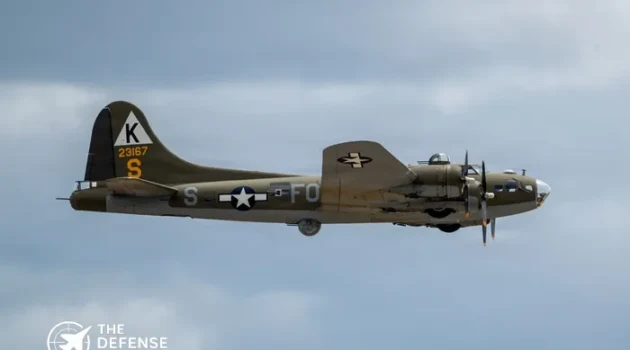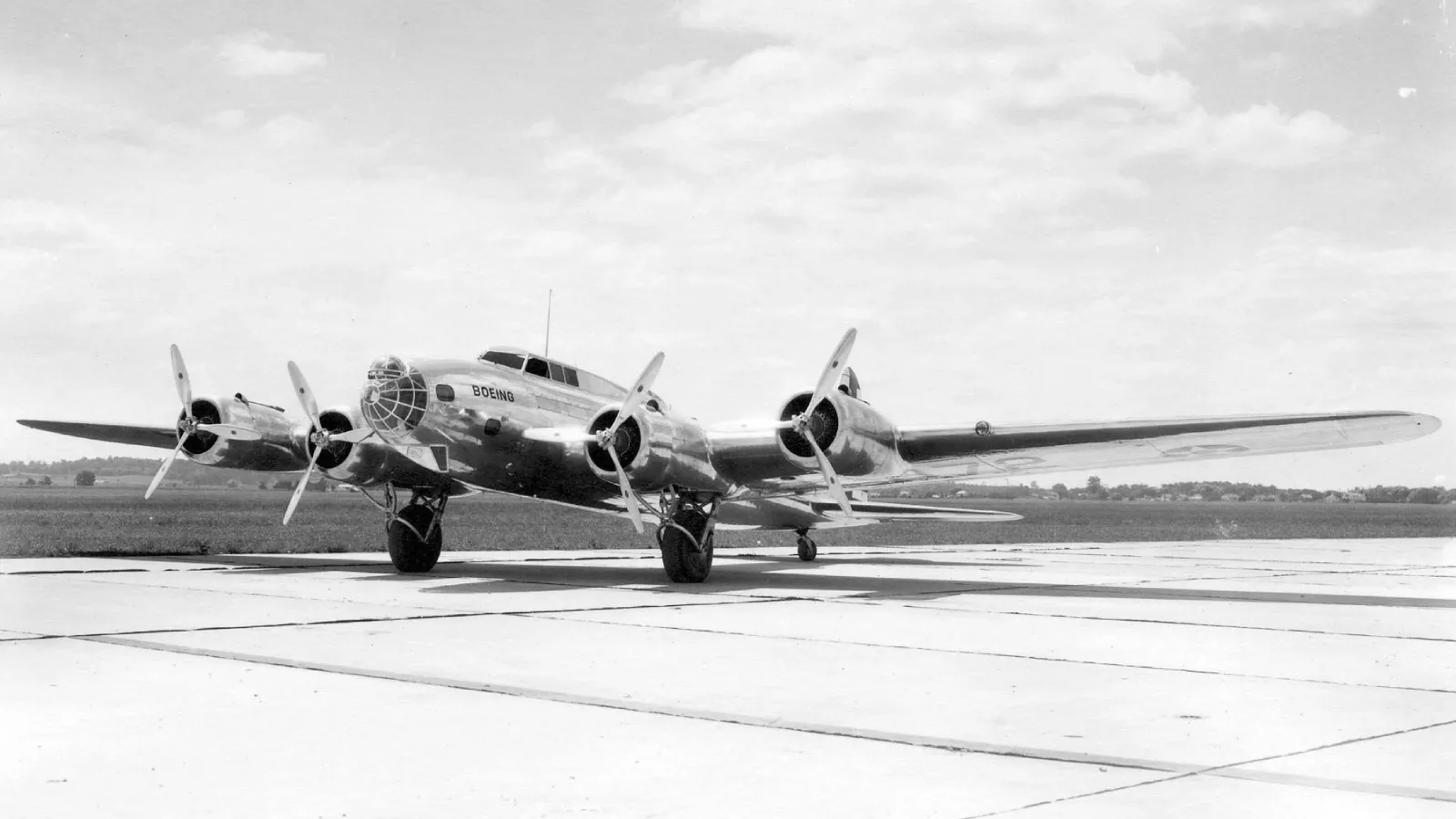
Ten obsolete B-17 Flying Fortresses, stripped of their cockpit glass and packed with more than nine tons of Torpex explosive apiece, sat on the runway at RAF Fersfield in the summer of 1944. Each one needed a two-man volunteer crew willing to fly it into the air, arm the payload, and then bail out of a plane that had, for all practical purposes, already become a bomb. This was Operation Aphrodite, the U.S. Army Air Forces’ attempt to build the world’s first operational strike drone — decades before the term “unmanned combat aerial vehicle” existed. It would end in a string of failures, the death of a Kennedy, and a hard lesson about the limits of 1944-era guidance technology. But the concept it tested — a remotely piloted aircraft delivering a massive payload against a target too hardened for conventional bombs — is exactly the concept that underwrites today’s loitering munitions and strike drones.
At-a-Glance: Strategic Brief
| Strategic Brief | Details |
|---|---|
| Codename / Mission | Operation Aphrodite (USAAF); Operation Anvil (U.S. Navy parallel program) |
| Date / Theater | August 1944 – January 1945; launched from RAF Fersfield and Royal Air Force Station Woodbridge, England, against targets in occupied France and Germany |
| Executing Force(s) | U.S. Eighth Air Force, 3rd Bombardment Division, 388th Bombardment Group (562nd Bomb Squadron detachment); U.S. Navy Special Air Task Force One |
| Primary Target | Hardened V-1 and V-2 sites (Mimoyecques, Siracourt, Watten/Wizernes), U-boat pens, and industrial targets |
| Key Platforms & Tech | War-weary Boeing B-17 (redesignated BQ-7) and Navy PB4Y-1/B-24 Liberator (redesignated BQ-8) drones; “Double Azon” radio guidance; television camera relay to de Havilland Mosquito and B-17 “mother ships” |
| Mission Outcome | Tactical failure — no confirmed direct hits on primary targets; strategically notable as an early proof-of-concept for remote-guided strike aircraft |
Strategic Background & Operational Context
By mid-1944, Allied planners faced a problem that conventional heavy bombing simply could not solve. Germany’s V-weapon program had produced launch and storage facilities built with concrete walls many meters thick — the V-3 supergun site at Mimoyecques and the V-2 bunker complexes at Watten and Wizernes among them. Standard daylight precision bombing runs by Eighth Air Force B-17s and B-24s were failing to penetrate these structures, and the missions were exacting a steady toll on aircrews facing dense flak belts.
Eighth Air Force commander Major General Jimmy Doolittle formally approved the concept on June 26, 1944, tasking the 3rd Bombardment Division with turning the idea into an operational weapon after the United States Strategic Air Forces in Europe ordered the project into development on June 23. The logic was simple, if ruthless in its arithmetic: American industry was producing B-17s faster than combat losses could consume them, so a small number of war-weary airframes — planes too worn for further combat duty — could be converted into single-use weapons carrying a payload roughly ten times larger than any bomb a manned aircraft could deliver. If a hundred sorties by conventional bombers couldn’t crack a bunker roof, perhaps one flying bomb loaded with Torpex could.
Engineering & Technological Innovation
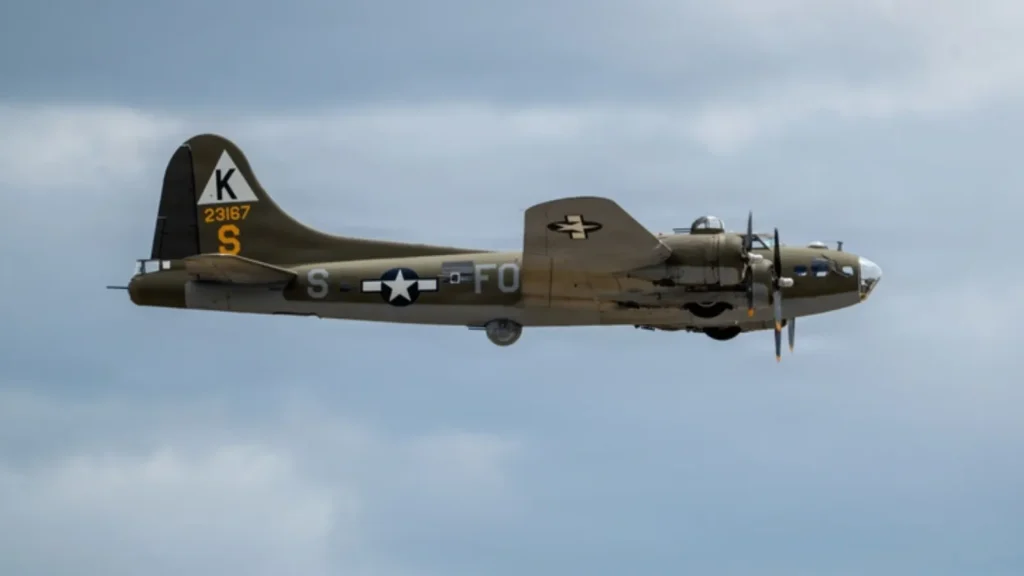
The technical execution of Operation Aphrodite was a patchwork of contemporary radio-control technology, adapted under wartime urgency rather than purpose-built from the ground up. Ground crews stripped the B-17’s cockpit down to a bare windscreen, removed all nonessential equipment, and packed the fuselage with roughly 20,000 pounds of Torpex — a naval explosive considerably more powerful than TNT by weight. The converted airframes were redesignated BQ-7; the Navy’s parallel effort under Operation Anvil used the PB4Y-1 Liberator, redesignated BQ-8.
Guidance relied initially on a system nicknamed “Double Azon,” short for a double azimuth-only control layout adapted from the existing AZON guided bomb program. A volunteer pilot and flight engineer took the drone off manually, climbed to roughly 2,000 feet, leveled the aircraft on its assigned heading, armed the explosive charge, and then bailed out through cockpit hatches deliberately widened for a fast exit — a sequence with almost no margin for error. Control then passed to a “mother ship,” typically a de Havilland Mosquito or a B-17 flying at around 20,000 feet, whose operator steered the drone toward the target using a primitive television camera feed mounted in the drone’s nose. Later missions added Eureka/Rebecca homing transponders and a radio-triggered smoke dispenser to help the mother ship track the drone visually, along with yellow paint on the drone’s upper surfaces for the same reason.
Mission Execution & Key Sorties
The first operational Aphrodite mission flew on August 4, 1944, when four BQ-7 drones lifted off from Woodbridge intending to strike V-weapon infrastructure in France. None hit their targets; the results ranged from guidance failures to drones going down well short of the objective. The pattern repeated on August 6: two drones crashed into the sea off the English coast and a third was shot down over Gravelines.
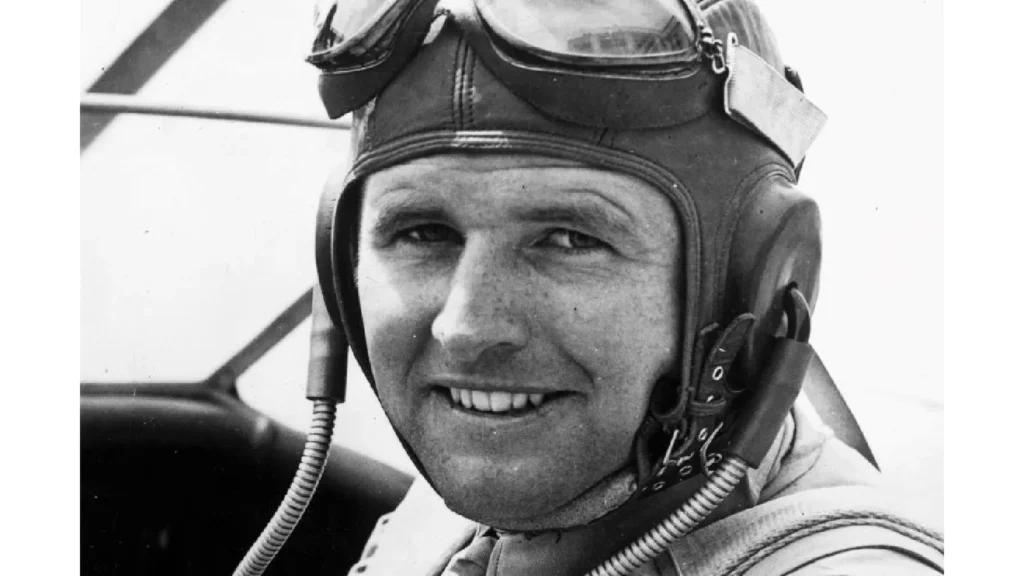
The most consequential — and tragic — sortie flew on August 12, 1944, as part of the Navy’s Anvil effort. Lieutenant Joseph P. Kennedy Jr., elder brother of the future president and already a combat veteran of 25 completed missions, volunteered to fly a BQ-8 Liberator loaded with Torpex against a V-weapon site believed to be at Mimoyecques. Kennedy and his co-pilot were killed when the aircraft’s explosive charge detonated prematurely, apparently while they were still aboard preparing to arm and bail out, destroying the aircraft over Blythburgh, Suffolk, and damaging buildings on the ground below.

Photo : Lieutenant Joseph P. Kennedy Jr. Subsequent missions through the autumn fared little better. On September 3, 1944, a Navy-controlled BQ-8 aimed at U-boat pens near Heligoland was accidentally guided by its own controller into Düne Island rather than the intended target. Additional Aphrodite sorties between August 1944 and January 1945 — a total of roughly 14 to 17 drone launches across both the Army and Navy programs — were flown against U-boat pens, oil facilities, and remaining hardened sites, but no mission is confirmed to have scored a direct hit on its primary objective. One further pilot died when his parachute failed during egress.
Tactical Outcome & Operational Assessment
Judged purely on tactical results, Operation Aphrodite was a failure. Not one of its drones is confirmed to have destroyed its intended target, and the program cost the lives of at least two aircrew, including Kennedy, during a sequence of the mission — manual takeoff and bailout — that guidance technology of the era could not remove from human hands. The core vulnerabilities were consistent across missions: the “Double Azon” and later television-relay guidance systems lacked the resolution, reliability, and latency performance needed for precision terminal guidance; radio links were vulnerable to interference and simple mechanical failure; and the requirement for a live crew to fly the initial climb-out negated much of the risk-reduction rationale that justified the program in the first place.
Strategically, however, Aphrodite is better understood as an expensive but genuine proof-of-concept. It demonstrated — under actual combat conditions rather than a test range — that a large aircraft could be flown by remote control for a sustained period, that a chase aircraft could receive a live video feed from a drone in flight, and that a war-weary airframe could be repurposed as a one-way precision-strike vehicle rather than being scrapped. Those were nontrivial engineering achievements for 1944, even though the weapon system built around them wasn’t yet ready for the battlefield it was sent into.
The Modern Connection: Lineage to 21st-Century Warfare
The conceptual DNA of Operation Aphrodite runs directly through the decades to today’s loitering munitions and one-way attack drones. The core proposition Aphrodite tested — an expendable airframe, a remote operator, a real-time video feed for target correction, and a warhead sized to defeat hardened structures — is the same proposition behind systems like the Israeli Harop, the U.S. Switchblade family, and the Shahed-136-derived weapons seen extensively in the Russia-Ukraine war. Where Aphrodite’s operators watched a grainy black-and-white television picture and steered with a joystick over a radio link prone to interference, modern loitering munitions use encrypted digital datalinks, inertial navigation backed by GPS, and in some cases onboard machine-vision terminal guidance that requires no human in the loop at all for the final seconds of flight.
atOptions = { ‘key’ : ‘e7d18db8b7513fb2a224cf4c3f18bbf0’, ‘format’ : ‘iframe’, ‘height’ : 90, ‘width’ : 728, ‘params’ : {} };The most important lesson Aphrodite left for later programs was arguably about the takeoff-and-transition problem: the riskiest and least automatable phase of the mission was getting the weapon safely into stable flight before handing off control. Modern designs solve this the way Aphrodite’s engineers could not, by removing the human from the airframe entirely — rail-launching, catapult-launching, or air-launching munitions so that no aircrew is ever aboard, at any phase of flight. In esports and military simulation circles, this same handoff problem shows up in real-time strategy titles that model early unmanned or remote-guided units: the “manual liftoff, AI-assisted terminal phase” workflow Aphrodite pioneered is a recognizable template for the two-stage unit-control mechanics found in games like Command: Modern Operations, where players hand off a drone or missile from manual waypoint control to autonomous terminal guidance — a design choice that traces its lineage to exactly the handoff Aphrodite crews performed by hand in 1944.
Key Takeaways
- Operation Aphrodite converted war-weary B-17s (BQ-7) and Navy PB4Y-1/B-24 Liberators (BQ-8) into radio-controlled flying bombs to strike hardened V-weapon sites and U-boat pens that conventional bombing couldn’t destroy.
- The August 12, 1944 mission that killed Lieutenant Joseph P. Kennedy Jr. remains the operation’s most well-known and consequential sortie.
- No Aphrodite or Anvil drone is confirmed to have hit its primary target; the program’s roughly 14-17 missions were plagued by guidance failures, crashes, and premature detonations.
- The program’s core concept — an expendable remote-guided airframe with a large warhead and video-assisted terminal guidance — directly foreshadows today’s loitering munitions and one-way attack drones.
FAQs
What was Operation Aphrodite?Operation Aphrodite was a 1944 U.S. Army Air Forces program that converted retired B-17 Flying Fortress bombers into radio-controlled flying bombs, intended to strike heavily fortified German targets that conventional bombing could not destroy.
Did Operation Aphrodite succeed?No confirmed direct hits on primary targets were achieved across the program’s roughly 14 to 17 missions between August 1944 and January 1945; it is generally judged a tactical failure, though it proved several remote-guidance concepts under combat conditions.
How did Joseph Kennedy Jr. die in relation to this program?Kennedy died on August 12, 1944, when the Torpex explosive charge aboard his BQ-8 drone Liberator detonated prematurely during Operation Anvil, the Navy’s parallel version of Aphrodite, before he and his co-pilot could bail out.
What is the difference between Operation Aphrodite and Operation Anvil?Aphrodite was the U.S. Army Air Forces’ program using converted B-17s designated BQ-7; Anvil was the parallel U.S. Navy effort using converted PB4Y-1/B-24 Liberators designated BQ-8, targeting similar objectives with a comparable remote-guidance approach.
How does Operation Aphrodite connect to modern drones?Its combination of an expendable airframe, remote piloting, video-assisted guidance, and a large warhead against hardened targets is the same basic template used by modern loitering munitions such as the Switchblade and Harop.