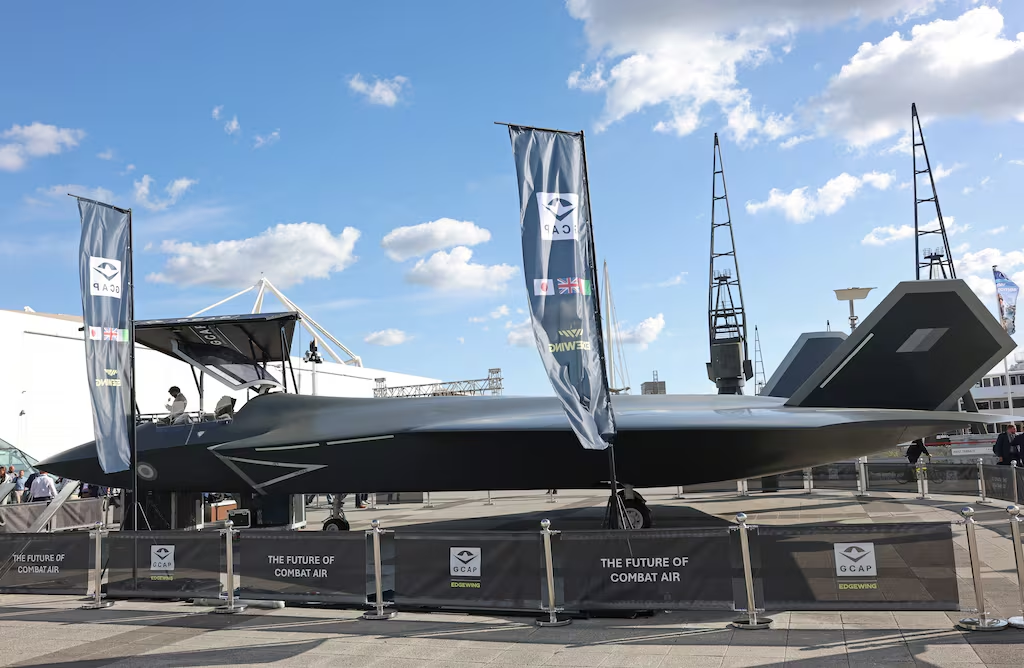
UK, Italy, and Japan Award $850M GCAP Contract, Putting Sixth-Generation Fighter Program On a Clear Runway
The Global Combat Air Programme received its most consequential industrial milestone to date when the UK, Italy, and Japan awarded Edgewing a £686 million contract on April 1, 2026, formally designating the trinational joint venture as the program’s unified design and engineering authority. The award marks GCAP’s transition from a politically coordinated national effort into a fully integrated international acquisition program with a single design authority accountable for delivering a sixth-generation combat aircraft by 2035.
- The UK, Italy, and Japan awarded Edgewing a £686 million (~$850M) contract on April 1, 2026, under the Global Combat Air Programme (GCAP) to lead unified design, engineering, and airworthiness oversight.
- Edgewing — a joint venture of BAE Systems, Leonardo, and Japan Aircraft Industrial Enhancement Co. Ltd. (JAIEC), each holding 33.3% — will serve as design authority for the aircraft’s entire service life, expected to extend beyond 2070.
- GCAP is designed as a “system of systems,” integrating manned-unmanned teaming, advanced sensing with radar delivering 10,000 times more data than current systems, and operations across air, land, sea, space, and cyber domains.
- Italy’s parliament approved €8.77 billion for initial GCAP phases through 2037, with total early-phase program costs estimated at €18.6 billion. The fighter is targeted for service entry in 2035.
- Canada is being considered as a potential GCAP observer nation by July 2026, signaling expanding allied interest in the trinational program.
The Big Picture: Allied Air Power at a Strategic Crossroads
Western air forces face a converging set of threats that their current fifth-generation fleets were not specifically designed to defeat at scale. China has fielded the J-20 stealth fighter and is developing two reported sixth-generation programs; Russia continues advancing air defense systems that challenge even low-observable aircraft. Against that backdrop, the UK, Italy, and Japan identified a shared operational requirement: a survivable, networked, next-generation combat aircraft capable of operating in heavily contested electromagnetic and air defense environments where fifth-generation platforms will face growing risks.
GCAP emerged from that shared threat calculus. The program grew out of Japan’s F-X requirement and the UK-Italy Tempest initiative, formally merging into a trilateral structure in December 2022. Canada has since been identified as a potential observer nation by July 2026, a development that, if confirmed, would further widen the program’s political and industrial footprint.
What’s Happening: A Single Authority Takes the Helm
Awarded on April 1 and running until June 30, 2026, the £686 million package places Edgewing at the center of key design and engineering work under the GCAP Agency, with the stated aim of accelerating delivery for the three partner nations.
Edgewing, formally launched in June 2025, is the UK-based joint venture created specifically for GCAP by BAE Systems, Leonardo, and Japan Aircraft Industrial Enhancement Co. Ltd. (JAIEC), each holding 33.3 percent, and will remain design authority for the aircraft throughout a service life expected to extend beyond 2070.
The practical significance of that structure is considerable. Activities that were previously conducted under three national contracts will now be executed as part of a fully fledged international program, and Edgewing will oversee engineering, airworthiness, and certification across all phases of development.
Edgewing does not absorb all manufacturing into a single plant. It leads design and development while subcontracting manufacturing and final assembly to BAE Systems, Leonardo, Mitsubishi Heavy Industries, and the wider supply chain. That structure preserves sovereign industrial weight in each nation while centralizing the functions that most often derail multinational aircraft programs: configuration control, airworthiness, certification, and system integration.
Why It Matters: More Than a Fighter, a Networked Kill Node
GCAP’s ambitions extend well beyond a conventional air superiority platform. The program is not being sold as a stand-alone fighter but as a “system of systems” operating across air, land, sea, space, and cyber, with the crewed combat aircraft serving as the core platform connected to crewed and uncrewed peripheral systems.

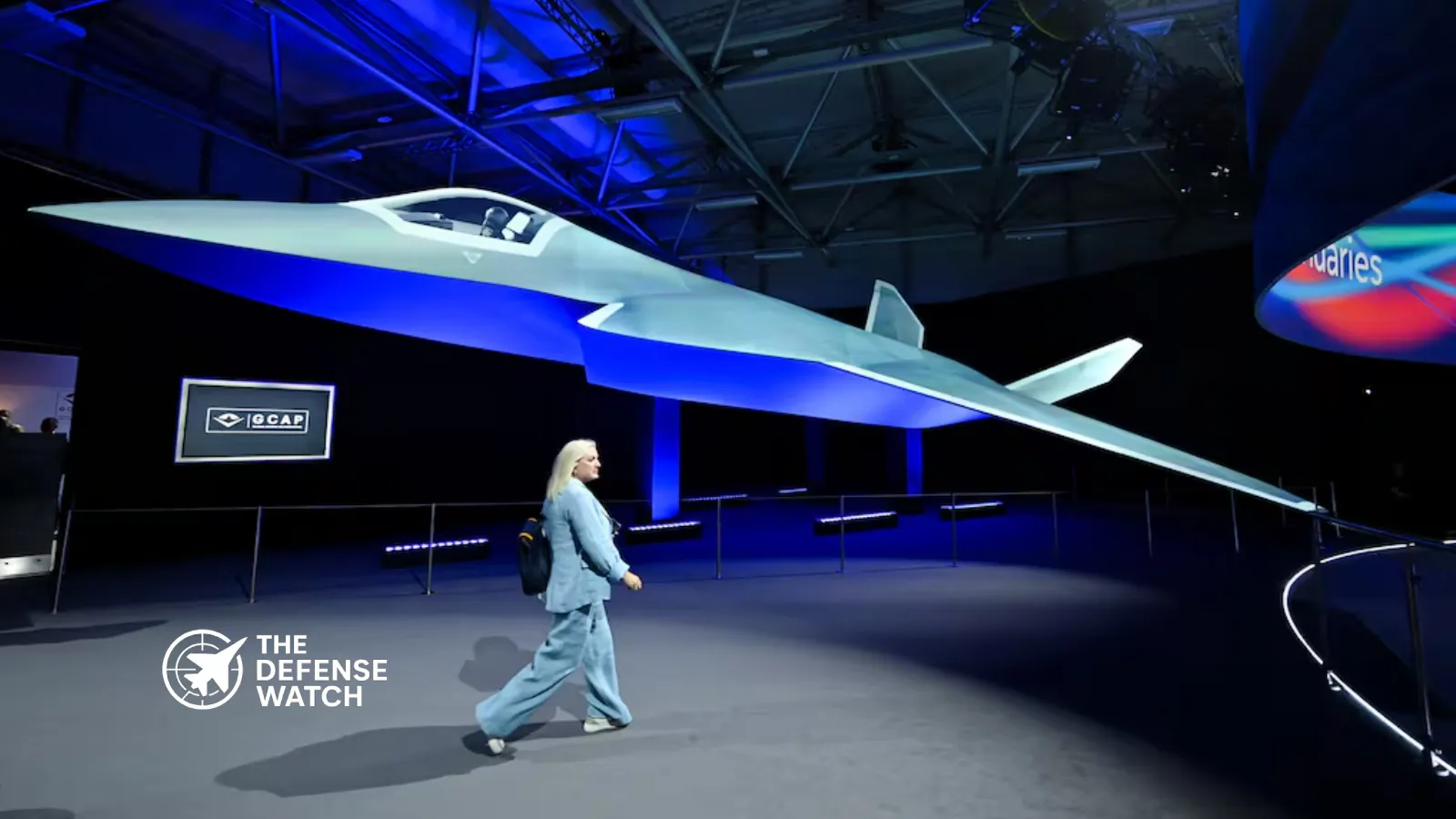
A person walks past the GCAP fighter jet concept design at the 2024 Farnborough International Airshow. (Justin Tallis/AFP via Getty Images) The sensor architecture behind that concept is striking. The future aircraft’s radar is intended to deliver 10,000 times more data than current systems, while Leonardo UK states that GCAP’s ISANKE and ICS architecture — Integrated Sensing and Non-Kinetic Effects plus Integrated Communications Systems — will provide mission-critical information and advanced self-protection capabilities.
Propulsion carries equal ambition. Rolls-Royce, IHI, and Avio Aero are developing a propulsion architecture designed not only to generate thrust but also to supply the larger electrical loads demanded by next-generation sensors, processors, and onboard systems. Rolls-Royce says the demonstrator engine effort involves roughly 40,000 individual parts.
That combination of sensor fusion, networked operations, and high-power propulsion points toward an aircraft designed to sense first, fuse faster, share securely, and survive inside dense electronic-warfare environments — capabilities that represent a genuine generational step beyond what current fifth-generation platforms offer at scale.
Strategic Implications: Governance Solved Early Is Influence Preserved
The deeper significance of the Edgewing contract lies in industrial governance, not just engineering progress. Multinational fighter programs most commonly derail not from technological failure but from diffused authority — the inability of any single body to force engineering trade-offs when national industrial interests collide. By establishing Edgewing as design authority at the program’s outset rather than years into development, the three partner nations have attempted to solve that problem before it compounds.
GCAP has been described as important for sovereignty in combat air, allied relationships, and export return, while Italy’s parliament approved €8.77 billion for the initial phases through 2037, even as expected early-phase costs rose to €18.6 billion. Those are not discretionary commitments. They signal that the three governments view GCAP as a long-cycle strategic industrial program, not a prestige project subject to cancellation at the next budget cycle.
For the United States, the program carries direct implications. Japan is a cornerstone Indo-Pacific ally, and a Japan operating GCAP alongside U.S. F-35s and future sixth-generation platforms creates interoperability opportunities — and questions. Whether GCAP’s sensor and communications architecture will integrate cleanly with U.S. kill-web concepts, including the Air Force’s Next Generation Air Dominance program, will shape how effectively allied air operations can be coordinated across the Pacific theater.
Competitor View: Beijing and Moscow Are Watching Timelines
China’s military planners will read the Edgewing contract as confirmation that a competitive sixth-generation threat is moving from concept to execution. Beijing’s reported sixth-generation development efforts — reportedly including two parallel programs — are also progressing, meaning the 2035 GCAP service-entry target is, in effect, a race to fielding against a Chinese peer effort. Each program delay carries strategic weight, and the unified design authority structure is in part a hedge against the schedule drift that plagued earlier European consortium programs like the Eurofighter Typhoon.
Russia, whose air force is operating under severe attrition from combat losses in Ukraine, faces a more distant sixth-generation threat horizon. Moscow’s Su-75 Checkmate program has stalled, and Russia’s defense-industrial capacity is stretched. Russian planners are unlikely to view GCAP as an immediate threat, but they will note the Japan dimension — a Japan equipped with advanced stealth fighters and manned-unmanned teaming capability substantially alters the balance in Northeast Asia, a region where Russia maintains significant Pacific Fleet and air defense investments.
What To Watch Next: Demonstrators, Decisions, and New Members
Several near-term milestones will test GCAP’s momentum. The contract runs through June 2026, at which point program leadership will likely announce the next phase of design and industrial activity. The UK Combat Air Flying Demonstrator, whose design BAE Systems revealed in July 2025, is expected to advance technology maturation and de-risk propulsion and sensor concepts before the final production configuration is locked.
Canada’s potential observer status by July 2026 is worth monitoring. An observer role could evolve into industrial partnership, and Canada’s combat air procurement requirements — driven by the eventual need to replace its CF-18 fleet — make GCAP an attractive long-term option, particularly given close Five Eyes intelligence-sharing ties with the UK.
Export prospects will increasingly drive program economics. A sixth-generation aircraft backed by the industrial depth of BAE Systems, Leonardo, and Mitsubishi Heavy Industries carries credibility across NATO Europe, the Middle East, and the wider Indo-Pacific. Early export success would distribute costs and sustain production rates, making the per-unit price more competitive against whatever the U.S. offers as an eventual NGAD export variant.
Capability Gap: Filling the Fifth-Generation Ceiling
Current fifth-generation platforms — the F-35, F-22, and Eurofighter with enhancements — were designed for threat environments projected a decade or more ago. They remain highly capable, but their sensor fusion, data-link bandwidth, electronic attack capacity, and payload flexibility are increasingly being tested by adversary integrated air defense systems that have evolved specifically to defeat low-observable aircraft.
GCAP targets that gap directly: higher sensor data throughput, manned-unmanned teaming that multiplies effective mass without multiplying pilot risk, and an open systems architecture designed to absorb mid-life upgrades across a service life stretching to 2070-plus. The realistic limitation is time and cost. Sixth-generation development is more technically complex than any previous fighter generation, and industrial supply chains for advanced composites, high-power electronics, and next-generation propulsion components are already strained across multiple simultaneous programs globally.
The Edgewing contract does not eliminate those risks. It does, however, put clear accountability in one place — and in a multinational combat aviation program, that alone is a meaningful achievement.
The Bottom Line
With Edgewing now empowered as the unified design authority and $850 million committed to the next development phase, GCAP has crossed from political ambition to executable program, positioning the UK, Italy, and Japan to field a genuine sixth-generation air combat system at a moment when allied air dominance can no longer be assumed.
Italy Criticizes UK Secrecy on GCAP Fighter Jet
Italy’s defense minister said the United Kingdom is not sharing advanced technology with partners in the Global Combat Air Programme fighter jet project, raising questions about cooperation within the trilateral effort. The comments center on the development of a sixth generation combat aircraft intended to enter service by 2035.
Italian Defense Minister Guido Crosetto told Defense News that UK reluctance to share certain technologies with Italy and Japan is “madness,” warning that keeping advanced systems under wraps could favour potential adversaries.
(adsbygoogle = window.adsbygoogle || []).push({});Crosetto repeated earlier remarks that Britain has been more reluctant than Italy and Japan to open its tech to partners. He said Italy has pushed its industry to share technologies and expects others to follow.
What is GCAP
The Global Combat Air Programme (GCAP) is a joint UK, Italy, and Japan initiative to design and build a sixth generation combat aircraft system. The programme merges the UK’s Tempest and Japan’s F-X efforts into a unified effort aimed at replacing existing fighter fleets like the Eurofighter Typhoon and Mitsubishi F-2 by the mid-2030s.
Governments and industry have formalized cooperation through a joint government organisation and industrial consortium. The GCAP venture is structured to share work and costs roughly equally among the three nations, with key firms such as BAE Systems, Leonardo, and Mitsubishi Heavy Industries leading development work.
Italy’s Cost and Partnership Comments
Crosetto’s remarks come as Italy’s projected cost for its share of GCAP development has risen sharply. Italy told parliament the country’s portion of design and development spending has grown from around €6 billion to roughly €18.6 billion, drawing scrutiny from Italian political parties.
Despite tension over technology sharing, Italian and Japanese leaders have publicly expressed satisfaction with GCAP’s overall progress. The partners aim to keep the programme on track for the 2035 target.
Industrial and Strategic Stakes
GCAP represents a major shift toward international cooperation on advanced combat aircraft, with a focus on networked systems, sensors, and unmanned teaming. Industry sources note formal agreements are in place to coordinate key subsystems, while partner nations continue to align technical and business arrangements.
(adsbygoogle = window.adsbygoogle || []).push({});U K government records show continued support for cooperation with Italy and Japan across military technology domains, including GCAP, as part of broader defense collaboration frameworks.
What Happens Next
Differences over technology sharing highlight the challenges of balancing national interests with partnership goals in large defense projects. For GCAP to proceed smoothly, partners will need to manage technical integration, intellectual property arrangements, and cost allocations while keeping the programme targeted for 2035 delivery.
Italy’s GCAP Warplane Cost Rises Sharply in Latest Budget Submission
ROME Italy’s projected spending on the Global Combat Air Programme (GCAP) has jumped sharply, with the government now estimating its share at approximately 18.6 billion euros (about 21.8 billion U.S. dollars), nearly three times earlier estimates, defense officials told parliament.
(adsbygoogle = window.adsbygoogle || []).push({});The updated figures were submitted this month and are due for review this week by the Senate Defense Commission and the defense committee of the lower house. A vote to approve the funding is expected in coming days.
Background on the GCAP Program
The Global Combat Air Programme is a collaborative effort between the United Kingdom, Japan, and Italy to develop a sixth-generation fighter aircraft. The initiative aims to deliver an advanced combat jet into service by around 2035.
The partnership combines design and development work across the three nations, integrating next-generation technologies such as advanced sensors, communications systems, and optionally unmanned capabilities. Industry leaders from each country, including BAE Systems, Leonardo, and Mitsubishi Heavy Industries, are engaged under a planned joint venture structure to guide the project.
Budget Update Details
Tripling of Cost Estimates
In 2021 Italian planners estimated that Rome’s share of Phase 1 (Concept Assessment and Preliminary Design) and Phase 2 (Full Development) would total roughly 6 billion euros. The new submission raises that figure to 18.6 billion euros at 2025 prices.
(adsbygoogle = window.adsbygoogle || []).push({});Defense Ministry officials said the revision reflects higher costs tied to technological maturity, expanded testing, and design work. About 2 billion euros have already been allocated, mainly covering early concept work. An additional 16.6 billion euros is needed to complete the initial phases. Of that, 8.8 billion euros is sought now in annual installments through 2037. The remaining 7.8 billion euros is expected to be covered in future budget proposals.
Legislative Process
The updated funding request is currently before the Senate Defense Commission and the defense committee in the lower house. With the governing coalition holding majorities in both, approval is expected to move forward, though opposition parties have raised concerns.
Parliamentary Debate and Political Response
Italy’s opposition Five Star party criticized the budget escalation, calling it unprecedented in scale and questioning the level of detail provided in the government’s explanation. The party noted that the new estimate makes GCAP the most expensive program in Italian military history, overtaking the F-35 initiative that cost roughly 18 billion euros for about 90 aircraft.
In official statements to lawmakers, critics stressed the need for clearer accounting and justification for the surge in projected costs. Discussion in parliament is expected to touch on long-term fiscal impacts and defense priorities.
How GCAP Fits into Broader Defense Strategy
Italy’s increased commitment to GCAP comes as part of a broader trend in defense spending. Recent multi-year budget documents reflect higher allocations for defense and modernization, in line with NATO expectations and evolving security dynamics in Europe. Analysts note that programs like GCAP are seen by participating states as essential for technological sovereignty and future air capability.
(adsbygoogle = window.adsbygoogle || []).push({});Industry efforts tied to GCAP extend beyond the fighter itself. Consortiums have formed to develop integrated sensing and communications systems for the aircraft, affirming industrial commitments across all partner nations.
What’s Next
With parliamentary approval on the horizon, Italy’s defense budget will likely include phased funding for GCAP through the end of the decade. The decision underscores Rome’s long-term focus on next-generation combat aircraft, even as overall defense expenditure remains a topic of domestic debate. Once approved, the expanded budget will support continued design work, testing, and eventual steps toward production.
The GCAP’s progress also strengthens international military cooperation, with the UK and Japan advancing complementary commitments to the joint program. Future discussions may address additional partners or exports, shaping the project’s trajectory well into the 2030s.