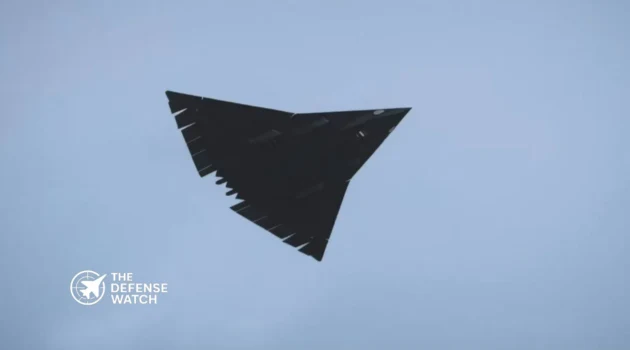
China’s new J-36 NGAD stealth fighters matter because they signal a shift in how major powers are trying to control future warfighting in the air and beyond. This program is part of a wider strategic competition between China and the United States over advanced military technology, force design, and regional influence.
What It Is
China’s J-36 Fighter
The J-36 is China’s emerging sixth-generation stealth fighter, developed by Chengdu Aircraft Corporation. Two prototypes have been seen flying together, a notable step in any advanced aircraft program and a sign that China is pushing ahead publicly with its next-generation jet effort.

It is large, has a tailless design and three engines, and aims to combine long range, stealth and heavy payload capacity. This places it closer in size and role to both heavy fighters and light bombers than to earlier fighters.
What NGAD Means
NGAD stands for Next Generation Air Dominance. In the United States it refers to a future system of systems that includes a sixth-generation manned fighter (often called F-47) and unmanned wingmen to maintain air superiority in high-end combat. China’s J-36 is sometimes compared to NGAD fighters, though it is a distinct program and not the U.S. system.
How It Works
Design and Features
The J-36’s tailless configuration, advanced shaping and stealth measures aim to reduce its radar and infrared signature, making it harder to detect. A three-engine layout gives it range and payload advantages, but also complexity and weight that might affect maneuverability.
Some reports suggest China added thrust-vectoring exhausts to improve control and agility.
Development Status
As of late 2025 the J-36 remains in prototype flight tests. It has not yet entered mass production or service. Analysts see its development as still early relative to the long road toward operational capability.
Why It Matters
Comparison to U.S. Programs
The U.S. NGAD effort seeks to replace or succeed current fifth-generation fighters with a mix of manned and unmanned systems. The planned NGAD fighter (often called F-47) focuses on stealth, advanced sensors, networking and drone control.
China’s J-36 design appears larger and oriented toward range and payload, which can aid strike missions and long-distance air superiority roles. It differs from U.S. plans that emphasize smaller, highly stealthy jets integrated with unmanned systems.
Strategic Competition
China’s push to field advanced aircraft reflects its broader goal to challenge U.S. airpower and influence in the Indo-Pacific and beyond. An operational sixth-generation fighter could reshape deterrence calculations and regional balance.

For the United States and allies, China’s progress adds pressure to maintain investment in future air dominance systems. U.S. Air Force leaders have publicly noted that Chinese sixth-gen development underscores the need to keep NGAD and related programs on track.
Known Unknowns and Speculation
What We Don’t Know
Public details on the J-36’s sensors, avionics, engine performance and stealth effectiveness are limited. Much of the technical picture remains speculation based on flight images and outside analysis.
There is also uncertainty about production timelines and how quickly China could field an operational force. Estimates range widely and are influenced by political and industrial priorities that are hard to verify independently.
Strategic Impact
The J-36 NGAD program is part of a broader trend where China seeks to match or exceed Western military capabilities. If successful, it could strengthen China’s deterrent posture, complicate U.S. planning in the Pacific and tilt regional calculations. For the U.S. and partners, this intensifies the need to sustain advanced aviation programs, deepen alliances, and invest in supporting technologies such as drones, sensors and integrated defenses.
Major actors will watch this development as both sides refine doctrines and force structures for high-end conflict scenarios in the coming decade.
Get real time update about this post category directly on your device, subscribe now.