

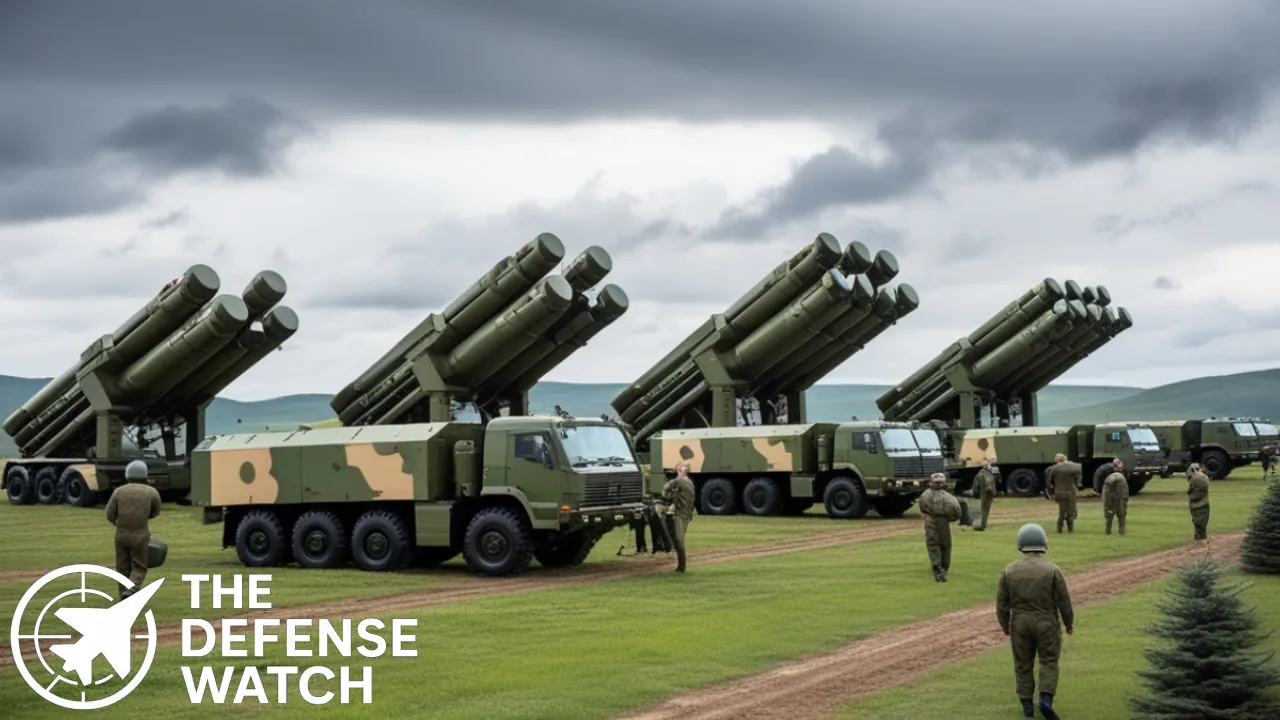
Russia’s layered IAD (Integrated Air Defense) has become one of the world’s most studied military architectures, combining the S-400, S-350, and S-500 into a unified, multi-tier air and missile defense network. Built to counter stealth aircraft, cruise missiles, drones, and ballistic threats, the system forms the backbone of Russia’s strategic air-defense posture from Kaliningrad to the Arctic.
This article examines how the integrated structure functions, how each layer contributes to Russia’s defensive doctrine, and what it means for regional security dynamics.
How Russia’s Layered IAD Works
Russia’s layered IAD is designed as a depth-based defense framework combining long-range, medium-range, and high-altitude intercept capabilities. These systems operate under a unified command-and-control architecture that links ground-based radars, airborne early-warning aircraft, electronic warfare units, and air-defense brigades.
Unlike single-system batteries used by many militaries, the Russian IAD is built around redundancy, overlap, and continuous coverage. Different missile systems are positioned so their engagement envelopes intersect, ensuring uninterrupted tracking and interception capability.
Key Components of the Multi-Tier Shield
- S-500 “Prometey”: High-altitude / exo-atmospheric interceptor
- S-400 “Triumf”: Long-range, multi-target engagement system
- S-350 “Vityaz”: Medium-range, high-capacity interceptor
Together, these systems allow Russia to cover distances from 10 km to 600 km, with tracking that extends far beyond weapon range.
The Role of the S-500: Russia’s Upper-Tier Shield
The S-500 Prometey sits at the top of Russia’s layered IAD, representing the next generation of missile defense. Its mission profile includes:
- Intercepting ballistic missiles in mid-course
- Countering hypersonic glide vehicles
- Engaging high-altitude reconnaissance targets
- Adding redundancy to nuclear missile defense units around Moscow
Though only deployed in limited numbers, Russian officials claim the S-500 can target objects at 600+ km and altitudes above 100 km, extending coverage into near-space.
Integration with A-135/A-235 Strategic Defense
The S-500 supplements existing Russian missile-defense networks around Moscow, functioning as a flexible, mobile complement to silo-based interceptors.
The S-400 Triumf: Long-Range Air and Missile Defense Backbone
Operating as the primary long-range layer, the S-400 defends critical facilities, airbases, and border regions.
Capabilities include:
- Engagement range: 250–400 km (with 40N6 missile)
- Ability to track up to 80 targets
- Engagement of low-observable aircraft including 5th-generation fighters
- Intercepting cruise missiles, UAVs, and tactical ballistic missiles
The S-400 forms the bulk of deployed Russian air-defense battalions, with coverage across:
- Kaliningrad and Crimea
- Moscow region
- Far East near Japan
- Arctic and Northwestern Russia
Operational Combat Experience
In Ukraine and Syria, the S-400 has demonstrated advanced tracking and long-range surveillance ability, though Russia rarely fires its most advanced missiles unless under direct attack.
The S-350 Vityaz: Russia’s New Medium-Range Workhorse
Introduced as a replacement for the aging S-300PS, the S-350 enhances Russia’s layered IAD with high-capacity interceptors suitable for modern saturation threats.
Key characteristics:
- Range: 60–120 km
- High missile load: up to 12–16 ready-to-fire missiles
- Optimized for intercepting drones, cruise missiles, and aircraft
- Designed to counter Western stand-off weapons like JASSM and Storm Shadow
The S-350’s active-radar missiles and automated fire-control make it a key layer between point defense systems (Pantsir-S1) and long-range interceptors (S-400).
How the Multi-Tier Structure Works Together
Long-Range Detection and Targeting
Russia’s radar network, including Nebo-M and Gamma series radars, feeds targeting data to all missile units. Persistent early-warning capability enables:
- Long-range tracking of NATO aircraft
- Identification of stealth aircraft using multi-band systems
- Fusion of data from air, ground, and space sensors
Overlapping Engagement Zones
Each system covers the weaknesses of another:
- S-500 intercepts high-altitude ballistic and strategic threats
- S-400 engages high-value aircraft before reaching launch zones
- S-350 counters mass raids, drones, and cruise missiles
This redundancy ensures resilience even if one layer is degraded.
Electronic Warfare Integration
Russia integrates EW systems like Krasukha, Murmansk-BN, and Repellent to disrupt adversary satellites, GPS, datalinks, and aircraft radars—further enhancing the survivability of the IAD.
Defense Analysis: Implications for NATO and Regional Security
Russia’s layered IAD presents challenges for NATO force planning. Its capability to push surveillance and engagement envelopes hundreds of kilometers beyond Russian territory affects:
- Air-access planning
- Strike package design
- Suppression of Enemy Air Defenses (SEAD) requirements
- Regional basing and air corridor calculations
Western analysts estimate that penetrating Russia’s integrated air-defense zones may require:
- Stealth aircraft
- Long-range stand-off weapons
- Multi-domain EW and cyber support
- Coordinated suppression of radar and command nodes
The S-500’s claimed ability to target near-space assets, if validated, could further complicate strategic planning.
H3 — Limitations and Unknowns
Despite its sophistication, Russia’s IAD faces constraints:
- Limited number of S-500 units
- Vulnerability to coordinated saturation attacks
- Logistics strain in contested environments
- Potential radar and datalink vulnerabilities
Combat performance in Ukraine has also revealed inconsistencies in Russian air-defense coordination, although long-range strategic systems remain largely intact.
FAQs
What is Russia’s layered IAD?It is a multi-tier air-defense system integrating S-500, S-400, S-350, and shorter-range systems to create overlapping engagement zones.
How effective are Russia’s S-400 systems?The S-400 is considered one of the most capable long-range SAM systems, able to target aircraft, drones, and missiles at ranges up to 400 km.
Does Russia’s S-500 really counter hypersonic weapons?Russian officials claim it does, but independent verification is limited.
How does the S-350 improve Russia’s defense network?It provides high-capacity, medium-range coverage optimized for drones and cruise missiles, replacing older S-300 systems.
Which areas are most protected by the layered IAD?Moscow, Kaliningrad, Crimea, the Arctic region, and strategic airbases feature the densest coverage.



1 comment
[…] involvement highlights a growing European role in sustaining Ukraine’s layered air defense network as the conflict enters another year with no signs of […]