KEY FACTS AT A GLANCE
- Ukraine signed 10-year defense cooperation agreements with Saudi Arabia and Qatar during Zelenskyy’s Gulf tour; a similar UAE deal is pending finalization.
- Qatar’s defense agreement with Ukraine explicitly covers the exchange of expertise in countering missiles and unmanned aerial systems, along with joint defense industry and co-production arrangements.
- Ukraine has deployed more than 200 counter-drone specialists to five Gulf nations — UAE, Saudi Arabia, Qatar, Kuwait, and Jordan — to help blunt Iranian drone and missile strikes.
- Kyiv is proposing an exchange of its cost-effective drone interceptors for the far more expensive Patriot and THAAD missiles Gulf states are currently expending against Iranian attacks.
- The U.S.-Israeli war on Iran, which began February 28, 2026, has effectively shut the Strait of Hormuz and killed more than 2,000 people, triggering Iranian retaliatory strikes across the Gulf region.
Ukraine Expands Gulf Defense Partnerships as Drone Expertise Becomes a Strategic Asset
Ukraine’s defense cooperation agreements with Saudi Arabia, Qatar, and the UAE represent Kyiv’s effort to transform its hard-won battlefield experience into a strategic export — one that could help sustain its own war effort against Russia in return. The deals, formalized during an unannounced Gulf tour by President Volodymyr Zelenskyy, signal a significant shift in how Ukraine positions itself on the global stage: no longer solely a recipient of Western military aid, but a defense partner offering capabilities other nations urgently need.
The Big Picture
The U.S.-Israeli war on Iran, which erupted February 28, has upended global travel, sent oil prices soaring, and extended its economic fallout well beyond the region. Iran’s retaliatory strikes, which have targeted Gulf Arab states alongside Israel, have forced countries like Qatar, the UAE, Saudi Arabia, Kuwait, and Jordan to burn through their limited inventories of high-end interceptor missiles at an unsustainable rate.
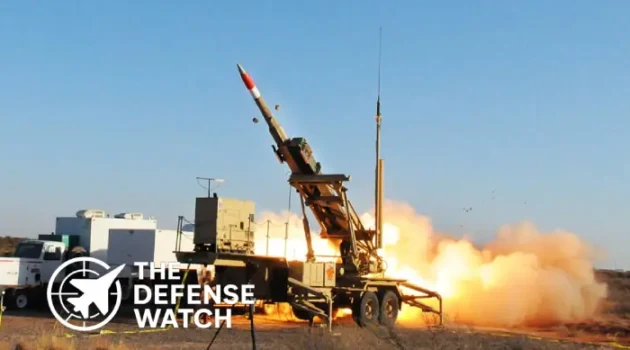
The Gulf states have been relying primarily on Patriot and THAAD missiles to down Iranian missiles and drones — systems that carry per-unit costs in the hundreds of thousands to millions of dollars. Iran has been firing Shahed drones at Gulf targets, the same platform Russia has used against Ukraine since at least September 2023, which Ukraine has been downing nearly every day.
That battlefield convergence created a strategic opening Kyiv moved quickly to exploit.
What’s Happening
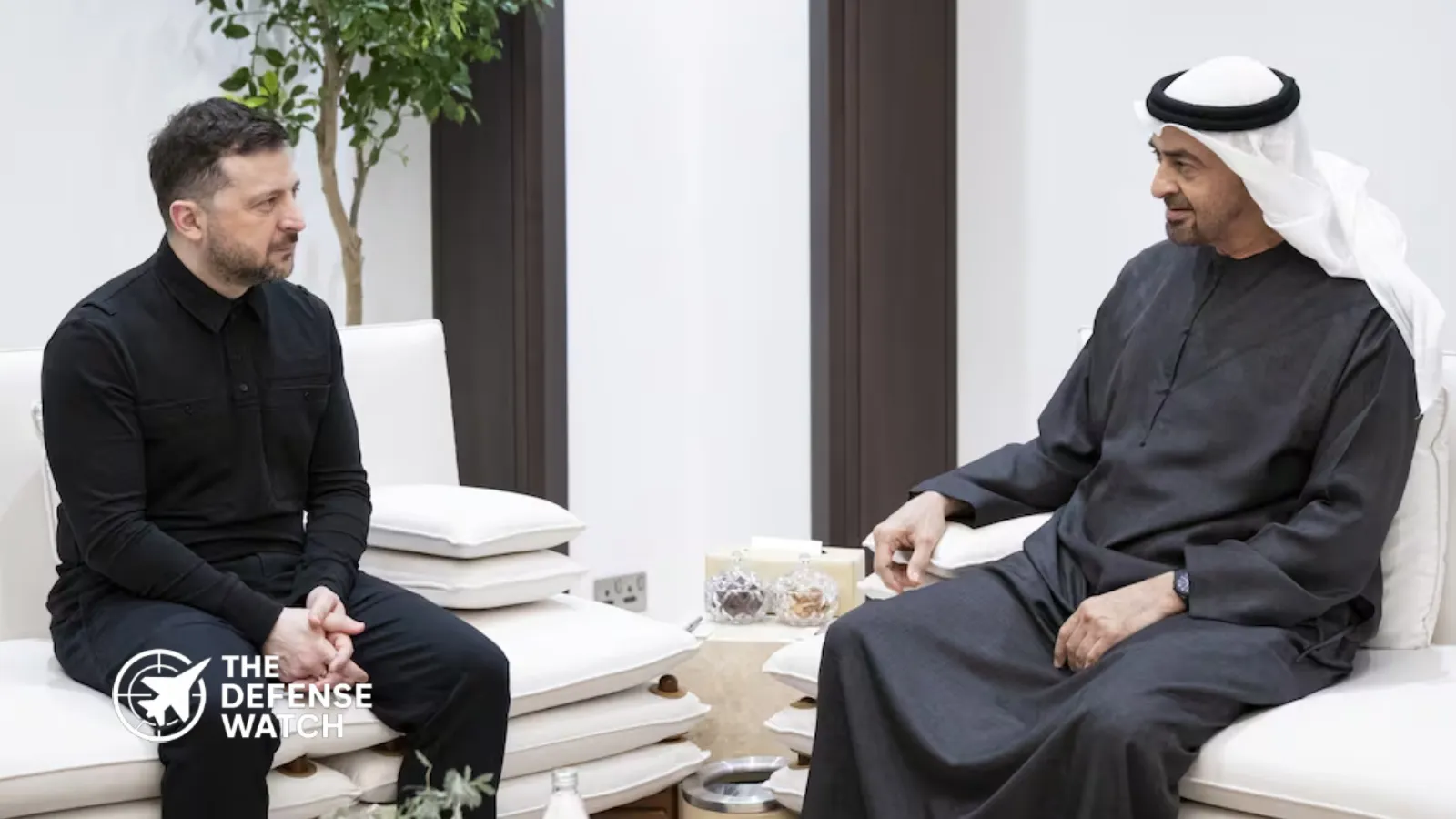
Zelenskyy made unannounced visits to the United Arab Emirates and Qatar on March 28, following a stop in Saudi Arabia on March 27, as Ukraine sought to use its drone expertise to help Gulf Arab states counter Iranian aerial attacks.
Ukraine has signed 10-year security agreements with Saudi Arabia and Qatar, and Zelenskyy said he expects to finalize a similar agreement with the UAE shortly.
Qatar’s defense agreement specifically covers the exchange of expertise in countering missiles and unmanned aerial systems, along with collaboration in technological fields and the development of joint investments. The agreement was signed by Qatari Armed Forces Lieutenant General Jassim bin Mohammed Al Mannai and Ukraine’s defense representative.
In the UAE, Zelenskyy met President Sheikh Mohammed bin Zayed Al Nahyan, with both countries agreeing to cooperate in the fields of security and defense.
The Qatar deal also involves joint defense industry projects, the establishment of co-production facilities, and technological partnerships between companies , Zelenskyy confirmed on X.
Why It Matters
Ukraine’s Gulf diplomacy accomplishes two objectives simultaneously. First, it establishes Kyiv as a credible defense partner for energy-rich states that previously had no meaningful security relationship with Eastern Europe. Second, it creates a transactional framework that could help Ukraine address one of its most critical wartime shortfalls: advanced air defense interceptors.
Zelenskyy told reporters that simple sales do not interest Ukraine — his government is seeking to build long-term strategic ties with Middle Eastern countries, including joint production, investment, energy cooperation, and the sharing of battlefield experience.
Ukraine has quickly grown into one of the world’s leading producers of cutting-edge, battle-tested drone interceptors that are cheap and effective, playing a key part in its defense against Russia’s invasion. That cost asymmetry is central to the deal’s appeal for Gulf partners spending enormous sums on legacy interceptor systems.
Ukraine is offering Gulf states a cheap way of countering Iranian drones — one that has been operationally validated in one of the most intense drone warfare environments in modern history.
Strategic Implications
The Ukraine-Gulf defense cooperation framework carries implications well beyond the immediate drone-for-missiles exchange.
For Ukraine, these agreements diversify its security relationships beyond the NATO sphere at a moment when the U.S.-Israeli conflict in Iran has consumed significant Western defense resources and attention. Zelenskyy’s comments followed weeks of speculation that the Iran war could detract attention from Ukraine, deplete Western arsenals, and force NATO allies to reduce military support for Kyiv. By securing independent partnerships with Gulf states, Kyiv partially hedges against that risk.
For the Gulf states, Ukraine’s offer presents a cost-efficient complement to existing high-end air defense infrastructure. Integrating Ukrainian-developed interceptor systems and operator expertise alongside Patriot and THAAD batteries creates a layered defense architecture — one where cheaper systems handle lower-tier drone threats, preserving expensive interceptors for ballistic and cruise missile engagements.
Ukraine has sent more than 200 of its drone-countering experts to the region, with some 30 more heading to Jordan and Kuwait. The deployment of specialists, not just hardware, suggests Ukraine is pursuing an advisory and training relationship that mirrors how Western nations structure security cooperation — building institutional dependency alongside capability transfer.
Zelenskyy also said Ukraine is looking into whether it can play a role in restoring security in the Strait of Hormuz, a statement that, if operationalized, would represent an unprecedented Ukrainian naval and security presence in a global maritime chokepoint.
Competitor View
Russia and Iran will view the Ukraine-Gulf agreements from different, but overlapping, angles of concern.
From Moscow’s perspective, Ukraine successfully monetizing its Russian-conflict experience — turning the very weapons Russia helped proliferate into a source of geopolitical leverage — represents a strategic embarrassment. Every Gulf security agreement Kyiv signs extends Ukraine’s international legitimacy and potentially generates resources that feed back into its war effort.
Russia is already benefiting from surging global energy prices brought on by damage to Gulf oil and gas infrastructure and Iran’s blockade of the Strait of Hormuz. A Ukraine that simultaneously profits from the same conflict by selling defense services to Gulf states partially offsets Moscow’s economic windfall — an outcome the Kremlin would prefer to prevent.
For Iran, Ukrainian counter-drone expertise deployed in the Gulf directly degrades the effectiveness of its primary asymmetric strike tool. Tehran’s use of Shahed-type drones — the same platform it supplied to Russia — created the very expertise now being used against it. That operational feedback loop represents a significant miscalculation in Iran’s long-term drone proliferation strategy.
What To Watch Next
Several milestones will determine whether these agreements translate into durable operational partnerships or remain primarily symbolic.
The UAE agreement remains to be formally signed. Zelenskyy said he expects to finalize a 10-year agreement with the UAE shortly, following the same structure as the Saudi and Qatari deals. Whether the UAE agreement includes co-production provisions similar to the Qatar deal will indicate the depth of the partnership.
The establishment of joint co-production facilities, referenced in the Qatar agreement, will be the longer-term indicator to watch. Ukraine producing drone interceptors on Gulf soil — or with Gulf investment — would represent a significant expansion of its defense industrial base beyond European borders.
The Ukrainian leader said he had received no signals from the U.S. about potential diversions of weapons funded by Kyiv’s European partners from Ukraine to the Middle East, a concern that remains alive given competing demands on Western defense stocks.
Capability Gap
Ukraine’s offer to Gulf states targets a genuine operational gap: the inability to cost-effectively engage large-scale drone swarm attacks with existing high-end interceptor systems.
Iran’s aerial campaign against Gulf neighbors has continued as Tehran retaliates for U.S.-Israeli strikes, generating a sustained attrition of interceptor stocks. Systems like Patriot PAC-3 and THAAD are engineered primarily for ballistic missile defense, not optimized for volume drone engagements, where the per-shot cost of the interceptor can dwarf the cost of the drone being destroyed.
Ukraine’s counter-drone model — built around electronic warfare, kinetic interceptors, trained operators, and integrated sensor networks — addresses exactly that cost-exchange problem. The limitation is scalability: deploying Ukrainian specialists and integrating Ukrainian systems into Gulf defense architectures takes time, and the Iranian threat is active now.
Ukraine also faces its own interceptor supply constraints. Trading systems abroad while simultaneously defending against near-daily Russian missile attacks requires careful inventory management that Kyiv has not fully detailed publicly.
The Bottom Line
Ukraine’s Gulf defense partnerships convert four years of brutal drone warfare experience into strategic currency — potentially yielding both the advanced air defense missiles Kyiv needs and a geopolitical footprint that extends its relevance well beyond the European theater.