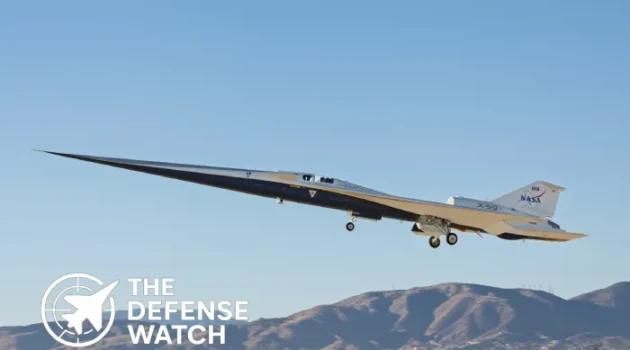
- ► NASA’s X-59 quiet supersonic aircraft completed engine run testing on March 12, 2026, at Armstrong Flight Research Center, Edwards, California — a critical final ground check before its second flight.
- ► Test pilot Jim “Clue” Less will fly the X-59 for its second flight, accompanied by NASA pilot Nils Larson in a chase F/A-18.
- ► The aircraft’s first flight took place on October 28, 2025 — followed by removal and reinstallation of the engine, lower empennage, cockpit seat, and more than 70 inspection panels.
- ► Second flight will begin envelope expansion, gradually progressing from 230 mph at 12,000 feet toward the X-59’s mission target of Mach 1.4 at 55,000 feet.
- ► The X-59 is the centerpiece of NASA’s Quesst mission, which aims to replace the traditional sonic boom with a quieter sonic “thump” and eventually open U.S. skies to commercial overland supersonic travel.
NASA’s X-59 Quiet Supersonic Aircraft Prepares for Second Flight, Targeting Mach 1.4
NASA’s X-59 quiet supersonic research aircraft is moving to its next major milestone: a second test flight that will launch the program into its critical envelope expansion phase. According to a NASA announcement published March 17, 2026, ground crews at Armstrong Flight Research Center in Edwards, California, completed engine run testing on March 12 — one of the final verification steps before the aircraft takes to the skies again.
The X-59, NASA’s flagship experimental platform under the agency’s Quesst mission, is designed to fly faster than the speed of sound while generating only a low-level sonic thump rather than a disruptive boom. If successful, the program could fundamentally reshape commercial aviation regulations, potentially reopening the door to overland supersonic passenger travel in the United States for the first time since the Concorde era.
A New Pilot Takes the Controls
NASA test pilot Jim “Clue” Less is set to fly the X-59 for its second sortie, marking his first time at the controls of an X-plane in his career. Less will take off and land at Edwards Air Force Base, operating out of the X-59’s home facility at Armstrong Flight Research Center.
“This will be the first time I’ve flown an X-plane,” Less said in the NASA release. “I think I’ll mostly be focused on getting the test cards done and getting them done correctly. It’ll probably sink in later that I was in the X-59.”
Flying in formation nearby will be Nils Larson — the pilot who made the X-59’s historic first flight on October 28, 2025 — operating a NASA F/A-18 aircraft in a chase and observation role. The structured crew pairing reflects the careful, data-driven methodology that defines the Quesst program. Each flight builds on the last, and no phase proceeds without meticulous review of what came before.
Post-First-Flight Maintenance: A Deep Dive
Following the October 2025 maiden flight, NASA and prime contractor Lockheed Martin undertook an extensive post-flight maintenance campaign. Technicians removed the X-59’s modified General Electric F414-GE-100 engine — the same powerplant used in the F/A-18 Super Hornet — along with a tail section known as the lower empennage, the cockpit seat, and more than 70 individual panels for thorough structural and systems inspections. All components have since been reinstalled and verified.

“These guys know what they’re doing,” Less said. “Nils trusted them for the first flight. I trust them for the second flight and every flight after that.”
Ray Castner, NASA’s X-59 lead propulsion engineer, described the March 12 engine run as an emotionally charged moment for the team. “It’s always exciting to see the X-59 come to life on the ground,” he said. For our team, it’s a moment to pause and appreciate how far this aircraft has come — and how close we are to pushing into the next phase of flight.
What Is Envelope Expansion — and Why Does It Matter?
The concept of “envelope expansion” is standard practice in experimental aircraft testing, but for the X-59 it carries outsized strategic significance. The term refers to the incremental, methodical process of pushing an aircraft progressively faster, higher, and through increasingly demanding flight conditions, verifying safety and performance at each step before advancing further.
For second flight, the X-59 will initially replicate a test condition from the first flight to confirm the aircraft behaves consistently after the maintenance interval. It will then advance to 260 mph at 20,000 feet — a modest but meaningful step beyond the first flight’s performance band.
“Second flight will look a lot like the first flight,” said Cathy Bahm, NASA’s Low Boom Flight Demonstrator project manager. We’ll start the flight at a test condition from first flight to ensure X-59 performs as expected after the maintenance phase, then we’ll start the envelope expansion by testing a little higher and faster.
The long-range mission parameters are ambitious: approximately 925 mph — or Mach 1.4 — at 55,000 feet. Getting there will require dozens of incremental test flights over the coming months, each one carefully analyzed before the next is authorized.
“From here on out, once we’re airborne, we can increase speed and increase altitude in small, measured chunks,” Less explained. Eventually we get to supersonic flight — a few more steps — and we’re out to Mach 1.4 at about 55,000 feet.
The Three Phases of Quesst: A Mission Roadmap
The broader Quesst mission is structured around three sequential phases, and the X-59’s current work represents only the first.
Phase 1 — Envelope Expansion: The ongoing series of test flights at Armstrong, gradually pushing the X-59 to its design limits while gathering performance and systems data.
Phase 2 — Acoustics Validation: Once envelope expansion is complete, engineers will closely examine how the X-59’s unique airframe design — including its elongated, carefully sculpted nose — disperses shockwaves. The goal is to confirm that these shockwaves do not merge into a conventional sonic boom, but instead produce only the intended low-level sound signature.
Phase 3 — Community Overflight Studies: In the program’s most consequential phase, NASA plans to fly the X-59 over selected U.S. communities at supersonic speed. Residents will be surveyed on how they perceive the aircraft’s quieter sound, and that data will be shared with aviation regulators — both domestic (the FAA) and international (ICAO) — to inform potential revisions to rules that have banned overland supersonic commercial flight since 1973.
Analysis: Why the X-59 Program Has Implications Far Beyond Aerospace Research
On the surface, the X-59 looks like a classic NASA research program — incremental, patient, and methodical. But its strategic implications reach well beyond the walls of Armstrong Flight Research Center.
The commercial supersonic aviation market is attracting significant private investment. Companies such as Boom Supersonic, with its Overture airliner concept, and smaller startups are betting that regulatory barriers to overland supersonic flight can eventually be removed. The X-59 is essentially the scientific and regulatory argument that makes that future possible — or blocks it. If the aircraft’s acoustic data convincingly demonstrates that supersonic flight can be made tolerable to communities below, it hands regulators the justification they need to modernize a rule set that has remained frozen since the Concorde era.
There is also a defense-industrial dimension worth noting. Lockheed Martin’s Skunk Works division — one of the most secretive and prestigious advanced aircraft development organizations in the world — built the X-59. The aerodynamic and propulsion innovations embedded in this airframe do not exist in isolation. Technologies validated through programs like the X-59 historically migrate into military applications, influencing next-generation high-speed aircraft design, advanced trainer concepts, and even the aerodynamic shaping of future strike platforms.
For the U.S. aerospace industry, the X-59 represents something larger than a single research aircraft. It is a proof of concept for American leadership in a domain — high-speed civil and military aviation — where competition from foreign programs is intensifying. The stakes of getting the science right are considerable.
Looking Ahead: A Busy 2026 for the X-59 Program
NASA has signaled that second flight is just the starting gun for an accelerating test schedule across 2026. As envelope expansion progresses and the program advances toward supersonic speeds, public and regulatory attention on the X-59 will grow accordingly. Each milestone will be watched closely — not only by aviation enthusiasts, but by airline executives, defense planners, and policymakers weighing the future of high-speed air travel.
For now, the immediate focus is straightforward: get the X-59 airborne for flight number two, execute the test cards correctly, and begin the careful, cumulative work of building toward Mach 1.4. If the aircraft performs as designed, the quiet boom of history may be just around the corner.
FAQs
What is NASA’s X-59 aircraft designed to do?The X-59 is an experimental supersonic aircraft built by Lockheed Martin’s Skunk Works for NASA. Its primary purpose is to demonstrate that a plane can fly faster than the speed of sound while producing only a quiet sonic “thump” rather than a disruptive boom, potentially enabling future overland commercial supersonic flight.
When did the X-59 make its first flight?The X-59 completed its maiden flight on October 28, 2025, piloted by NASA test pilot Nils Larson at Edwards Air Force Base, California.
What is envelope expansion and how does it apply to the X-59?Envelope expansion is the flight test process of incrementally pushing an aircraft to higher speeds and altitudes in measured steps to verify safety and performance. For the X-59, this means gradually working from its second-flight parameters toward the mission goal of Mach 1.4 at 55,000 feet.
What engine does the X-59 use?The X-59 is powered by a modified General Electric F414-GE-100 engine, the same engine family that powers the Boeing F/A-18 Super Hornet fighter jet.
What is NASA’s Quesst mission?Quesst (Quiet SuperSonic Technology) is the NASA mission built around the X-59. Its goal is to gather acoustic data on the aircraft’s reduced boom signature, ultimately sharing findings with U.S. and international aviation regulators to support potential changes to rules banning commercial supersonic flight over land.
Who will pilot the X-59 for its second flight?NASA test pilot Jim “Clue” Less will be at the controls for second flight, with Nils Larson observing from a NASA F/A-18 flying in formation nearby.