

Executive Summary:
NASA’s X-59 experimental aircraft has successfully reached Mach 1.4 and 55,000 feet during a June 12 test flight, achieving the exact operating conditions required for future community overflight campaigns. The milestone advances NASA’s Quesst mission, which seeks to demonstrate that supersonic aircraft can fly over land while generating a quiet sonic thump rather than a disruptive sonic boom, potentially reshaping future civil aviation regulations.
NASA’s X-59 Reaches Critical Mission Conditions Flight Milestone
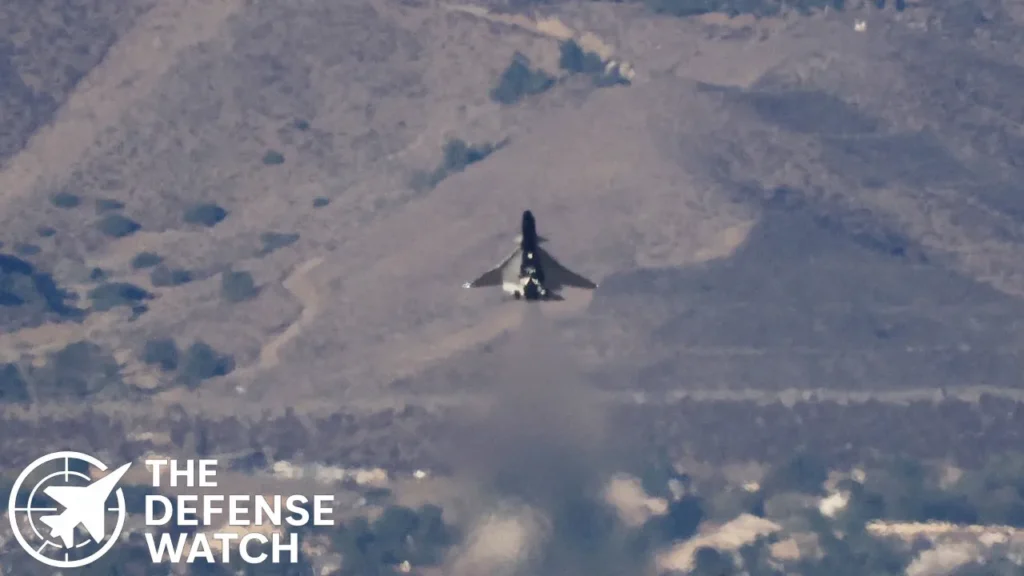
NASA’s X-59 quiet supersonic research aircraft has achieved a major program milestone by flying at Mach 1.4 and an altitude of 55,000 feet, the exact conditions planned for future community response testing under the agency’s Quesst mission. According to NASA, the achievement occurred during a June 12 flight test and represents the first time the aircraft has operated at its intended mission profile.
The milestone comes only days after the X-59 completed its first supersonic flight on June 5, when the aircraft exceeded the speed of sound for the first time by reaching approximately Mach 1.1 at 43,400 feet.
NASA officials describe the latest flight as more significant because it validates the aircraft’s ability to operate at the altitude and speed necessary for future community overflight demonstrations. Those demonstrations form the core objective of the Quesst program.
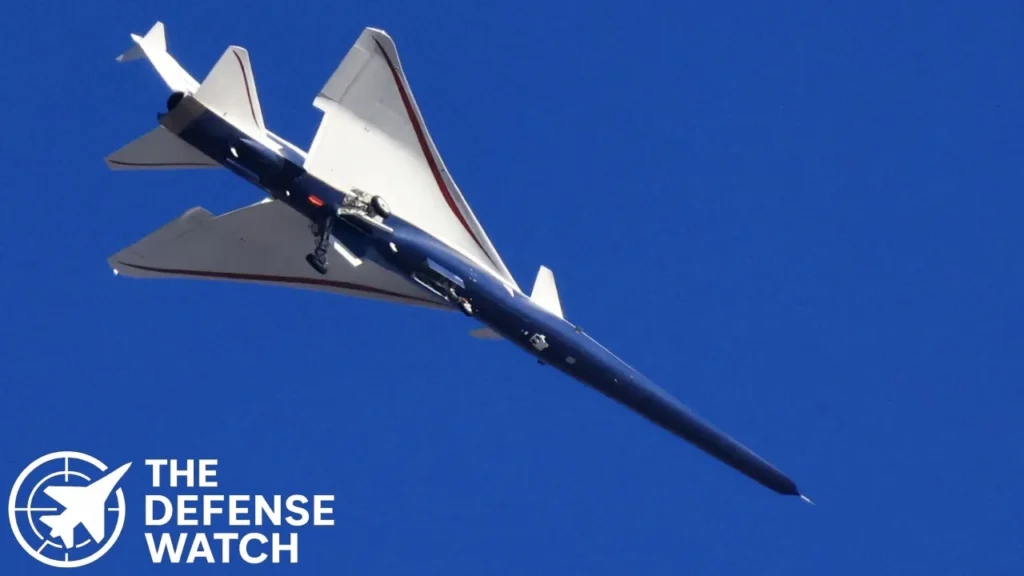
What Makes the X-59 Different?
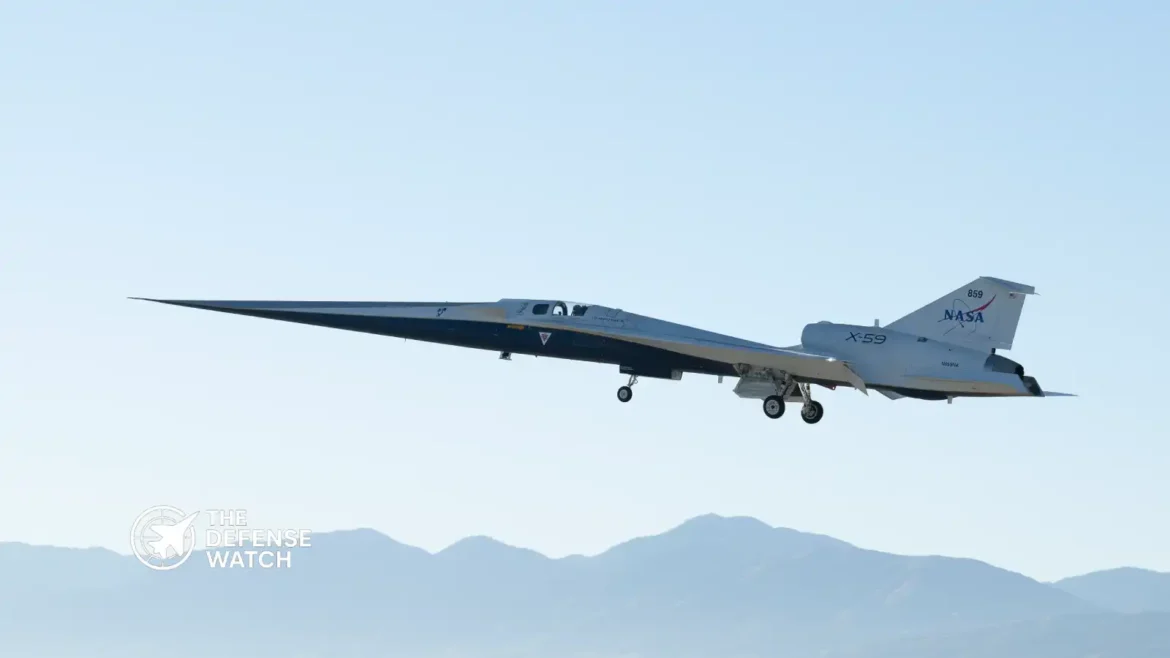
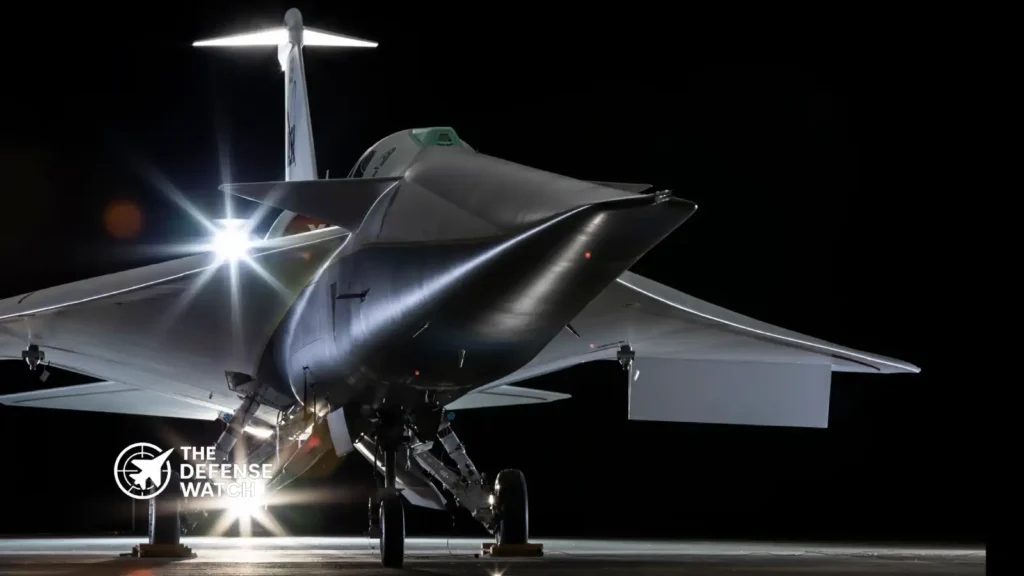
Unlike traditional supersonic aircraft such as the Concorde or military fighters, the X-59 was specifically engineered to minimize the shock waves that create loud sonic booms.
The aircraft features an unusually long and narrow nose, optimized fuselage shaping, and aerodynamic design elements intended to distribute pressure waves more evenly as the aircraft travels faster than sound. NASA’s objective is to transform the traditional sonic boom into a significantly quieter “sonic thump.”
Key X-59 specifications include:
Specification X-59 Maximum Test Speed Mach 1.4 Cruise Altitude 55,000 ft Length Nearly 100 ft Mission Quiet Supersonic Demonstrator Program NASA Quesst Prime Contractor Lockheed Martin Skunk Works The aircraft was developed by NASA in partnership with Lockheed Martin and serves as a flying laboratory rather than a prototype airliner. Its primary purpose is to collect scientific and acoustic data that regulators can use when evaluating future supersonic flight rules.
Community Overflights Are the Next Major Phase
NASA’s testing campaign remains focused on expanding the aircraft’s flight envelope and validating performance before acoustic testing begins.
The agency plans to conduct flights over multiple U.S. communities after the aircraft completes additional performance evaluations. During those flights, researchers will gather data on how people on the ground perceive the sound generated by the aircraft while operating at Mach 1.4 and 55,000 feet.
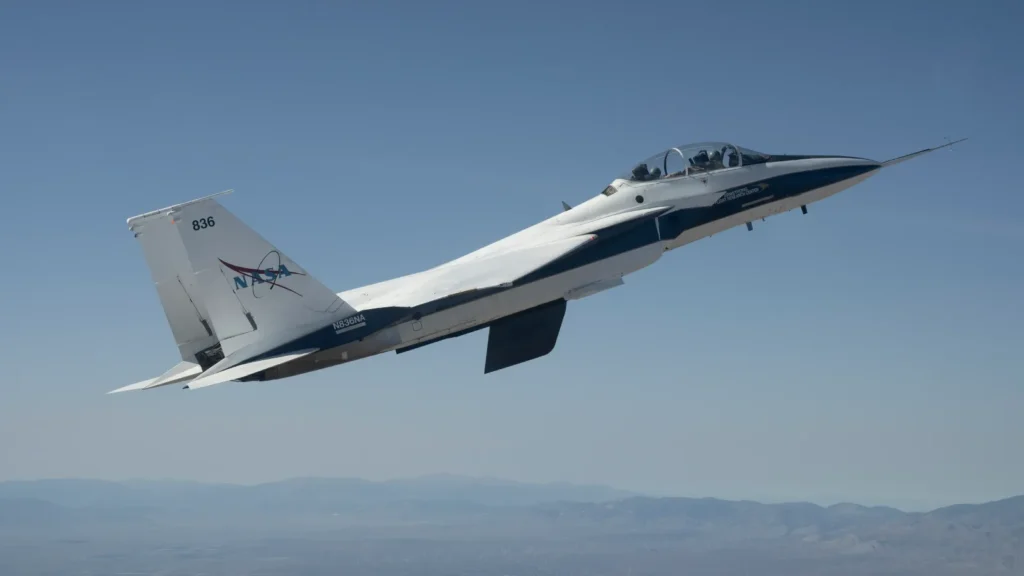
Interestingly, NASA has not yet verified the aircraft’s actual low-boom performance during recent supersonic flights. The X-59 has been accompanied by a NASA F-15 chase aircraft whose conventional sonic booms intentionally mask any sound generated by the experimental jet during early flight testing. Acoustic validation will occur during later testing phases.
Why the Program Matters for Future Aviation
The X-59 is attempting to address a regulatory challenge that has limited commercial supersonic travel for decades.
In 1973, U.S. regulators effectively prohibited routine civilian supersonic flight over land because traditional sonic booms created significant noise disturbances for communities below. That restriction remains a major barrier to the development of next-generation supersonic passenger aircraft.

Image : NASA NASA’s strategy is not to build a commercial airliner itself. Instead, the agency aims to generate scientifically validated acoustic data that could help regulators establish future noise-based standards for overland supersonic operations. The collected information will be shared with U.S. and international aviation authorities.
If successful, the effort could enable a new generation of commercial aircraft capable of dramatically reducing travel times on domestic and international routes while remaining acceptable to communities beneath flight paths.
Defense and Aerospace Implications
While the Quesst mission is fundamentally a civil aviation research effort, the technologies being evaluated have broader aerospace significance.
Low-boom aerodynamic shaping, advanced computational modeling, and high-speed flight control techniques could inform future military aircraft design. Reduced acoustic signatures during supersonic operations may offer operational advantages for reconnaissance, rapid response, and long-range strike platforms where minimizing detectability remains important.
-
The program also demonstrates continued U.S. leadership in experimental aerospace development through the use of X-plane research aircraft. Historically, X-plane programs have served as technology incubators for capabilities that later transitioned into operational military and civilian aviation systems.
From a strategic perspective, the X-59 represents one of the most ambitious efforts since the retirement of the Concorde to address the fundamental noise challenge that has constrained supersonic transportation for more than half a century.
Technical Challenges Still Ahead
Despite the recent milestone, the program remains in a test and validation phase.
NASA officials note that months of additional performance testing remain before the aircraft begins its community overflight campaign. Engineers must continue validating handling qualities, flight stability, and acoustic performance across a range of operating conditions.
The next critical objective will be confirming that the aircraft’s unique design consistently produces the predicted low-noise signature under real-world atmospheric conditions. Success in that phase will determine whether the collected data can support future regulatory changes governing overland supersonic flight.
-
What Is a Sonic Boom, and Why Does It Matter for Military Aviation?
A sonic boom is one of the most dramatic byproducts of modern air power — a thunderclap produced not by weather, but by the raw physics of supersonic flight. A sonic boom is an impulsive noise caused by an object moving faster than sound, which travels at approximately 750 miles per hour at sea level. The phenomenon has shaped U.S. Air Force doctrine, civilian airspace law, and now, the trajectory of a new generation of aerospace technology designed to tame it.
For defense analysts and aviation professionals alike, understanding how sonic booms are generated, regulated, and potentially neutralized has become increasingly relevant in 2026 — as both military trainers and commercial developers push the boundaries of supersonic operations over populated land.
- A sonic boom is produced when any aircraft exceeds approximately 750 miles per hour at sea level — roughly the speed of sound.
- The U.S. Air Force has conducted supersonic test flights since 1947, and most of its fighter aircraft are supersonic-capable today.
- Peak sonic boom overpressure for typical fighter aircraft ranges from less than 1 to about 10 pounds per square foot under normal flight conditions.
- NASA’s X-59 QueSST demonstrator completed its maiden flight on October 28, 2025, targeting a reduced “sonic thump” instead of a full boom.
- Community overland supersonic acceptance flights by NASA are planned for 2026, with regulatory data submissions expected by 2028.
The Physics Behind the Boom
To grasp why a sonic boom happens, it helps to understand how aircraft interact with the air around them. An aircraft traveling through the atmosphere continuously produces air-pressure waves similar to the water waves caused by a ship’s bow. When the aircraft exceeds the speed of sound, these pressure waves combine and form shock waves which travel forward from the generation or “release” point.
The result on the ground is not a single bang, but rather a sustained pressure event that moves with the aircraft. As an aircraft flies at supersonic speeds it is continually generating shock waves, dropping sonic boom along its flight path, similar to someone dropping objects from a moving vehicle.
Two distinct waveform types determine how a boom manifests. The N-wave is generated from steady flight conditions, and its pressure wave is shaped like the letter “N,” with a front shock rising to positive peak overpressure followed by a linear decrease until the rear shock returns to ambient pressure. The U-wave, or focused boom, is generated from maneuvering flights, and its pressure wave is shaped like the letter “U,” with positive shocks at both the front and rear of the boom where peak overpressures are amplified compared to the N-wave.
In practical terms, maneuvers matter enormously. Pilots and mission planners must account for how aircraft movements alter a boom’s ground footprint and intensity.
How Strong Can a Sonic Boom Get?
The intensity of a sonic boom varies widely depending on aircraft size, altitude, speed, and flight maneuvers. For today’s supersonic aircraft in normal operating conditions, the peak overpressure varies from less than one pound to about 10 pounds per square foot for an N-wave boom. Peak overpressures for U-waves are amplified two to five times the N-wave, but this amplified overpressure impacts only a very small area.
Historical data points to some remarkable extremes. The strongest sonic boom ever recorded was 144 pounds per square foot, produced by an F-4 flying just above the speed of sound at an altitude of 100 feet — yet it did not cause injury to the researchers exposed to it.
Under more operationally realistic scenarios, the maximum boom measured was 21 pounds per square foot. Buildings in good repair should suffer no damage from pressures below 16 pounds per square foot, and community exposure to sonic boom typically stays below two pounds per square foot.
Image : NASA These figures matter greatly for airspace planning. The difference between a training route that keeps a fighter at 40,000 feet and one that permits lower supersonic operations can mean the difference between a faint distant rumble and cracked windows in homes below.
Altitude, Distance, and the Boom Carpet
One of the most operationally significant aspects of sonic boom behavior is how altitude affects its spread and intensity. In general, the greater an aircraft’s altitude, the lower the overpressure on the ground. Greater altitude also increases the boom’s lateral spread, exposing a wider area to the boom.
The scale of this spread is considerable. Ground width of the boom exposure area is approximately one mile for each 1,000 feet of altitude — meaning an aircraft flying supersonic at 30,000 feet will create a lateral boom spread of about 30 miles. For steady supersonic flight, the boom is described as a carpet boom since it moves with the aircraft as it maintains supersonic speed and altitude.
Weather and atmospheric conditions further complicate the picture. Under standard atmospheric conditions, air temperature decreases with increased altitude, which helps bend sound waves upward. For a boom to reach the ground, the aircraft’s speed relative to the ground must be greater than the speed of sound at ground level — for example, an aircraft must travel at least 750 miles per hour, or Mach 1.12, for a boom to be heard at the surface.
U.S. Air Force Supersonic Regulations: Balancing Combat Readiness and Public Impact
The U.S. Air Force has operated supersonic aircraft since Chuck Yeager broke the sound barrier in October 1947. That history carries significant regulatory weight. Air Force procedures require that, whenever possible, supersonic flights be conducted over open water, above 10,000 feet, and no closer than 15 miles from shore. Supersonic operations over land must be conducted above 30,000 feet or, when below 30,000 feet, in specially designated areas approved by Headquarters United States Air Force and the Federal Aviation Administration.
This regulatory architecture reflects a long-standing tension between the demands of realistic combat training and the rights of civilian communities beneath military flight corridors. Fighter pilots cannot fully prepare for high-speed engagements by flying subsonic training sorties; pushing through Mach 1 in realistic tactical scenarios is operationally essential. Yet the communities surrounding air bases and designated supersonic corridors bear the acoustic impact of that training.
The Air Force continues to expand its knowledge of sonic boom, with ongoing research specifically addressing modeling of boom generation and its impact on the environment — including people, domestic animals, wildlife, and structures. This research provides tools to mitigate disturbances through flight operations and land use planning.
NASA’s X-59: The Turning Point for Overland Supersonic Flight
The most consequential development in sonic boom science in years came in late 2025, when a purpose-built aircraft took to the skies specifically to answer a regulatory question: can supersonic flight over populated land ever be made acceptable?
The single-seat X-59, developed by Lockheed Martin Skunk Works in partnership with NASA, is designed to cruise faster than sound while producing a minimal sonic boom — reduced to what engineers describe as a “gentle thump.” The aircraft completed its first flight on October 28, 2025, flying from Palmdale, California to NASA’s Armstrong Flight Research Center at Edwards to verify basic handling and data systems.
The engineering behind this achievement is substantial. The X-59’s elongated nose, carefully shaped fuselage, and engine integration aim to reshape shock waves and reduce noise output to levels comparable to slamming a car door. The aircraft’s 38-foot nose cone and uniquely contoured fuselage prevent shock waves from merging into a disruptive sonic boom, resulting in a softer “sonic thump.”
The X-59 is designed to operate at speeds up to Mach 1.4 and altitudes around 55,000 feet. NASA estimates that community acceptance flights over selected U.S. cities will begin in 2026, and data will inform regulatory proposals by 2028. Aviation A2Z
The Regulatory and Commercial Stakes
The implications of the X-59 program extend far beyond the aerospace research community. For decades, a 1973 FAA rule has effectively banned civil supersonic flight over U.S. soil, a restriction that grounded Concorde from trans-continental routes and has since constrained every commercial supersonic ambition that followed.
The United States recently reversed its 50-year-old ban on supersonic aircraft flying over land — a development that creates the regulatory framework into which X-59 data will feed. If NASA’s acoustic measurements demonstrate that the X-59’s “sonic thump” falls within community-acceptable noise thresholds, the FAA and the International Civil Aviation Organization could revise standards that have been frozen since the Concorde era.
The commercial sector is watching closely. Looking ahead to 2026, supersonic travel appears poised to move from concept to reality once more, with NASA’s X-59 demonstrating that sonic booms can be tamed and Boom Supersonic proving that civil jets can break the sound barrier again. Boom Supersonic’s Overture airliner, which has secured orders from United Airlines, American Airlines, and Japan Airlines, targets service entry by 2029.
Analysis: Why This Matters for Defense Strategy and Airspace Policy
From a defense perspective, the convergence of military sonic boom research and commercial low-boom technology carries strategic weight that extends beyond noise ordinances.
First, quiet supersonic flight has direct implications for reconnaissance and rapid-response aircraft. A platform capable of operating at Mach 1.4 while generating a noise signature comparable to background levels fundamentally changes what an adversary’s acoustic detection systems can track. The X-59 program, while civilian in charter, is generating data that military planners and aircraft designers will closely monitor.
Second, the regulatory shift underway in U.S. airspace policy creates new operational flexibility for Air Force training. Designated supersonic corridors could expand if community noise thresholds are revised upward based on low-boom technology. Pilots could access realistic supersonic training environments closer to populated air bases — a meaningful readiness advantage.
Third, the broader revival of supersonic commercial aviation will inevitably blur the line between civil and military aerospace industrial capacity. Engine designs, materials science, and aerodynamic shaping developed for commercial supersonic programs will feed back into next-generation military platforms, compressing development timelines and potentially cutting costs for future advanced fighters and reconnaissance assets.
The sonic boom — for 78 years a blunt announcement of military air power — may soon become a whisper. And in that transformation lies some of the most consequential aerospace policy and technology competition of the coming decade.
FAQs
What causes a sonic boom?A sonic boom is caused when an aircraft exceeds the speed of sound — roughly 750 mph at sea level — generating combined shock waves that release a sudden pressure burst heard as a loud crack on the ground.
Can a sonic boom damage buildings?Structural damage is unlikely at typical community exposure levels below two pounds per square foot. Buildings in good condition can generally withstand pressures below 16 pounds per square foot without damage.
Why can’t civilian aircraft fly supersonic over the United States?A 1973 FAA rule banned civil supersonic overland flight due to sonic boom disturbances. The U.S. government recently reversed this restriction, opening the door for new supersonic aircraft — provided they meet updated noise standards.
What is the NASA X-59 aircraft?The X-59 QueSST is a research aircraft developed by Lockheed Martin Skunk Works and NASA designed to fly at Mach 1.4 while reducing its sonic signature to a quiet “thump.” Its first flight occurred on October 28, 2025. Data from the program will be used to propose new FAA and ICAO noise regulations.
How does altitude affect a sonic boom on the ground?Higher altitude reduces peak overpressure at ground level but increases the width of the area exposed to the boom. An aircraft at 30,000 feet produces a boom carpet approximately 30 miles wide.
What is the difference between an N-wave and a U-wave sonic boom?An N-wave is produced by steady supersonic flight and has a pressure profile shaped like the letter “N.” A U-wave results from maneuvers such as dives or turns and has amplified peak pressures at both the front and rear of the boom, though it affects a smaller area.
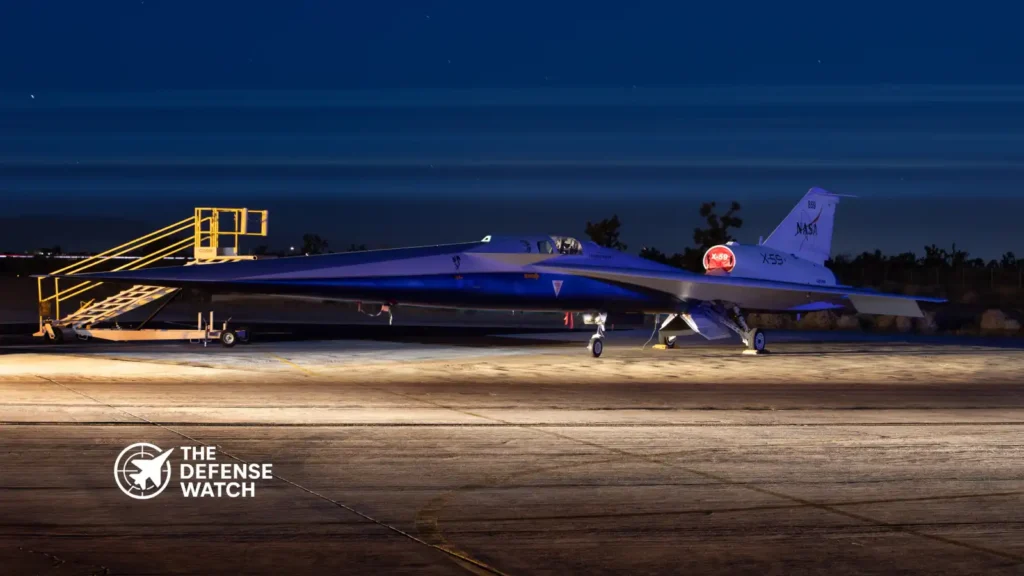

- ► NASA’s X-59 quiet supersonic aircraft completed engine run testing on March 12, 2026, at Armstrong Flight Research Center, Edwards, California — a critical final ground check before its second flight.
- ► Test pilot Jim “Clue” Less will fly the X-59 for its second flight, accompanied by NASA pilot Nils Larson in a chase F/A-18.
- ► The aircraft’s first flight took place on October 28, 2025 — followed by removal and reinstallation of the engine, lower empennage, cockpit seat, and more than 70 inspection panels.
- ► Second flight will begin envelope expansion, gradually progressing from 230 mph at 12,000 feet toward the X-59’s mission target of Mach 1.4 at 55,000 feet.
- ► The X-59 is the centerpiece of NASA’s Quesst mission, which aims to replace the traditional sonic boom with a quieter sonic “thump” and eventually open U.S. skies to commercial overland supersonic travel.
NASA’s X-59 Quiet Supersonic Aircraft Prepares for Second Flight, Targeting Mach 1.4
NASA’s X-59 quiet supersonic research aircraft is moving to its next major milestone: a second test flight that will launch the program into its critical envelope expansion phase. According to a NASA announcement published March 17, 2026, ground crews at Armstrong Flight Research Center in Edwards, California, completed engine run testing on March 12 — one of the final verification steps before the aircraft takes to the skies again.
The X-59, NASA’s flagship experimental platform under the agency’s Quesst mission, is designed to fly faster than the speed of sound while generating only a low-level sonic thump rather than a disruptive boom. If successful, the program could fundamentally reshape commercial aviation regulations, potentially reopening the door to overland supersonic passenger travel in the United States for the first time since the Concorde era.
A New Pilot Takes the Controls
NASA test pilot Jim “Clue” Less is set to fly the X-59 for its second sortie, marking his first time at the controls of an X-plane in his career. Less will take off and land at Edwards Air Force Base, operating out of the X-59’s home facility at Armstrong Flight Research Center.
“This will be the first time I’ve flown an X-plane,” Less said in the NASA release. “I think I’ll mostly be focused on getting the test cards done and getting them done correctly. It’ll probably sink in later that I was in the X-59.”
Flying in formation nearby will be Nils Larson — the pilot who made the X-59’s historic first flight on October 28, 2025 — operating a NASA F/A-18 aircraft in a chase and observation role. The structured crew pairing reflects the careful, data-driven methodology that defines the Quesst program. Each flight builds on the last, and no phase proceeds without meticulous review of what came before.
Post-First-Flight Maintenance: A Deep Dive
Following the October 2025 maiden flight, NASA and prime contractor Lockheed Martin undertook an extensive post-flight maintenance campaign. Technicians removed the X-59’s modified General Electric F414-GE-100 engine — the same powerplant used in the F/A-18 Super Hornet — along with a tail section known as the lower empennage, the cockpit seat, and more than 70 individual panels for thorough structural and systems inspections. All components have since been reinstalled and verified.

“These guys know what they’re doing,” Less said. “Nils trusted them for the first flight. I trust them for the second flight and every flight after that.”
Ray Castner, NASA’s X-59 lead propulsion engineer, described the March 12 engine run as an emotionally charged moment for the team. “It’s always exciting to see the X-59 come to life on the ground,” he said. For our team, it’s a moment to pause and appreciate how far this aircraft has come — and how close we are to pushing into the next phase of flight.
What Is Envelope Expansion — and Why Does It Matter?
The concept of “envelope expansion” is standard practice in experimental aircraft testing, but for the X-59 it carries outsized strategic significance. The term refers to the incremental, methodical process of pushing an aircraft progressively faster, higher, and through increasingly demanding flight conditions, verifying safety and performance at each step before advancing further.
For second flight, the X-59 will initially replicate a test condition from the first flight to confirm the aircraft behaves consistently after the maintenance interval. It will then advance to 260 mph at 20,000 feet — a modest but meaningful step beyond the first flight’s performance band.
“Second flight will look a lot like the first flight,” said Cathy Bahm, NASA’s Low Boom Flight Demonstrator project manager. We’ll start the flight at a test condition from first flight to ensure X-59 performs as expected after the maintenance phase, then we’ll start the envelope expansion by testing a little higher and faster.
The long-range mission parameters are ambitious: approximately 925 mph — or Mach 1.4 — at 55,000 feet. Getting there will require dozens of incremental test flights over the coming months, each one carefully analyzed before the next is authorized.
“From here on out, once we’re airborne, we can increase speed and increase altitude in small, measured chunks,” Less explained. Eventually we get to supersonic flight — a few more steps — and we’re out to Mach 1.4 at about 55,000 feet.
The Three Phases of Quesst: A Mission Roadmap
The broader Quesst mission is structured around three sequential phases, and the X-59’s current work represents only the first.
Phase 1 — Envelope Expansion: The ongoing series of test flights at Armstrong, gradually pushing the X-59 to its design limits while gathering performance and systems data.
Phase 2 — Acoustics Validation: Once envelope expansion is complete, engineers will closely examine how the X-59’s unique airframe design — including its elongated, carefully sculpted nose — disperses shockwaves. The goal is to confirm that these shockwaves do not merge into a conventional sonic boom, but instead produce only the intended low-level sound signature.
Phase 3 — Community Overflight Studies: In the program’s most consequential phase, NASA plans to fly the X-59 over selected U.S. communities at supersonic speed. Residents will be surveyed on how they perceive the aircraft’s quieter sound, and that data will be shared with aviation regulators — both domestic (the FAA) and international (ICAO) — to inform potential revisions to rules that have banned overland supersonic commercial flight since 1973.
Analysis: Why the X-59 Program Has Implications Far Beyond Aerospace Research
On the surface, the X-59 looks like a classic NASA research program — incremental, patient, and methodical. But its strategic implications reach well beyond the walls of Armstrong Flight Research Center.
The commercial supersonic aviation market is attracting significant private investment. Companies such as Boom Supersonic, with its Overture airliner concept, and smaller startups are betting that regulatory barriers to overland supersonic flight can eventually be removed. The X-59 is essentially the scientific and regulatory argument that makes that future possible — or blocks it. If the aircraft’s acoustic data convincingly demonstrates that supersonic flight can be made tolerable to communities below, it hands regulators the justification they need to modernize a rule set that has remained frozen since the Concorde era.
There is also a defense-industrial dimension worth noting. Lockheed Martin’s Skunk Works division — one of the most secretive and prestigious advanced aircraft development organizations in the world — built the X-59. The aerodynamic and propulsion innovations embedded in this airframe do not exist in isolation. Technologies validated through programs like the X-59 historically migrate into military applications, influencing next-generation high-speed aircraft design, advanced trainer concepts, and even the aerodynamic shaping of future strike platforms.
For the U.S. aerospace industry, the X-59 represents something larger than a single research aircraft. It is a proof of concept for American leadership in a domain — high-speed civil and military aviation — where competition from foreign programs is intensifying. The stakes of getting the science right are considerable.
Looking Ahead: A Busy 2026 for the X-59 Program
NASA has signaled that second flight is just the starting gun for an accelerating test schedule across 2026. As envelope expansion progresses and the program advances toward supersonic speeds, public and regulatory attention on the X-59 will grow accordingly. Each milestone will be watched closely — not only by aviation enthusiasts, but by airline executives, defense planners, and policymakers weighing the future of high-speed air travel.
For now, the immediate focus is straightforward: get the X-59 airborne for flight number two, execute the test cards correctly, and begin the careful, cumulative work of building toward Mach 1.4. If the aircraft performs as designed, the quiet boom of history may be just around the corner.
FAQs
What is NASA’s X-59 aircraft designed to do?The X-59 is an experimental supersonic aircraft built by Lockheed Martin’s Skunk Works for NASA. Its primary purpose is to demonstrate that a plane can fly faster than the speed of sound while producing only a quiet sonic “thump” rather than a disruptive boom, potentially enabling future overland commercial supersonic flight.
When did the X-59 make its first flight?The X-59 completed its maiden flight on October 28, 2025, piloted by NASA test pilot Nils Larson at Edwards Air Force Base, California.
What is envelope expansion and how does it apply to the X-59?Envelope expansion is the flight test process of incrementally pushing an aircraft to higher speeds and altitudes in measured steps to verify safety and performance. For the X-59, this means gradually working from its second-flight parameters toward the mission goal of Mach 1.4 at 55,000 feet.
What engine does the X-59 use?The X-59 is powered by a modified General Electric F414-GE-100 engine, the same engine family that powers the Boeing F/A-18 Super Hornet fighter jet.
What is NASA’s Quesst mission?Quesst (Quiet SuperSonic Technology) is the NASA mission built around the X-59. Its goal is to gather acoustic data on the aircraft’s reduced boom signature, ultimately sharing findings with U.S. and international aviation regulators to support potential changes to rules banning commercial supersonic flight over land.
Who will pilot the X-59 for its second flight?NASA test pilot Jim “Clue” Less will be at the controls for second flight, with Nils Larson observing from a NASA F/A-18 flying in formation nearby.