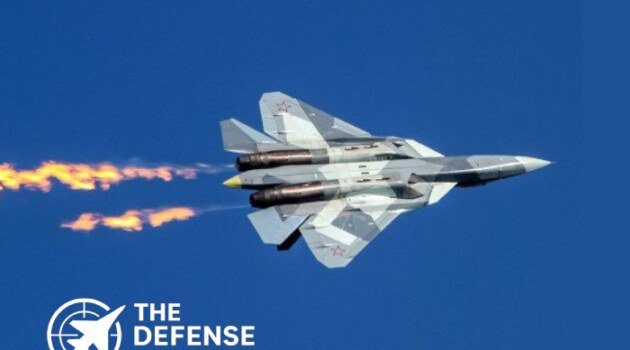
What Happened: Tejas Crashes During Dubai Airshow Performance
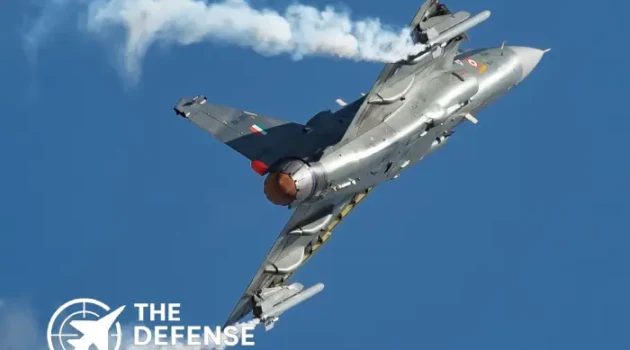
During a demonstration flight at the Dubai Airshow 2025, an Indian HAL Tejas light combat aircraft crashed, according to reports. The incident occurred at approximately 14:10 local time over Al Maktoum International Airport, where the biennial air show is being held.
Eyewitnesses at the event saw black smoke rising from the crash site, prompting emergency sirens and evacuation of nearby spectators. As of now, there is no confirmed information on whether the pilot ejected safely.
The Indian Air Force has acknowledged the crash.
Controversy: Oil Leak Claims Debunked by Indian MoD
Prior to the crash, social media circulated videos claiming that the Tejas Mk1 had suffered an oil leakage while ground-parked at the airshow.
India’s Ministry of Defence (MoD), via its Press Information Bureau (PIB) Fact Check unit, strongly refuted these claims. The MoD stated the fluid seen in the videos was condensed water, not oil, being intentionally drained from the Tejas’ Environmental Control System (ECS) and On-Board Oxygen Generating System (OBOGS) — normal procedures in high-humidity environments like Dubai.
According to the PIB, the leaking narrative was “deliberately pushed … to undermine the fighter’s proven technical reliability.”
Dubai Airshow 2025: Strategic Showcase for India
The Dubai Airshow is one of the world’s premier aerospace trade fairs, held biennially at Al Maktoum Airport. Wikipedia Billed as a high-profile platform, the 2025 event spans November 17–21 and attracts major global aerospace and defense players.
India’s participation has been particularly ambitious. Alongside the Tejas, the Suryakiran Aerobatic Team has flown displays, and India’s pavilion highlights capabilities from HAL, DRDO, and other firms in its push for defense exports and technological diplomacy.
Analysis: Implications for Defense, Diplomacy & Reputation
1. Operational Risks of Aerobatic Display Missions
Airshows inherently carry risk, especially when combat aircraft perform demonstration flights. The Tejas crash underscores how even mature platforms can face performance issues or pilot error in high-stress, low-margin environments.
For U.S. and allied defense observers, this incident may reinforce the value of thorough risk mitigation when deploying aircraft for public demonstrations. Lessons from this crash could influence how display teams structure their safety protocols, emergency ejection training, and pre-flight checks.
2. Strategic Setback for India’s Export Ambitions
India has been marketing the Tejas LCA to several international customers. A high-profile crash at a major global airshow could damage its reputation, potentially undermining confidence among potential buyers and partners. Given that part of India’s aerospace diplomacy strategy heavily relies on showcasing Tejas in such venues, this incident poses reputational risk.
3. Misinformation Challenges & Information Warfare
The rapid spread of “oil-leak” claims — and the MoD’s forceful rebuttal — highlights how disinformation and propaganda landscapes can directly affect defense narratives. For international defense analysts, the episode is a reminder: technical events can be manipulated as soft-power tools.
This incident also emphasizes the importance of official fact-check units (like PIB) in countering misinformation and protecting the credibility of defense platforms.
4. Impact on Global Aviation Safety Standards
Each crash at a major show tends to prompt scrutiny of safety standards across the event. Regulators and event organizers may respond by reviewing their risk frameworks, flight envelope rules for demonstration aircraft, and emergency response planning. The U.S. aerospace industry, deeply integrated in global airshow circuits, is likely to closely monitor the investigation’s outcome.
What’s Next: Investigation & Long-Term Impact
Investigation teams are already on the ground at Al Maktoum Airport. They will likely examine flight data recorders, maintenance logs, and airframe integrity to determine the cause of the crash.
If the cause turns out to be a technical malfunction, it could trigger redesign or retrofits. If pilot error or human factors are responsible, India’s air display protocols may undergo revisions.
From a bigger-picture perspective, the incident could slow Tejas’ export momentum — or spur reforms that make the platform more resilient. In either case, the fallout will be closely watched by international markets, including the U.S., as nations judge both the reliability and perceived stability of India’s aerospace sector.
Conclusion:
The crash of India’s HAL Tejas at Dubai Airshow 2025 is a sobering moment in what has otherwise been a showcase for India’s aerospace ambitions. Beyond immediate safety concerns, the incident raises deeper questions about the risk landscape for demonstration flights, the resilience of the Tejas program, and how nations manage defense reputations in the face of misinformation. As investigations proceed, the outcome could have lasting implications for India’s export strategy, airshow safety norms, and the credibility of one of its signature indigenous platforms.

Russia Puts Su-57E on Display in Dubai
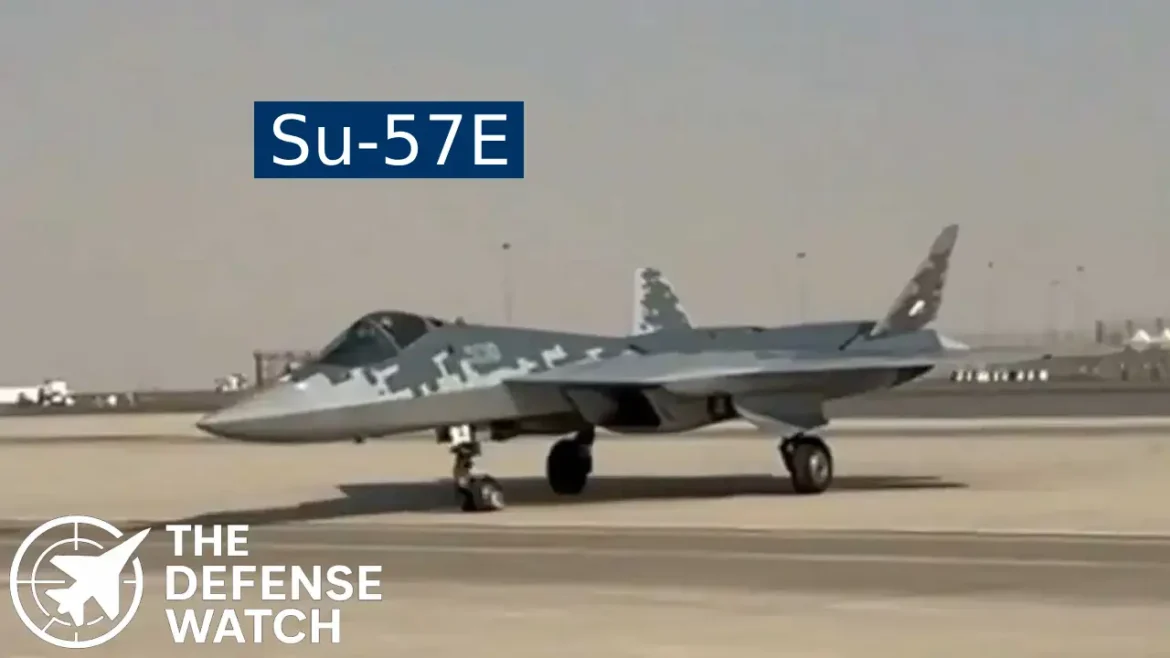
At the Dubai Airshow 2025, Russia publicly displayed its Su-57E, the export variant of the Su-57 fifth-generation fighter, for the first time in the Middle East. According to Russian defense authorities, the aircraft performed both static demonstration and flight displays — including high-angle-of-attack maneuvers, yaw rolls, and post-stall flight — to showcase its supermaneuverability and advanced thrust-vectoring capability.
Rosoboronexport and Sukhoi officials emphasized the Su-57E’s role as a multirole stealth platform suited for both air-to-air combat and strike missions.
What Makes the Su-57E Distinct
The Su-57E is tailored for export customers with certain cost optimizations, while retaining core performance traits: low observability, internal weapons bays, and a highly agile airframe.
Moscow has offered unprecedented technology transfer, including full access to the aircraft’s source code, allowing buyers to integrate their own avionics, mission computers, and weapons.
In a proposal to India, Russia has offered to produce the Su-57E locally at HAL’s Nashik facility, leveraging India’s ongoing Su-30MKI production lines.
India: A Key Target for Su-57E Sales
Russia’s outreach to India is especially ambitious. The offer includes:
- 20–30 Su-57E jets delivered off-the-shelf in the short term.
- Deep localization with 40–60% of the aircraft built in India.
- Full transfer of source code, enabling integration of Indian weapons such as the Astra air-to-air missile, Rudram anti-radiation missile, and Virupaksha AESA radar.
- Engine support: Russia has proposed supplying its AL-41F1S engine and, in the future, the newer Izdeliye-177S engine to India.
- An invitation for Indian Air Force test pilots to evaluate the Su-57E firsthand.
A recent technical assessment by a Russian delegation reportedly found that HAL already possesses around 50% of the capacity needed to produce Su-57 jets.
Export Track Record: Algeria First Customer
Algeria became the first confirmed export customer of the Su-57E, with deliveries expected in 2025. Reports suggest an initial batch of six aircraft, along with pilot training in Russia and support infrastructure.
Despite being offered at a lower price point than Western stealth fighters, the Su-57E has raised questions about sustainment, production scale, and long-term support — especially in the context of Russia’s strained defense-industrial base under sanctions.
Analysis: What This Means for U.S. Defense and Global Security
Challenging U.S. Dominance in Stealth Exports:
The Su-57E’s public debut in Dubai signals Russia’s renewed ambition to compete in the global fifth-generation market. Traditionally, stealth fighter exports have been dominated by U.S. aircraft such as the F-35. Offering source code access and deep technology transfer marks a departure from conventional Western export models, potentially appealing to countries that prioritize operational sovereignty.Strategic Implications in the Indo-Pacific:
Russia’s pitch to India reflects a long-term vision. If India accepts and co-produces the Su-57E, New Delhi could develop a homegrown stealth ecosystem, weakening U.S. leverage and shifting the regional defense balance. This comes amid India’s development of its own Advanced Medium Combat Aircraft (AMCA), and could act as an interim solution for India’s fifth-generation ambitions.Sustainment Risks and Geopolitical Constraints:
However, questions remain. Russia’s own Su-57 program has faced production delays, and sanctions could complicate parts supply and long-term maintenance for export customers. For Gulf buyers, embracing the Su-57E may offer cost-effective stealth, but it also ties them to a partner facing geopolitical and industrial headwinds. These aspects could limit broad adoption unless Russia proves it can reliably deliver and sustain the platform.Conclusion: Strategic Push and Watch for Buyers
Russia’s showcase of the Su-57E at the Dubai Airshow may mark a turning point in global stealth fighter exports. By combining attractive pricing, technology transfer, and export readiness, Moscow is staking out a position as a major competitor to traditional Western suppliers.
For buyers in the Middle East and Asia, the Su-57E represents a compelling, sovereign-rich path to fifth-generation combat capability. But the critical test ahead will be whether Russia can deliver on sustainment, production scale, and parts reliability under increasingly challenging geopolitical conditions.
As discussions deepen — especially with key potential buyers such as India — the Su-57E deal could reshape regional airpower dynamics and trigger a reassessment of long-term procurement strategies. For U.S. defense stakeholders, this underlines the need to sharpen competitive offerings and deepen alliances to counter Russia’s growing influence in the global stealth market.