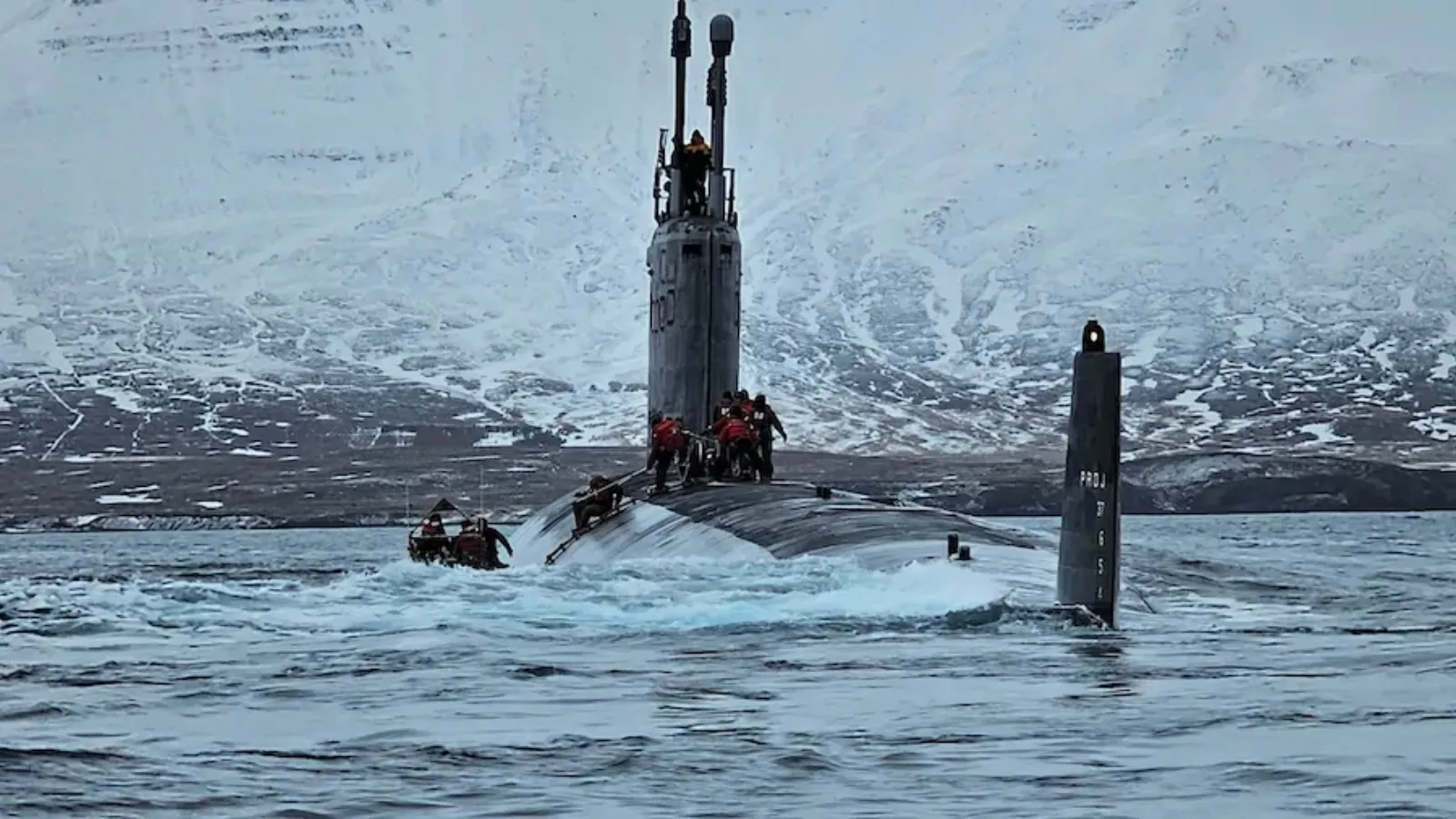
- The U.S. Navy launched Operation Ice Camp Boarfish in the Arctic Ocean on March 7, 2026.
- Fast attack submarines USS Delaware (SSN 791) and USS Santa Fe (SSN 763) are conducting under ice operational testing.
- The mission includes multinational participation and focuses on Arctic submarine warfare readiness.
- The three week operation is conducted from a temporary ice camp built on a drifting Arctic ice floe.
- Ice Camp Boarfish represents the 100th major U.S. submarine under ice evolution.
Operation Ice Camp Boarfish Begins In The Arctic
The US Navy Operation Ice Camp Boarfish has begun in the Arctic Ocean, bringing together submarines, allied personnel, and specialized Arctic research teams to test under ice operational capabilities. The mission officially started on March 7, 2026, following the construction of a temporary ice camp and the arrival of two U.S. Navy fast attack submarines, USS Delaware (SSN 791) and USS Santa Fe (SSN 763).
The three week operation focuses on research, training, and capability testing in one of the most demanding maritime environments on Earth. Personnel from the U.S. Navy, U.S. Marine Corps, and Air National Guard are participating alongside international partners from Australia, Canada, France, Japan, Norway, and the United Kingdom.
The mission operates from Ice Camp Boarfish, a temporary installation built on a drifting Arctic ice floe that serves as the command center for submarine operations, logistics, and research activities.
The Big Picture: The Arctic As A Strategic Maritime Domain
The Arctic has become a growing focus for global military planners. Climate change and receding sea ice are opening new shipping routes and expanding access to natural resources across the region.
U.S. defense planners increasingly view the Arctic as an operational theater where maritime traffic, resource exploration, and military presence will expand over the coming decades. Estimates suggest the Arctic may contain about 13 percent of the world’s undiscovered oil reserves and roughly 30 percent of undiscovered natural gas resources.
These developments have heightened strategic competition.
Russia maintains the largest military presence in the Arctic, with a network of bases, airfields, and ice capable naval forces across its northern coastline. China, though not an Arctic state, has also declared itself a “near Arctic power” and has expanded scientific research and polar shipping initiatives.
Against this backdrop, Operation Ice Camp Boarfish demonstrates Washington’s effort to maintain operational readiness in the region while reinforcing alliances with Arctic and NATO partners.
What’s Happening
Operation Ice Camp Boarfish centers on the deployment of two nuclear powered fast attack submarines:
- USS Delaware (SSN 791), a Virginia class submarine
- USS Santa Fe (SSN 763), a Los Angeles class submarine
During the operation, crews conduct a range of activities designed to test submarine systems in extreme Arctic conditions. These include navigation under polar ice, communication testing, sonar performance evaluation, and vertical surfacing through thick sea ice.
The camp itself consists of modular shelters, communications equipment, and operational infrastructure that allow personnel to coordinate submarine activities while operating on a constantly shifting sheet of ice.
The Arctic Submarine Laboratory, a specialized unit within the Navy’s Undersea Warfighting Development Center, leads the planning and execution of the operation. The organization serves as the Navy’s center of excellence for Arctic submarine operations.
Why It Matters
Arctic submarine operations pose unique technical and operational challenges.
Under the ice, submarines face a complex acoustic environment caused by the irregular underside of the ice canopy, which reflects sound and complicates sonar detection and navigation. Communication with forces above the surface can also become more difficult.
These factors make Arctic training essential for maintaining operational proficiency.
Submarines remain one of the few naval platforms capable of operating freely beneath the polar ice cap. This provides a significant strategic advantage, allowing covert movement, intelligence collection, and potential strike operations in areas where surface ships and aircraft have limited access.
Exercises like Operation Ice Camp Boarfish allow the U.S. Navy to refine tactics and technologies specifically designed for these conditions.
Strategic Implications
Operation Ice Camp Boarfish highlights the importance of undersea dominance in the evolving Arctic security environment.
Submarines play a central role in deterrence and intelligence gathering. By maintaining the ability to operate under ice, the U.S. Navy preserves freedom of maneuver across northern sea lanes and strengthens its strategic reach between the Atlantic and Pacific oceans.
The Arctic also offers shorter transit routes for submarines moving between major operational theaters. Control of these routes could prove critical during a future high end conflict.
From a NATO perspective, Arctic submarine proficiency also supports defense planning for northern Europe and the North Atlantic. Allied participation in the operation reflects a broader effort to build interoperability among Western naval forces in polar environments.
Competitor View
Russia closely monitors Western military activity in the Arctic.
Moscow has invested heavily in Arctic infrastructure, including upgraded airbases, radar networks, and naval facilities along the Northern Sea Route. Russian submarines routinely operate under the polar ice and are considered among the most capable Arctic naval forces.
China has also increased its Arctic research activities and maritime presence. While Beijing does not operate combat submarines in the Arctic today, its expanding polar strategy could eventually lead to a greater military role.
Exercises like Operation Ice Camp Boarfish therefore serve not only as training events but also as signals of U.S. commitment to maintaining access and operational capability in the Arctic domain.
What To Watch Next
Several developments will shape future Arctic naval operations.
First, the U.S. Navy continues to expand its Virginia class submarine fleet, including newer variants equipped with the Virginia Payload Module for increased strike capacity.
Second, NATO allies are increasing their Arctic training activities, particularly Norway, Canada, and the United Kingdom, which operate forces designed for cold weather operations.
Finally, the Navy is investing in technologies that improve under ice navigation, autonomous underwater systems, and Arctic communications networks.
These capabilities will likely play a key role in future iterations of Ice Camp operations.
Capability Gap
Operating under Arctic ice requires specialized training, navigation techniques, and equipment that differ significantly from standard submarine operations.
Without regular Arctic deployments, naval forces risk losing the institutional knowledge required to operate safely in the region. Ice Camp missions help maintain those skills while validating new systems designed for polar conditions.
However, logistical challenges remain significant. The Arctic’s extreme weather, limited infrastructure, and communications constraints complicate sustained operations.
As competition in the region increases, maintaining a consistent training presence will remain essential for closing these operational gaps.
Historical Context
The U.S. Navy has conducted submarine operations beneath the Arctic ice for more than six decades.
The first nuclear powered submarine to transit under the polar ice cap was USS Nautilus in 1958, followed by USS Skate, which became the first submarine to surface at the North Pole in 1959.
Earlier experiments also played a critical role. In 1947, the submarine USS Boarfish conducted pioneering under ice navigation tests during Operation Blue Nose, demonstrating that extended submarine operations beneath polar ice were feasible.
Operation Ice Camp Boarfish continues that legacy and marks the 100th major U.S. submarine under ice evolution conducted by the Navy.
The Bottom Line
Operation Ice Camp Boarfish reinforces the U.S. Navy’s ability to operate submarines under Arctic ice, a capability that remains essential for maintaining strategic deterrence and maritime access in a rapidly evolving polar region.
Get real time update about this post category directly on your device, subscribe now.