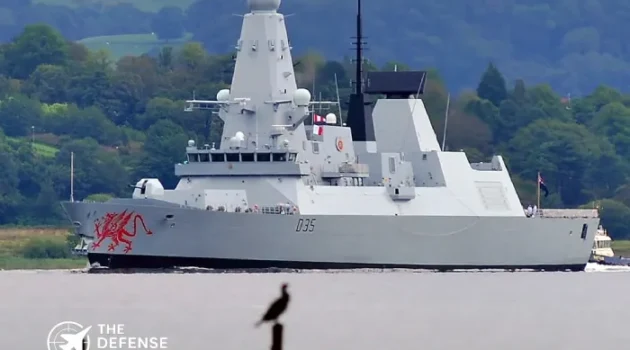
- DragonFire laser weapon is scheduled for Royal Navy deployment on a Type 45 destroyer in 2027.
- System developed by MBDA UK, Leonardo UK, QinetiQ, and DSTL under a national program.
- Designed to counter drones, mortar rounds, and other aerial threats using a high energy laser.
- Two major firing trials completed in 2025 support transition toward operational readiness.
- Represents one of Europe’s earliest naval directed energy weapon deployments.
Royal Navy DragonFire Laser Weapon Advances Toward 2027 Deployment
The Royal Navy DragonFire laser weapon is progressing toward operational deployment in 2027 aboard a Type 45 destroyer, marking a key milestone in the United Kingdom’s directed energy program. The system has completed multiple firing trials and is now transitioning from experimental validation to integration on a frontline warship.
The Ministry of Defence has reiterated that the program remains on track, with contracts awarded and system development continuing under an established timeline rather than a newly accelerated schedule.
The Big Picture
Naval forces worldwide are adapting to a changing threat environment shaped by the rapid growth of unmanned systems and low cost precision weapons. Drones, loitering munitions, and saturation attacks are increasingly challenging traditional shipborne defenses.
Directed energy weapons such as the DragonFire laser represent a shift toward scalable, cost efficient interception methods. Instead of relying solely on missile based defenses, navies are exploring layered systems that combine kinetic interceptors with high energy lasers.
For NATO members, this capability contributes to broader modernization goals focused on resilience, cost control, and sustained operations in contested maritime environments.
What’s Happening
The UK government confirmed that DragonFire remains on course for Royal Navy deployment in 2027 following a written parliamentary response from Defence Minister Lord Coaker. The statement emphasized continued commitment to development, testing, production, and integration of the system.
A contract for the first two DragonFire systems was awarded to MBDA UK in November 2025. The initial installation is planned for a Type 45 destroyer, a class already central to the Royal Navy’s air defense role.
Two major firing trials conducted in 2025 demonstrated the system’s ability to track and engage aerial targets. The trials took place at established UK test ranges, supporting confidence in the transition toward operational use.
DragonFire is developed by a consortium including MBDA UK, Leonardo UK, QinetiQ, and the Defence Science and Technology Laboratory, reflecting a multi industry approach to directed energy development.
Why It Matters
The DragonFire laser weapon introduces a fundamentally different engagement model compared to conventional naval interceptors. It uses a high energy laser in the 50 kilowatt class to engage targets at the speed of light, enabling rapid response against fast moving threats.
The system’s reported low cost per shot, estimated at around £10, significantly reduces the economic burden of defending against inexpensive threats such as drones or mortar rounds. This cost advantage is particularly relevant in scenarios involving repeated or massed attacks.
From an operational standpoint, the ability to engage multiple targets without expending physical munitions enhances a ship’s endurance during extended missions. This is especially important for deployed naval forces operating far from resupply lines.
The Royal Navy DragonFire laser also represents a step toward integrating directed energy into layered defense architectures, complementing existing missile and gun systems.
Strategic Implications
The introduction of the DragonFire system strengthens the Royal Navy’s defensive posture by adding a new engagement layer against aerial threats. It improves the survivability of high value naval assets such as destroyers and aircraft carriers.
As a directed energy system, it may reduce reliance on stored missile inventories during high tempo operations. This has implications for logistics planning and sustained naval presence in contested regions.
For NATO, the deployment supports collective defense objectives by contributing to shared technological advancement. It may also inform future allied programs focused on integrating laser weapons into multi domain operations.
At the strategic level, the system enhances deterrence by complicating adversary planning. Potential opponents must now account for an additional defensive layer capable of neutralizing certain classes of threats at low cost.
Competitor View
China has publicly demonstrated ship mounted laser technologies and continues to expand its directed energy research across naval and ground platforms. The United Kingdom’s deployment of DragonFire aligns with broader global competition in this domain.
Russia has also explored laser based systems, though operational deployment on naval platforms appears less mature. Both countries are likely monitoring Western progress in integrating such systems into frontline fleets.
Regional actors with access to low cost unmanned systems may reassess their tactics in light of the increasing availability of laser based defenses. Saturation strategies could evolve to account for both kinetic and directed energy intercept layers.
What To Watch Next
The next key milestone is the integration of DragonFire onto a Type 45 destroyer, scheduled for 2027. This will mark the system’s transition from testing environments to operational naval service.
Future developments may include expanded trials at sea, evaluation under varied environmental conditions, and potential upgrades in power output or tracking capabilities.
Additional procurement decisions could follow depending on performance outcomes, with possible expansion across multiple vessels in the Royal Navy fleet.
Capability Gap
The Royal Navy DragonFire laser addresses a growing gap in defending against low cost, high volume aerial threats. Conventional missile systems remain effective but are not optimized for sustained engagements against swarms or repeated attacks.
Laser weapons provide a complementary solution, but they are not without limitations. Their effectiveness depends on line of sight and can be reduced by adverse weather conditions such as fog, rain, or atmospheric distortion.
Power generation and thermal management also impose constraints on sustained firing rates. These factors require careful integration with ship systems to ensure consistent performance during operations.
The Bottom Line
The DragonFire laser weapon’s planned deployment marks a measured but significant step in integrating directed energy into Royal Navy surface combatant operations.
Get real time update about this post category directly on your device, subscribe now.