
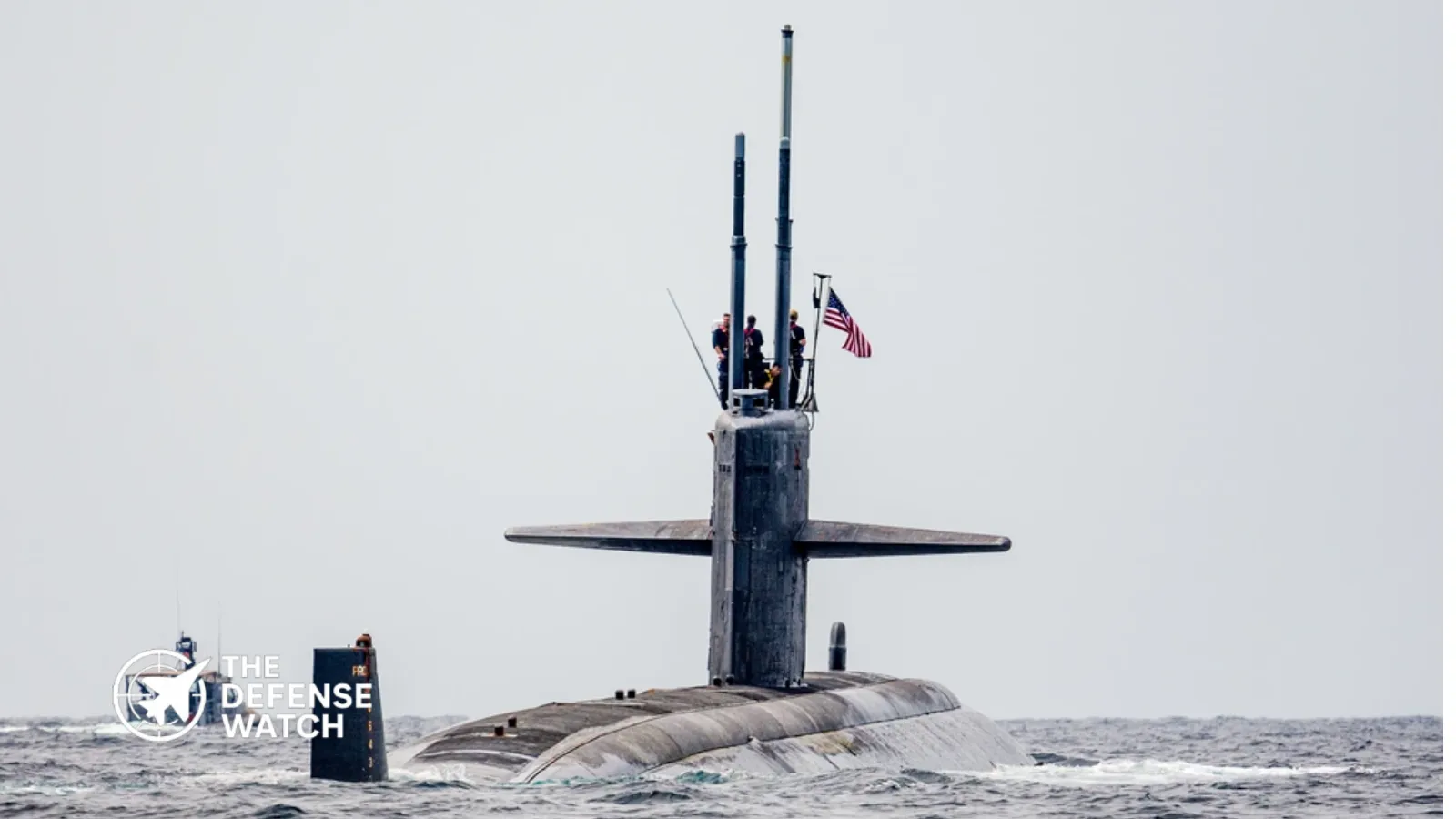
- ► Denmark evacuated a sailor from a U.S. Navy attack submarine operating off Greenland.
- ► The operation involved Danish Arctic response assets supporting a medical emergency.
- ► The U.S. attack submarine off Greenland was conducting operations in Arctic waters.
- ► The incident highlights close U.S.-Danish defense cooperation in the High North.
- ► Arctic submarine activity underscores growing strategic focus on Greenland and surrounding seas.
Denmark Evacuates Sailor From US Attack Submarine Off Greenland
Denmark evacuated a sailor from a US attack submarine off Greenland following a medical emergency, underscoring the operational realities of submarine deployments in the Arctic.
According to Danish Arctic Command, Danish authorities responded after the U.S. Navy requested assistance while the submarine was operating in waters near Greenland. The sailor required medical evacuation, prompting coordination between U.S. and Danish forces in a remote and challenging environment.
Danish Arctic response assets were dispatched to support the transfer. Details about the sailor’s condition and the specific submarine involved were not publicly disclosed, consistent with standard U.S. Navy operational security practices.
Arctic Operations And Allied Coordination
The presence of a US attack submarine off Greenland reflects sustained American naval activity in the High North. The U.S. Navy regularly deploys fast attack submarines to Arctic and sub-Arctic waters for training, deterrence, and strategic patrols.
Greenland remains a critical node in transatlantic defense. The United States maintains a military footprint at Pituffik Space Base, formerly known as Thule Air Base, supporting missile warning and space surveillance missions. Danish sovereignty over Greenland, combined with its NATO membership, makes Copenhagen a key partner in Arctic security.
Medical evacuations from submarines are complex even in temperate waters. In Arctic conditions, the risks increase. Sea state, ice coverage, limited infrastructure, and long distances to advanced medical facilities all complicate response efforts. That Denmark was able to assist a US attack submarine off Greenland highlights established contingency planning and interoperability between the two navies.
Strategic Context In The High North
The Arctic has taken on renewed strategic importance in recent years. Melting sea ice is expanding seasonal access, while competition among major powers has intensified. The United States has emphasized freedom of navigation, early warning, and undersea dominance as core elements of its Arctic posture.
Attack submarines play a central role in that posture. Their ability to operate undetected, gather intelligence, and project force makes them one of the most flexible assets in the U.S. naval inventory. Deployments near Greenland also place submarines along key maritime approaches between North America and Europe.
For Denmark, Arctic readiness is both a national and alliance obligation. The Danish Joint Arctic Command is responsible for search and rescue, maritime surveillance, and sovereignty enforcement around Greenland and the Faroe Islands. Supporting a US attack submarine off Greenland during a medical emergency fits squarely within that mandate.
Operational Transparency And Limits
Neither Danish officials nor the U.S. Navy released identifying details about the submarine, its mission, or its precise location. Such discretion is typical. Submarine movements are closely guarded to protect operational security and crew safety.
However, the public acknowledgment of Danish assistance signals confidence in allied cooperation. NATO members routinely support each other’s vessels in port visits, exercises, and emergencies. In the Arctic, where infrastructure is sparse, that cooperation becomes more visible.
The incident does not appear to have disrupted broader operations. Medical evacuations, while serious, are not uncommon during extended naval deployments. Submarine crews operate in confined spaces for prolonged periods, often far from immediate medical facilities.
Why This Matters
The evacuation from a US attack submarine off Greenland offers a practical example of how Arctic strategy translates into day to day operations. It is not only about deterrence or geopolitical signaling. It also involves logistics, emergency response, and trust between allies.
As Arctic maritime activity grows, so does the need for coordinated search and rescue and medical support frameworks. Denmark’s response demonstrates that those mechanisms are active and functional.
For the United States, continued submarine operations in the High North reinforce commitments to NATO and maintain undersea awareness in a region of increasing military interest. For Denmark, the mission highlights its role as a frontline Arctic ally.
In a region defined by distance and harsh conditions, cooperation remains a decisive factor.
Get real time update about this post category directly on your device, subscribe now.
