
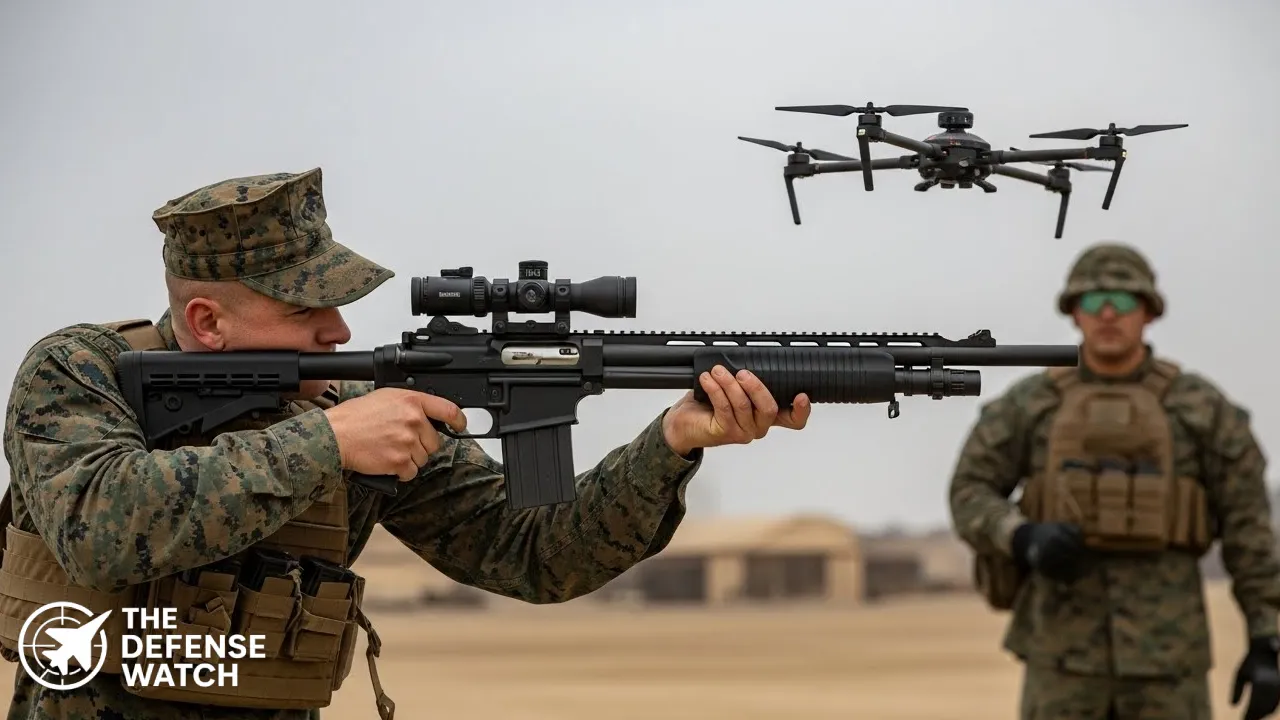
On December 2, 2025, at Camp Pendleton, U.S. Marines participating in Steel Knight 25 live-fired M1014 shotgun rounds at small, low-flying drone targets. The drill — designed to simulate fast, close-in aerial threats — is part of a growing effort to prepare frontline units for encounters with small unmanned aerial systems (sUAS) that evade traditional air-defense systems.
Officials present described the training as “hands-on” scenario work, aimed at building muscle memory and confidence among Marines who may face such threats in dispersed, urban, or forward-operating environments.
Why It Matters — Background
As drones proliferate on modern battlefields — from surveillance to low-cost loitering munitions — militaries worldwide face an evolving challenge: how to detect and defeat small, fast, low-signature threats that may slip past radar, jammers, or conventional air-defence.
In response, some armed forces have turned to a low-tech but effective solution: shotguns. The M1014, a 12-gauge semi-automatic combat shotgun originally adopted by the U.S. military in 1999, is especially suitable. Its auto-regulating gas-operated (ARGO) system cycles reliably across a variety of shells, and its compactness and ease of handling make it feasible for squad-level employment.
Shotguns loaded with buckshot or specialized frangible rounds present a wide spread of projectiles, increasing the likelihood of hitting small quadcopters or rotor-based drones — particularly when those drones operate at low altitude or in close proximity to friendly forces.
Given the rising use of sUAS for reconnaissance, target acquisition, or even explosive delivery, such close-range defensive options are becoming a practical necessity. For expeditionary or distributed operations, shotguns offer a flexible, portable, and immediately available layer in a broader counter-UAS (C-UAS) posture.
Details of the Training — How It Worked
Scenario & Engagement
During Steel Knight 25, Marines were tasked with visually detecting drone-representative targets, tracking their movement, and engaging them rapidly using the M1014’s semi-automatic fire. The emphasis was on fast reaction times, accurate leading (to account for drone movement), rapid shoulder transitions, and coordinated team firing — all skills critical when dealing with unpredictable aerial targets at close range.
The training used specialized ammunition: buckshot and frangible rounds — designed to spread pellets that can damage drone rotors, sensors, or frames. Thanks to the M1014’s 7+1 capacity and reliable gas-operated cycling, Marines could maintain rate of fire and recovery, even under stress.
Complementing Other C-UAS Efforts
Though shotguns fill a niche, they are not viewed as a standalone solution. The training aligns with a broader C-UAS strategy within the United States Marine Corps (USMC). Earlier in 2025, the service published its first doctrinal manual on small-UAS and counter-small-UAS integration.

Moreover, more capable systems remain in play. For example, the USMC is fielding the vehicle-mounted Marine Air Defense Integrated System (MADIS) to offer radar, jamming, and kinetic (30 mm cannon or missiles) coverage against drones — particularly those beyond shotgun range.
Nevertheless, shotguns offer a cost-effective, easily fielded fallback when other C-UAS layers are unavailable, or when drones approach rapidly at close range.
Global Context & Broader Adoption
The USMC is not alone in adopting shotgun-based counter-UAS tactics. The practice has gained traction in countries facing widespread drone threats — particularly for small, inexpensive FPV (first-person view) drones and quadcopters used for reconnaissance or explosive delivery.
For instance, forces in Europe, Ukraine, and other NATO members have fielded 12-gauge shotguns for short-range drone interception, often paired with handheld radars or visual spotters. At times, shotguns have proven effective in downing drones that electronic jammers, radars, or heavier air-defense systems failed to intercept.
In a recent case, the armed forces of Ukraine trained nearly 400 soldiers to shoot down FPV drones using shotguns — with success in certain field engagements, highlighting the method’s practical utility when more advanced systems are not available or overwhelmed.
Expert/Policy Perspective — What This Shift Reflects
Adaptation to a Changing Threat Environment
The decision by the USMC to integrate M1014 training reflects a growing recognition that modern battlefields — from Ukraine to the Middle East — are increasingly contested by low-cost, mass-produced drones rather than traditional air threats. In such an environment, layered C-UAS defence is becoming essential. Shotguns, with their simplicity and immediacy, offer an attractive — if imperfect — close-in solution.
As one military analyst observed, shotguns provide “a practical defensive tool that can be carried at the squad level, requires minimal electronics, and offers immediate lethality against small UAS that bypass sophisticated air-defense networks.”
Cost, Availability, and Speed of Adoption
High-end air-defence systems — radars, jammers, missile-based shooters — are expensive, logistically intensive, and not always available at the squad or platoon level. By contrast, shotguns like the M1014 are relatively inexpensive, widely fielded, and require minimal training beyond marksmanship and basic tactics.
This makes them suitable not only for frontline infantry, but also for base security details, vehicle crews, supply convoys, and other units that may lack organic air-defence assets — offering a democratized layer of C-UAS defence across the force.
Limitations — What Shotguns Cannot Do
However, experts caution against over-relying on shotguns. Their effective range remains limited — typically only tens of meters — and success depends heavily on visual detection, operator skill, and proximity of the target. Drones flying higher, faster, or from long range remain largely immune.
Furthermore, shotguns offer no electronic suppression, no radar tracking or intelligence fusion, and limited situational awareness. As such, they are best viewed as a complementary “last-line” tool — not a substitute for radar, jammers, or missile-based systems. The simultaneous adoption of systems like MADIS underscores the layered approach.
What to Watch — Implications & Next Steps
- Expect expansion of shotgun-based C-UAS training across more Marine units, particularly those engaged in expeditionary, urban, or distributed operations — where drone threats are likeliest.
- Monitor how ammunition stocks evolve: specialized frangible or drone-optimized rounds may increasingly supplement standard buckshot to enhance lethality and reduce collateral damage.
- Watch for doctrinal updates: The 2025 sUAS/C-UAS Integration Handbook suggests a broader shift in how the Marine Corps integrates small drones and counter-drone assets. Additional doctrine releases could define squad-level standard operating procedures (SOPs) for shotgun-based defense.
- Observe global practices: As other militaries continue to field shotguns, data on success rates, engagement conditions, and limitations will likely shape future C-UAS strategies and investments.
Conclusion
The US Marine Corps’ decision to train on M1014 shotguns during Steel Knight 25 marks a significant, pragmatic turn in its approach to countering small-drone threats. While not a silver-bullet solution, shotguns — already ubiquitous in infantry arsenals — offer a low-cost, immediately deployable layer for close-range drone defense.
In combination with radar, jamming, missile, and electronic warfare systems, shotgun-based C-UAS represents a flexible and adaptive response to a rapidly evolving aerial threat landscape.
As small drones become increasingly common across conflict zones worldwide, this shift toward layered, accessible, squad-level countermeasures may well become standard practice — not just for the Marines, but for ground forces globally.
Get real time update about this post category directly on your device, subscribe now.

2 comments
[…] deployment also serves as a command and control hub, enabling coordination between US Navy, US Marine Corps, and joint task force elements operating in the […]
[…] Brigadier General Matthew Ross, director of JIATF-401, said the award puts counter-small UAS capability “into the hands of our troops immediately,” providing a reliable interceptor that […]