
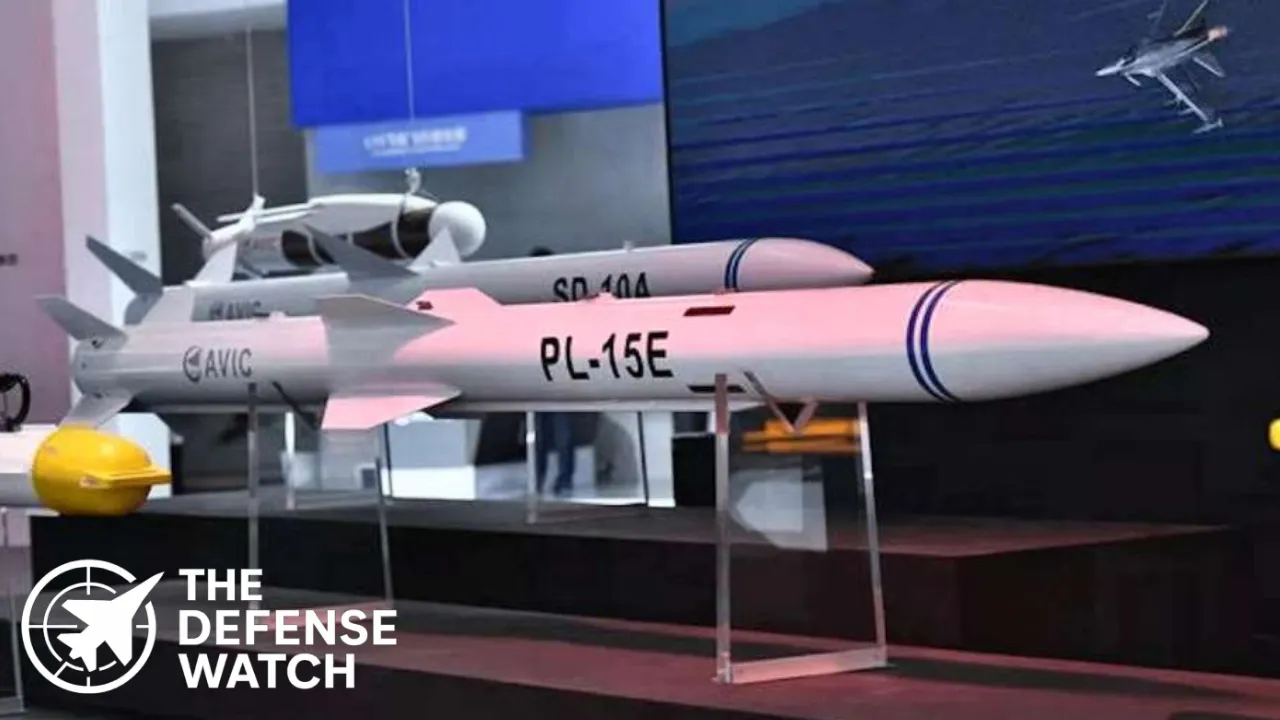
The PL‑15 (霹雳‑15, “Thunderbolt‑15”) is China’s premier long-range, beyond-visual-range air-to-air missile (BVRAAM), representing a crucial component in the People’s Liberation Army Air Force’s (PLAAF) modern air-combat architecture. Developed to extend China’s aerial engagement envelope and challenge high-value assets such as AWACS and tankers, the PL‑15 combines advanced propulsion, guidance, and warhead technologies. This article provides a detailed breakdown of its design, variants, deployment, and strategic implications.
Development History
- Origins and Development: The PL‑15 was developed by China’s 607 Air-to-Air Missile Research Institute, a key organization under the Aviation Industry Corporation of China (AVIC). According to multiple sources, its development began in the late 2000s, with public appearances in airshows around 2015.
- Service Entry: The missile is believed to have entered service with the PLAAF between 2016 and 2018, arming front-line aircraft such as the J-10C, J-16, and the stealth J-20.
- Manufacturing Process: In 2023, China revealed details of its production process, including efforts to produce variants with folding control surfaces — potentially to increase internal carriage capacity on stealth aircraft.
Design & Technical Characteristics
Propulsion
- The PL‑15 is powered by a dual-pulse solid-fuel rocket motor, which gives it a significant boost in performance. After the initial burn, the second pulse ignites during termination, providing additional thrust to improve speed, maneuverability, and terminal energy.
- Reported top speed exceeds Mach 5, making it a very fast missile in its class.
Airframe
- Dimensions: Approximately 3.996 m in length (for the export variant), with a diameter around 203 mm.
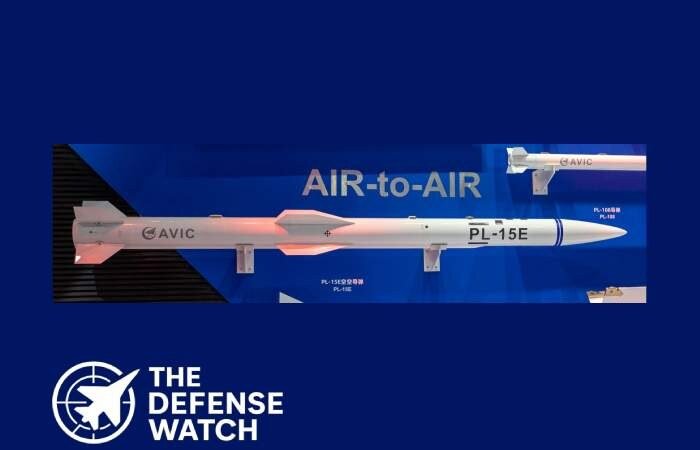
- Control surfaces: The missile uses cropped delta‑style mid-body fins and smaller tail control fins. This design is optimized for carriage inside internal bays of stealth aircraft such as the J-20.
- Weight: The PL‑15E export version reportedly weighs up to 210 kg.
Warhead
- The warhead is a high-explosive fragmentation type, estimated to weigh between 20 to 25 kg, designed to maximize damage against fast, maneuvering aerial targets.
- Detonation is believed to be triggered by a proximity fuse (possibly radar- or laser-based), ensuring optimal effect even on near-misses.
Guidance & Seeker
- The PL‑15’s guidance system is highly advanced:
- Inertial Navigation System (INS) for mid-course guidance.
- Data link updates, allowing mid-course corrections via two‑way link (e.g., from AEW&C platforms).
- Beidou satellite updates, which enhance accuracy over long flight distances.
- Active radar homing for terminal phase, using an AESA (Active Electronically Scanned Array) seeker. This helps engage maneuvering or stealthy targets.
- The seeker is reportedly resistant to electronic countermeasures, a critical capability in modern contested airspace.
Variants
- PL‑15 (Domestic): The standard version used by the PLAAF. Some sources claim a range in the 200–300 km band, though public figures vary.
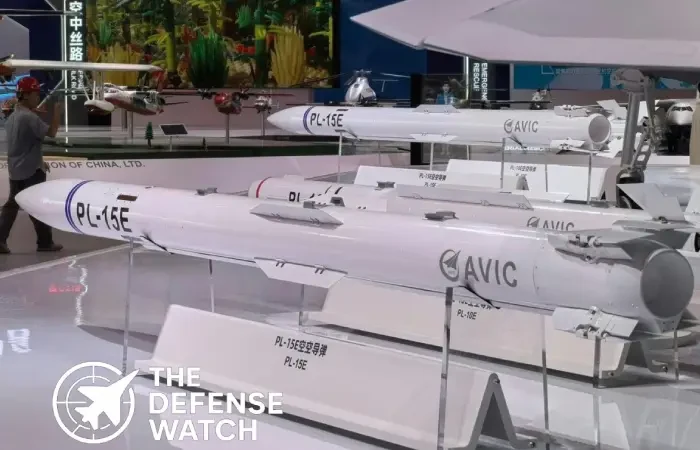
- PL‑15E (Export): Specifically designed for foreign customers. The export variant is shorter in range — publicly quoted at ~145 km.
- PL‑15E with Folding Fins: According to Chinese manufacturing disclosures, a version with folding control surfaces is under development to increase internal carriage capacity, especially for stealth platforms.
- Possible Future Developments: There is speculation (from open-source analysts) about further evolutions, including integration with ramjet propulsion or even more miniaturized designs (though not all claims are independently verified).
Deployment & Operational Use
- Chinese Platforms: The PL‑15 has been integrated on a number of PLAAF aircraft, including:
- J-20 stealth fighter
- J-10C multirole fighter
- J-16 (4th-generation strike / fighter-bomber)
- Export / Foreign Use:
- Pakistan is a notable customer: it has acquired the PL‑15E, reportedly in a package that included J-10CE fighters and possibly ~240 missiles.
- On Pakistani jets, the PL‑15E has been seen on both the JF-17 Block III and J-10CE.
- Combat & Strategic Role:
- The PL‑15 is often viewed as China’s tool for countering high-value support aircraft — AWACS, tankers, and other force-multipliers — from long ranges, denying adversaries freedom of action.
- Its “fire-and-forget” capability (combined with mid-course updates) allows for flexible use in both offensive and defensive counter-air missions.
Performance & Strategic Implications
Range & Kinematics
- The reported range of 200–300 km for the domestic variant allows China to threaten or engage distant targets before they can respond.
- The export PL‑15E’s shorter official range (~145 km), while less than the domestic version, is still significant and places it in the higher-end category among export air-to-air missiles.
- High speed (Mach 5+) and a dual-pulse rocket motor provide strong end-game energy, improving the missile’s ability to intercept fast or maneuvering targets.
Electronic Warfare & Survivability
- With a modern AESA seeker and robust guidance architecture, the PL‑15 is built to survive in contested electronic warfare (EW) environments.
- The ability to receive mid-course updates allows the missile to adapt to changes in a target’s flight path or to be re-tasked after launch.
Export Significance
- Delivering a long-range missile like the PL‑15E to external customers (e.g., Pakistan) underscores China’s growing confidence in its aerospace export capabilities.
- For countries acquiring the PL‑15E, the missile offers a credible long-range strike capability — particularly for nations that operate Chinese-made fighters.
Regional Impact
- The PL‑15 enhances China’s anti-access / area-denial (A2/AD) posture by extending the reach of its air force against key enablers in the skies.
- In the context of China–Pakistan cooperation, the PL-15E potentially shifts the aerial balance, making high-value assets more vulnerable during a high-intensity conflict.
Challenges & Limitations
- Effective vs. Theoretical Range: While public sources cite long ranges, the effective engagement range may be much shorter in practice, depending on launch altitude, target maneuvers, and platform radar performance.
- Platform Constraints: On export customers’ aircraft, limitations can arise. For instance, the JF-17 Block III in Pakistani service may have radar and aerodynamic limits that reduce the PL-15E’s effective engagement envelope.
- Countermeasures: Despite its advanced guidance, future adversaries could develop electronic countermeasures (ECM) or hard-kill defenses to mitigate the missile’s threat.
Future Outlook
- PL‑16 & Beyond: Analysts suggest that China is already pushing forward with the PL‑16, a next-gen missile optimized for internal carriage on stealth fighters.
- Improved Variants: Folding-fin versions and potentially ramjet-powered variants may appear, giving China even more flexibility in missile loadout and performance.
- Export Growth: More countries may seek the PL‑15E or future derivatives, especially those operating Chinese aircraft or seeking affordable alternatives to Western long-range missiles.
Conclusion
The PL‑15 missile stands as one of China’s most advanced air-to-air weapons. With its dual-pulse motor, AESA seeker, strong guidance architecture, and long-range capability, it significantly enhances the PLA’s ability to project airpower and challenge high-value aerial assets. Through its export variant, the PL‑15E, China is also extending these capabilities to partner nations, shaping regional airpower dynamics. As newer variants and more advanced versions emerge, the PL-15 family is poised to remain a critical component of both Chinese and export customers’ air combat strategies.
FAQs
The domestic PL‑15 is reported to have a range of 200–300 km, though exact operational ranges likely vary.
The export version (PL‑15E) officially lists ~145 km, though actual effective range may be lower depending on the launch platform.
Chinese users: J-20, J-10C, J-16, other modern fighters.
Export users: Pakistan uses PL‑15E on JF-17 Block III and J-10CE.
It carries a high-explosive fragmentation warhead, estimated at 20–25 kg, designed to defeat fast-moving, maneuvering aircraft.
It uses a combination of inertial navigation, data-link mid-course updates, Beidou satellite positioning, and terminal active homing via an AESA radar seeker.
This gives it fire-and-forget capability with the flexibility to receive course corrections after launch.
Yes, reports suggest a PL‑16 is in development, optimized for stealth fighters, possibly with folding fins for internal carriage.
Chinese PL-15 Missile – Full Specifications
Chinese PL-15 Missile
Full Specifications
1. General Information
| Name / Designation | PL-15 |
| Type / Role | Beyond-Visual-Range Air-to-Air Missile |
| Country of Origin | China |
| Manufacturer | CASIC (China Aerospace Science and Industry Corporation) |
| Service Entry / Year Introduced | 2015 |
| Operational Status | Active |
2. Performance & Range
| Range | 200–300 km (Long Range) |
| Speed | Mach 4 |
| Ceiling / Altitude Limit | Over 20,000 m |
| Accuracy (CEP) | High precision with radar homing |
| Warhead Type | High-Explosive Fragmentation |
3. Guidance & Targeting
| Guidance System | Inertial + Active Radar (AESA) |
| Targeting Mode | Fire-and-Forget / Midcourse Update |
| Launch Platform Compatibility | Fighter Jet |
| Seeker Type | Active Electronically Scanned Array (AESA) |
4. Physical Characteristics
| Length | 4.0 m |
| Diameter | 0.20 m |
| Wingspan | 0.60 m |
| Launch Weight | ~210 kg |
| Propulsion | Dual-pulse Solid-fuel Rocket |
5. Warhead & Payload
| Warhead Weight | ~40 kg |
| Explosive Type | High-Explosive Fragmentation |
| Detonation Mechanism | Proximity Fuse |
| Payload Options | Conventional |
6. Operational Use & Capabilities
| Operational Range Type | Long |
| Deployment Platform | Air |
| Target Types | Fighter Aircraft, AWACS, Tankers |
| Combat Proven | Limited Information |
| Users / Operators | China |
PROS
- Long-range engagement capability (200+ km)
- AESA radar seeker with high resistance to jamming
- Dual-pulse motor for sustained flight energy
- Compatible with 4th and 5th generation fighters
- Advanced data link for midcourse correction
CONS
- Unverified maximum range in real combat
- Limited export availability for testing or evaluation
- Dependence on Chinese data for performance validation
- High cost and complex production technology
- Potential vulnerability to future electronic warfare systems
Table of Contents
PL-15 Beyond-Visual-Range Air-to-Air Missile
The PL-15 (Pi Li-15) is China’s next-generation beyond-visual-range air-to-air missile (BVRAAM), designed to replace the older PL-12 and counter Western missiles such as the AIM-120D AMRAAM. Developed by the China Aerospace Science and Industry Corporation (CASIC), it represents a major leap in Chinese air combat technology and strategic air superiority doctrine.
Introduced in the mid-2010s, the PL-15 is primarily deployed by advanced fighters such as the Chengdu J-10C, Shenyang J-16, and the stealthy J-20 Mighty Dragon. It is equipped with an active electronically scanned array (AESA) radar seeker, enabling it to track and engage targets at extreme distances under heavy electronic countermeasures.
Capabilities and Performance
The missile reportedly boasts a range exceeding 200 kilometers, allowing Chinese fighters to engage adversaries well before entering their own missile envelopes. Its dual-pulse solid rocket motor provides sustained propulsion during midcourse and terminal phases, improving speed and endgame energy. Operating at Mach 4, it is among the fastest operational air-to-air missiles in service.
The PL-15’s data link system allows midcourse updates from the launch aircraft or supporting platforms, while its low-smoke solid propellant reduces visibility to enemy sensors. Combined with advanced guidance algorithms and high resistance to jamming, the PL-15 gives the People’s Liberation Army Air Force (PLAAF) a decisive advantage in long-range engagements.
PL-15 Price in United States
While the PL-15 is not available for foreign or U.S. acquisition due to export restrictions, defense analysts estimate its unit cost to range between $1–1.2 million USD, based on comparable missile systems and open-source assessments.
Get real time update about this post category directly on your device, subscribe now.
Reviews
Get real time update about this post category directly on your device, subscribe now.

6 comments
[…] U.S. fighter fleet is evolving to face high-end threats from China’s PLA Air Force, Russia, and emerging long-range missile […]
[…] the live-fire test succeeds, it could mark a first among CCAs: an uncrewed aircraft firing an air-to-air missile in a combat-like scenario. That would significantly shift the narrative on unmanned combat […]
[…] including Industry Minister Mélanie Joly, have said the review will consider domestic economic impact alongside capability requirements. Canada is also pushing Lockheed Martin to increase Canadian industrial participation […]
[…] Italy’s increased commitment to GCAP comes as part of a broader trend in defense spending. Recent multi-year budget documents reflect higher allocations for defense and modernization, in line with NATO expectations and evolving security dynamics in Europe. Analysts note that programs like GCAP are seen by participating states as essential for technological sovereignty and future air capability. […]
[…] France, Germany, Italy, Spain, Sweden, and the United Kingdom. Unlike conventional rocket-powered air-to-air missiles, Meteor’s throttleable ducted rocket (ramjet) motor enables the weapon to maintain energy […]
[…] the facility. The assessment marks one of the most detailed Ukrainian disclosures regarding the impact of strikes on Russian strategic missile […]