
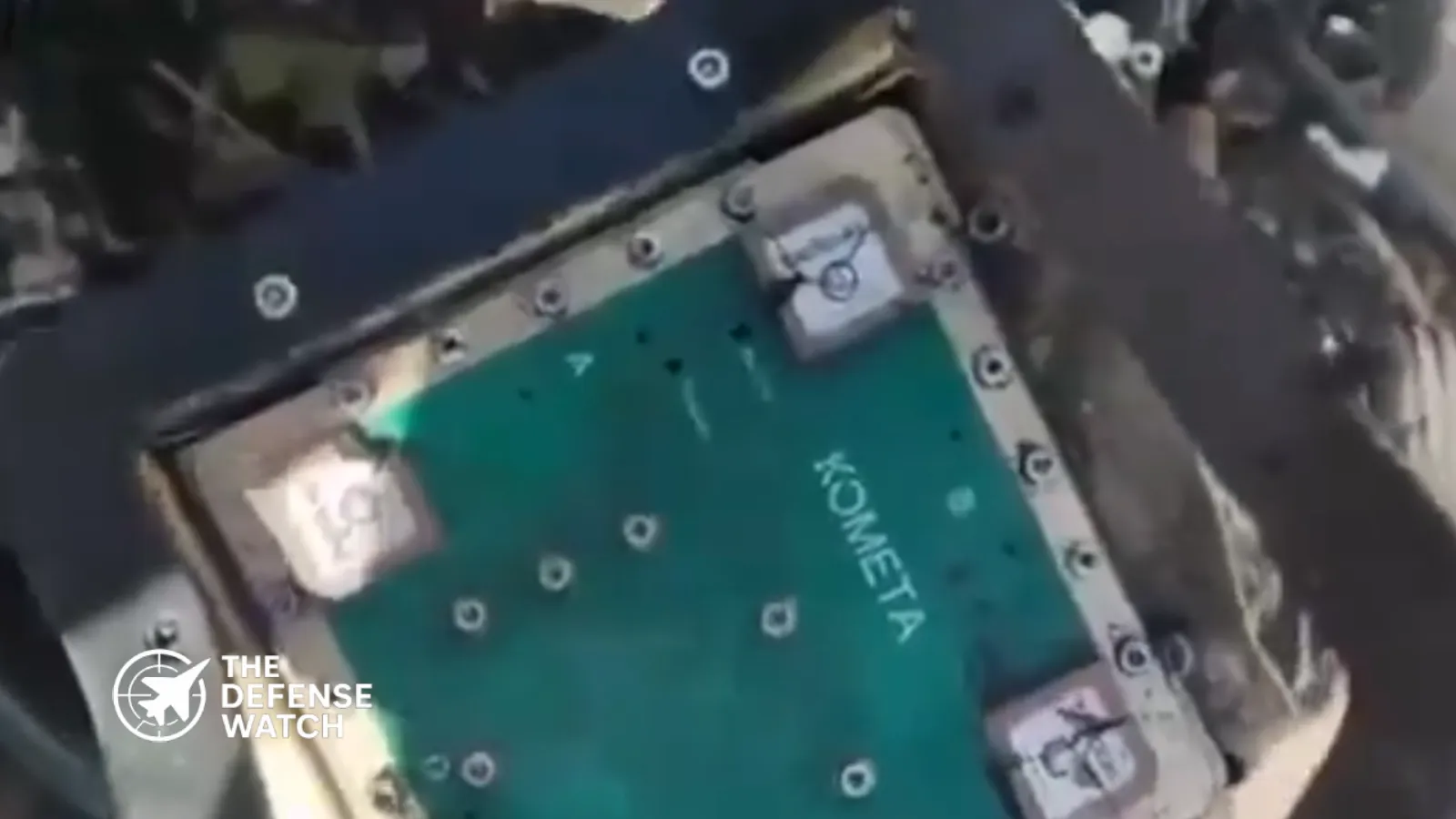
- ► Wreckage from a Shahed-136 drone reportedly revealed a Russian KOMETA-M anti-jamming receiver.
- ► The drone was linked to an attempted strike on RAF Akrotiri in Cyprus.
- ► KOMETA-M is used on Russian drones and precision-guided munitions in Ukraine.
- ► The discovery may indicate technology transfer between Tehran and Moscow.
- ► Neither Iran nor Russia has publicly commented on the reported finding.
Russian KOMETA-M Reportedly Found In Shahed-136 Drone Wreckage
A Russian KOMETA-M system was reportedly recovered from the wreckage of an Iranian Shahed-136 drone following an attempted strike on RAF Akrotiri in Cyprus, according to emerging defense reporting and imagery circulating among open source analysts.
The Shahed-136 drone, a loitering munition widely used by Iran and exported to Russia, was allegedly involved in an attack targeting the British airbase. Photographs shared by defense observers appear to show components consistent with the Russian made KOMETA-M anti-jamming receiver integrated into the airframe.
Neither London, Tehran, nor Moscow has officially confirmed the technical details of the recovered debris. However, the reported presence of a Russian electronic warfare component inside an Iranian drone would mark a notable development in the evolving defense relationship between the two countries.
What Is The KOMETA-M System?
The KOMETA-M is an anti-jamming satellite navigation receiver designed to protect unmanned aerial vehicles and precision guided munitions from electronic interference. The system is intended to maintain navigation accuracy in contested electromagnetic environments.
Open source research and battlefield recoveries in Ukraine have previously linked KOMETA-M modules to Russian drones and cruise missiles. Ukrainian authorities have documented similar navigation protection systems in debris from Russian strikes since 2022, according to statements from Ukraine’s Security Service and independent defense analysts.
If confirmed, the discovery of a Russian KOMETA-M inside a Shahed-136 drone would suggest a level of technical integration beyond simple platform transfers.
Shahed-136 And Its Expanding Operational Footprint
The Shahed-136 is a delta wing loitering munition designed for long range strikes against fixed targets. It has gained global attention due to its use by Russian forces in Ukraine under the designation Geran-2.
The system relies on satellite navigation and inertial guidance. In environments where GPS interference is present, anti-jamming enhancements significantly improve strike reliability.
Western intelligence agencies and defense officials have repeatedly stated that Iran has supplied drones to Russia. Tehran has acknowledged providing drones prior to the Ukraine conflict but denies direct involvement in combat use. Moscow has maintained that its systems are domestically produced.
The reported integration of KOMETA-M adds a new layer to this debate.
Strategic Implications For Cyprus And The United Kingdom
RAF Akrotiri is one of the United Kingdom’s key sovereign base areas in the Eastern Mediterranean. It supports Royal Air Force operations, including surveillance and strike missions across the region.
An attempted drone strike on the facility would carry political and military significance. While the scale of damage, if any, remains unclear, the incident underscores the growing reach of loitering munitions and the evolving threat to fixed military installations.
From a defense modernization standpoint, the presence of an anti-jamming receiver inside a Shahed-136 highlights how electronic warfare resilience is becoming standard in even relatively low cost drone systems.
Analysis: What The Russian KOMETA-M Finding Could Signal
The Russian KOMETA-M discovery, if independently verified, would reinforce assessments that Iran and Russia are deepening technical cooperation in unmanned systems.
There are several possible explanations. One scenario is direct transfer of navigation components from Russia to Iran. Another is collaborative adaptation of drone designs to withstand electronic countermeasures encountered in recent conflicts.
Electronic warfare has played a central role in Ukraine, where both sides routinely attempt to jam or spoof satellite signals. Systems like KOMETA-M are specifically designed to counter these tactics.
For NATO planners, this development matters. Enhanced anti-jamming capabilities increase drone survivability and mission success rates. That raises the threshold for defending fixed infrastructure such as airbases, logistics hubs, and command centers.
At the same time, without official forensic confirmation, conclusions should remain measured. Open source imagery can provide early indicators but requires technical validation.
Broader Context: Iran Russia Defense Ties
Defense analysts have documented expanding cooperation between Tehran and Moscow since 2022. This has included reported drone transfers, training exchanges, and industrial collaboration.
Western sanctions targeting both countries have accelerated parallel supply chains and defense industrial linkages. Electronic components, guidance systems, and propulsion technologies have been areas of particular scrutiny.
If the KOMETA-M presence is confirmed through official channels, it would serve as concrete evidence of shared technology integration in unmanned platforms.
Conclusion
The reported recovery of a Russian KOMETA-M anti-jamming receiver from a Shahed-136 drone near RAF Akrotiri marks a potentially significant development in Iran Russia military cooperation.
While governments involved have yet to comment publicly, the finding aligns with broader trends in electronic warfare adaptation and drone modernization.
For defense planners, the episode is another reminder that low cost unmanned systems are becoming more resilient, more precise, and more strategically consequential.
Get real time update about this post category directly on your device, subscribe now.


