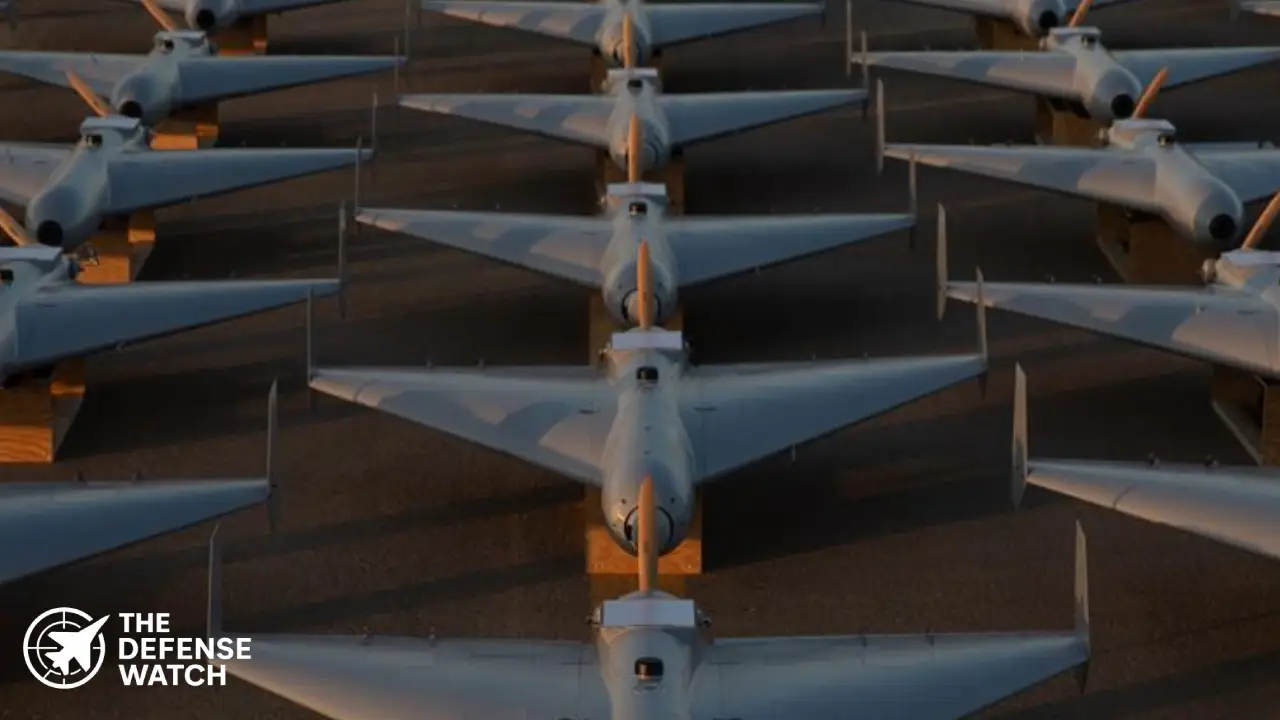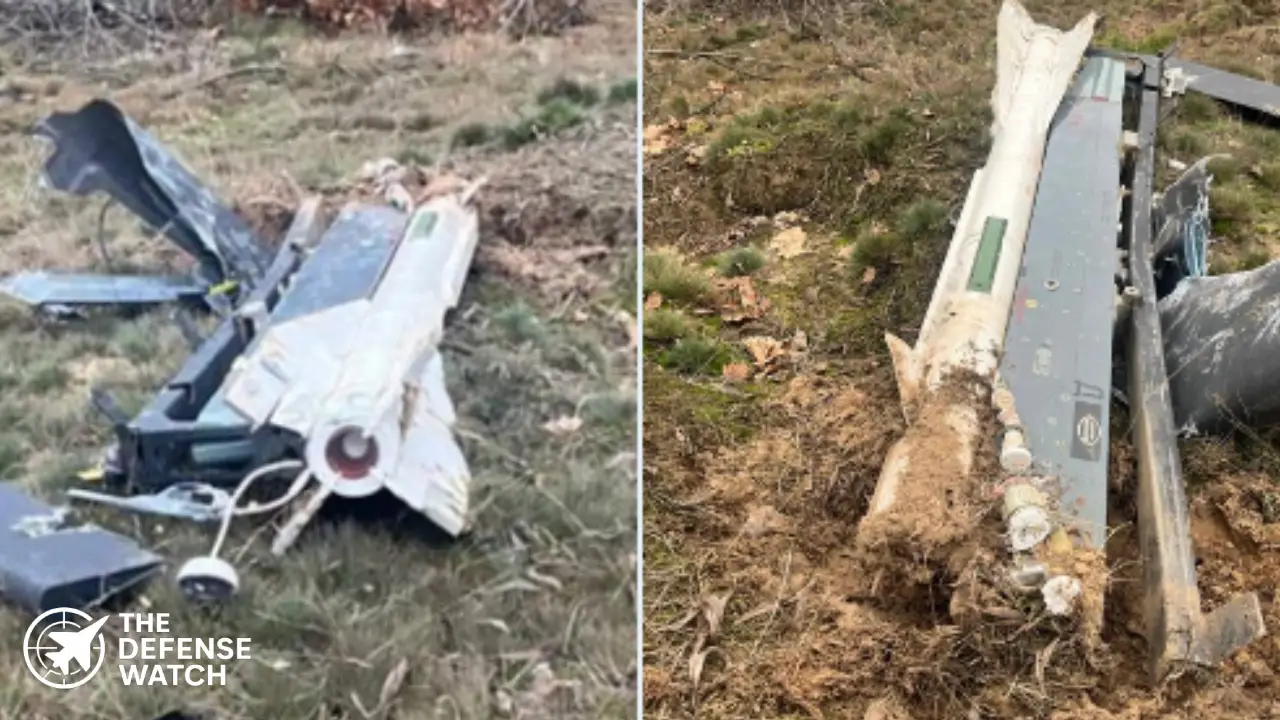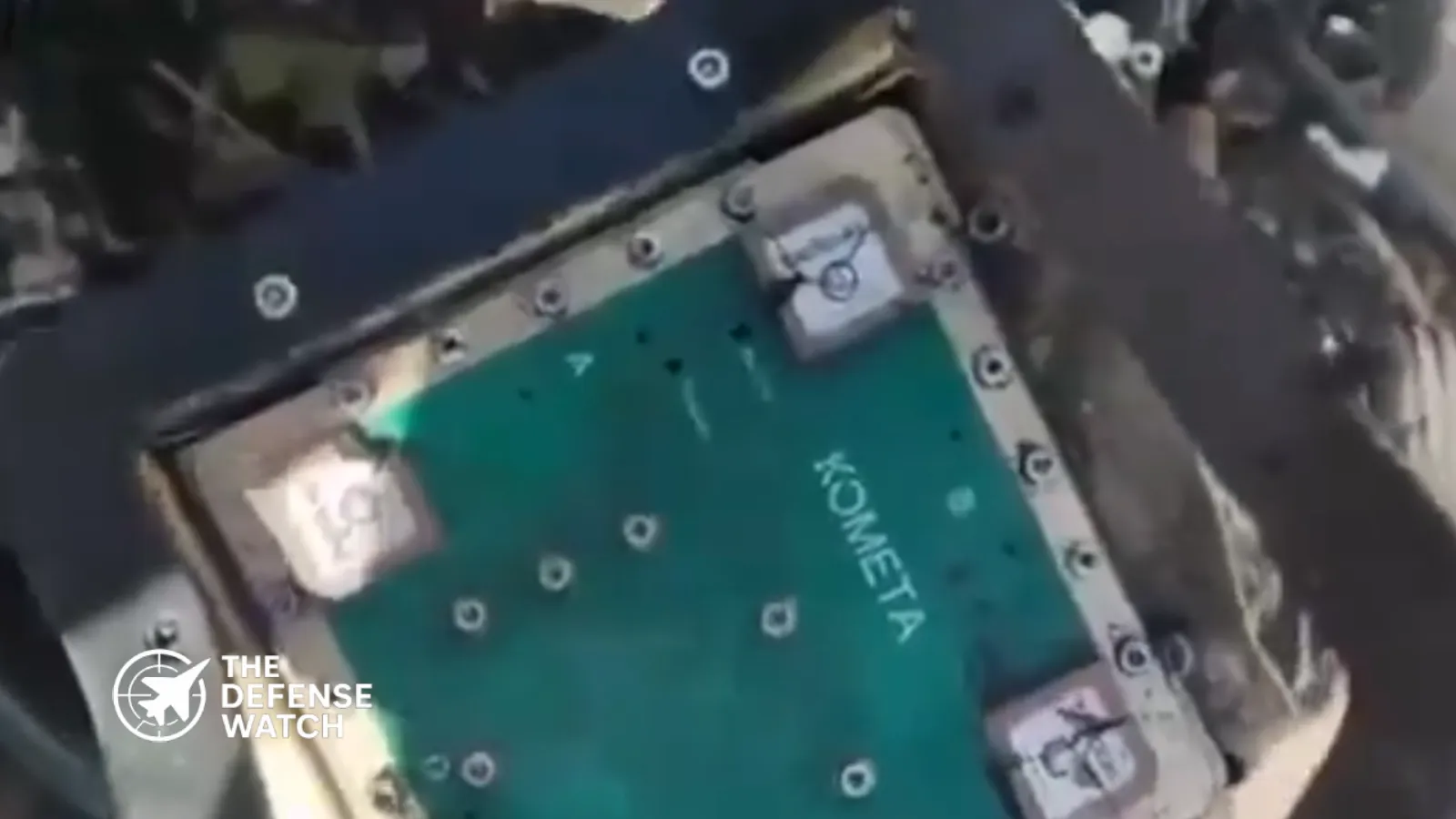
- Wreckage from a Shahed-136 drone reportedly revealed a Russian KOMETA-M anti-jamming receiver.
- The drone was linked to an attempted strike on RAF Akrotiri in Cyprus.
- KOMETA-M is used on Russian drones and precision-guided munitions in Ukraine.
- The discovery may indicate technology transfer between Tehran and Moscow.
- Neither Iran nor Russia has publicly commented on the reported finding.
Russian KOMETA-M Reportedly Found In Shahed-136 Drone Wreckage
A Russian KOMETA-M system was reportedly recovered from the wreckage of an Iranian Shahed-136 drone following an attempted strike on RAF Akrotiri in Cyprus, according to emerging defense reporting and imagery circulating among open source analysts.
The Shahed-136 drone, a loitering munition widely used by Iran and exported to Russia, was allegedly involved in an attack targeting the British airbase. Photographs shared by defense observers appear to show components consistent with the Russian made KOMETA-M anti-jamming receiver integrated into the airframe.
Neither London, Tehran, nor Moscow has officially confirmed the technical details of the recovered debris. However, the reported presence of a Russian electronic warfare component inside an Iranian drone would mark a notable development in the evolving defense relationship between the two countries.
What Is The KOMETA-M System?
The KOMETA-M is an anti-jamming satellite navigation receiver designed to protect unmanned aerial vehicles and precision guided munitions from electronic interference. The system is intended to maintain navigation accuracy in contested electromagnetic environments.
Open source research and battlefield recoveries in Ukraine have previously linked KOMETA-M modules to Russian drones and cruise missiles. Ukrainian authorities have documented similar navigation protection systems in debris from Russian strikes since 2022, according to statements from Ukraine’s Security Service and independent defense analysts.
If confirmed, the discovery of a Russian KOMETA-M inside a Shahed-136 drone would suggest a level of technical integration beyond simple platform transfers.
Shahed-136 And Its Expanding Operational Footprint
The Shahed-136 is a delta wing loitering munition designed for long range strikes against fixed targets. It has gained global attention due to its use by Russian forces in Ukraine under the designation Geran-2.
The system relies on satellite navigation and inertial guidance. In environments where GPS interference is present, anti-jamming enhancements significantly improve strike reliability.
Western intelligence agencies and defense officials have repeatedly stated that Iran has supplied drones to Russia. Tehran has acknowledged providing drones prior to the Ukraine conflict but denies direct involvement in combat use. Moscow has maintained that its systems are domestically produced.
The reported integration of KOMETA-M adds a new layer to this debate.
Strategic Implications For Cyprus And The United Kingdom
RAF Akrotiri is one of the United Kingdom’s key sovereign base areas in the Eastern Mediterranean. It supports Royal Air Force operations, including surveillance and strike missions across the region.
An attempted drone strike on the facility would carry political and military significance. While the scale of damage, if any, remains unclear, the incident underscores the growing reach of loitering munitions and the evolving threat to fixed military installations.
From a defense modernization standpoint, the presence of an anti-jamming receiver inside a Shahed-136 highlights how electronic warfare resilience is becoming standard in even relatively low cost drone systems.
Analysis: What The Russian KOMETA-M Finding Could Signal
The Russian KOMETA-M discovery, if independently verified, would reinforce assessments that Iran and Russia are deepening technical cooperation in unmanned systems.
There are several possible explanations. One scenario is direct transfer of navigation components from Russia to Iran. Another is collaborative adaptation of drone designs to withstand electronic countermeasures encountered in recent conflicts.
Electronic warfare has played a central role in Ukraine, where both sides routinely attempt to jam or spoof satellite signals. Systems like KOMETA-M are specifically designed to counter these tactics.
For NATO planners, this development matters. Enhanced anti-jamming capabilities increase drone survivability and mission success rates. That raises the threshold for defending fixed infrastructure such as airbases, logistics hubs, and command centers.
At the same time, without official forensic confirmation, conclusions should remain measured. Open source imagery can provide early indicators but requires technical validation.
Broader Context: Iran Russia Defense Ties
Defense analysts have documented expanding cooperation between Tehran and Moscow since 2022. This has included reported drone transfers, training exchanges, and industrial collaboration.
Western sanctions targeting both countries have accelerated parallel supply chains and defense industrial linkages. Electronic components, guidance systems, and propulsion technologies have been areas of particular scrutiny.
If the KOMETA-M presence is confirmed through official channels, it would serve as concrete evidence of shared technology integration in unmanned platforms.
Conclusion
The reported recovery of a Russian KOMETA-M anti-jamming receiver from a Shahed-136 drone near RAF Akrotiri marks a potentially significant development in Iran Russia military cooperation.
While governments involved have yet to comment publicly, the finding aligns with broader trends in electronic warfare adaptation and drone modernization.
For defense planners, the episode is another reminder that low cost unmanned systems are becoming more resilient, more precise, and more strategically consequential.
United States Central Command (CENTCOM) announced the activation of its first one-way attack drone squadron — a dedicated unit built around a new drone design derived from the Iranian HESA Shahed 136. The new force, dubbed Task Force Scorpion Strike (TFSS), immediately deployed low-cost strike drones to the Middle East, signaling a major shift in U.S. drone strategy.
Background: Shahed-136 and Low-Cost Drone Warfare
The Shahed-136 is an Iranian-designed loitering munition — commonly described as a “kamikaze drone” — that has been widely used by Tehran, its allied militias and Russia (under the designation Geran-2) in various conflicts, including in Ukraine.
Measuring roughly 3.5 m in length, with a 2.5 m wingspan, weighing about 200 kg and carrying a warhead of 30–50 kg, the Shahed-136 features a delta-wing configuration, rear-mounted pusher propeller, and uses GNSS/INS guidance.
Because of its relatively low cost and simple design — in stark contrast to expensive, sophisticated U.S. or NATO missiles — the Shahed-136 has become a symbol of a shift toward scale: saturation attacks with many cheap drones rather than fewer high-cost precision munitions.
What Happened: Deployment of the LUCAS Squadron
CENTCOM Unveils Task Force Scorpion Strike
According to CENTCOM, Task Force Scorpion Strike was activated on 3 December 2025. The new force is built around one-way, expendable attack drones derived from the Shahed-136 design. These drones, known as Low-cost Unmanned Combat Attack System (LUCAS), have already been deployed to the Middle East.
In remarks accompanying the activation, CENTCOM commander Admiral Brad Cooper described the new task force as a demonstration of rapid innovation and deterrence: “This new task force sets the conditions for using innovation as a deterrent,” he said.
LUCAS Drones Mirror Shahed-136 Design, Offer Low-Cost Strike Option
Visual evidence released by CENTCOM shows rows of LUCAS drones situated at an undisclosed base in its area of responsibility. The design strongly resembles the Shahed-136: delta wing, rear-mounted propeller, vertical stabilizers and compact airframe.
Though CENTCOM has not released full specifications, the LUCAS drones are described as having “extensive range” and autonomous operation capability. Launch methods include catapults, rocket-assisted takeoff, or mobile vehicle-based launchers — enabling flexible deployment in austere environments.
Industry sources and media reporting associate LUCAS closely with the product line developed by Arizona-based uncrewed aircraft manufacturer SpektreWorks, specifically its “FLM 136” family originally designed to emulate Shahed drones for threat testing.
Cost and Strategic Trade-Offs
Each LUCAS drone reportedly costs approximately USD 35,000 — a fraction of what legacy U.S. strike systems or precision missiles cost. mint+1
By comparison, traditional U.S. strike assets such as strike jets or guided missiles can cost tens of thousands to millions of dollars per shot. The economics of LUCAS reverses that equation: expend cheap drones en masse, rather than expend expensive missiles one at a time.
Analysis: Strategic Implications of the New Drone Squadron
A Shift From Defense to Low-Cost Offense
Historically, U.S. drone efforts have prioritized surveillance, precision strikes, and high-value targets — using expensive, reusable platforms. The deployment of a dedicated one-way attack drone squadron signals a doctrinal shift, embracing the notion that “quantity has a quality all its own.” The LUCAS drones allow the Pentagon to field large numbers of inexpensive kamikaze UAVs capable of saturating air defenses or striking dispersed or hardened targets.
Catching Up With Adversaries’ Playbook
This move can be seen in part as a reaction to the widespread use of Shahed-type drones by adversaries, including state and non-state actors, which has challenged U.S. and allied defenses in recent years. By reverse-engineering the Shahed-136 and deploying LUCAS, the U.S. military closes the gap — developing the capability to use low-cost one-way drones offensively, not just defend against them.
Lowering the Entry Barrier for Drone Warfare
At USD 35,000 per drone, LUCAS makes drone strikes accessible for tactical units. The modular launch mechanism (catapults, rocket assist, vehicle-based launchers) simplifies deployment. This could enable small ground units — not only air or special-forces — to leverage drone strikes as a regular part of their toolbox.
Potential Risks and Considerations
Because these drones are expendable, ethical and collateral-damage risks may increase. Moreover, adversary forces may respond by upgrading inexpensive counter-UAS systems, leading to a renewed arms race. The autonomous nature of LUCAS (loitering then diving onto targets) also raises command, control, and risk-of-fratricide challenges, especially in complex environments.
What’s Next: Wider Rollout and Operational Use
According to CENTCOM, the establishment of Task Force Scorpion Strike is just the first step. The Pentagon has launched a multiyear initiative to acquire hundreds of thousands of low-cost, one-way drones, with purchase orders beginning in early 2026.
Over the next 18–24 months, this could mean widespread deployment not only in the Middle East but potentially other theaters deemed high-risk or strategically vital.
In practical terms, we may see LUCAS drones used in saturation strikes, suppression of enemy air defenses, targeting of hardened infrastructure, or rapid response strikes — shifting small drones from auxiliary roles to frontline offensive tools.
Russia Arms Shahed-136 With Air-to-Air Missiles
On December 1, 2025, multiple sources—including a detailed report by a defense-technology outlet—confirmed that Russia has deployed a modified version of the Shahed-136 kamikaze drone equipped with a Soviet-era R-60 air-to-air guided missile.
The new configuration was first observed when the drone — known in Russian service as the Geran-2 — was intercepted and shot down by a Ukrainian interceptor loitering munition, marking the first publicly documented case of such a weaponized combination in the conflict.
Context: Evolving Shahed Threat
The Shahed-136, originally an Iranian-designed kamikaze drone, has been a backbone of Russian long-range drone strikes since 2022.
Over time, Russia has significantly upgraded the Shahed, shifting it from a slow, propeller-driven loitering munition — easy to neutralize — into a more formidable threat. Upgrades have included improved warheads, GPS-resistant navigation systems, thermal-imaging cameras, and even jet or turbojet-powered variants.
The adoption of an air-to-air missile appears to represent the next phase of this evolution, broadening the drone’s mission set beyond ground strikes and decoy swarms to aerial threats.
New Air-to-Air Capability: Details & Significance
The R-60 Missile Integration
- The missile identified on the downed drone is the Soviet-designed R-60 air-to-air missile (NATO reporting name AA-8 “Aphid”), a compact, infrared-guided missile introduced in the early 1970s.
- The missile was mounted on a launch rail affixed to the nose (or upper fuselage) of the drone — not under the wings as is standard for manned aircraft.
- According to a Ukrainian military analyst, this configuration is “designed to destroy helicopters and tactical aircraft that hunt Shaheds.”
First Recorded Shoot-Down
The missile-armed Shahed — identified as a Geran-2 — was engaged by a Ukrainian interceptor drone, the Sting, developed by the volunteer group Wild Hornets. According to released footage and wreckage photos, the R-60 remained attached after destruction.
This engagement suggests at least two things:
- Ukraine’s air defenses are adapting quickly and fielding low-cost, flexible interceptor solutions.
- Russia is exploring ways to blunt Ukraine’s use of helicopters and light aircraft for drone-hunting roles by repurposing its own UAVs for aerial combat.
Tactical Implications
- Broadened Threat Spectrum — The traditional role of Shaheds as one-way strike drones against ground infrastructure or troop concentrations is now expanding. With air-to-air missiles, they pose a potential threat to helicopters, light aircraft, even fighter jets engaged in air-defense.
- Deterrent Effect — The presence of a missile, even if rarely used, may force Ukrainian aircrews to operate more cautiously, limiting or avoiding helicopter or fixed-wing sorties near frontline or drone-heavy zones.
- Shift in Counter-Drone Strategy — Air defense doctrine may need to evolve: using interceptor drones, radar-guided SAMs, or more robust aerial defenses rather than relying solely on machine guns or small arms.
Broader Context: Shahed’s Rapid Evolution
The new missile-armed Shahed is part of a broader pattern of upgrades and tactical refinements. Over the past two years, Russia has:
- Shifted to mass production of Shahed-type drones (known in Russia as “Geran-2”), reportedly manufacturing thousands per month.
- Added improved warheads — fragmentation, thermobaric, cluster munitions — to maximize damage.
- Developed variants with enhanced navigation (jam-resistant GNSS and INS), optical/thermal cameras, and even jet propulsion to increase speed and survivability.
- Adopted more complex attack tactics, combining Shaheds with decoys and loitering munitions to complicate detection and overwhelm air defenses.
Analysts have called this rapid “mutation” of a relatively cheap UAV into a multi-role aerial munition one of the defining features of the modern drone-powered conflict.
What This Means for the Air War Over Ukraine
- The documented use of air-to-air missiles on Shaheds significantly increases the risks for Ukrainian helicopters, transport aircraft, or other light air assets previously considered safe from drone threats.
- Air defense planners in Ukraine (and other countries observing the conflict) will likely reconsider the viability of manned aircraft for drone-hunting missions, pushing instead for interceptor drones, improved radar/SAM coverage, or layered air defense systems.
- The low cost and modular adaptability of drones like Shahed — combined with legacy missiles like R-60 — reflect a shift toward asymmetric, cost-effective aerial warfare. This could influence future conflict zones where even lower-budget forces can project substantial aerial threat.
- For Russia, success in deploying such drones at scale could degrade Ukraine’s aerial mobility, complicate resupply and medevac operations, and erode air-defense deterrence — though the actual effectiveness of missile-armed drones remains to be fully seen.
What’s Next
Defensive analysts and militaries worldwide must now account for UAVs as potential aerial combatants — not just as kamikaze weapons. Expect efforts to deploy:
- More interceptor drones (like the Sting) or unmanned surface/air vehicles equipped to counter missile-armed UAVs.
- Advanced sensors, IR-guided missile defenses, and radar systems optimized to detect small, low-signature drones carrying heat-seeking weapons.
- Revised air operations doctrine, with stricter risk assessments for helicopter and light aircraft operations where UAV thresholds are high.
Monitoring open-source intelligence (satellite imagery, wreckage photos, battlefield footage) will remain critical — as will documentation of any successful uses of missile-armed drones against aircraft.