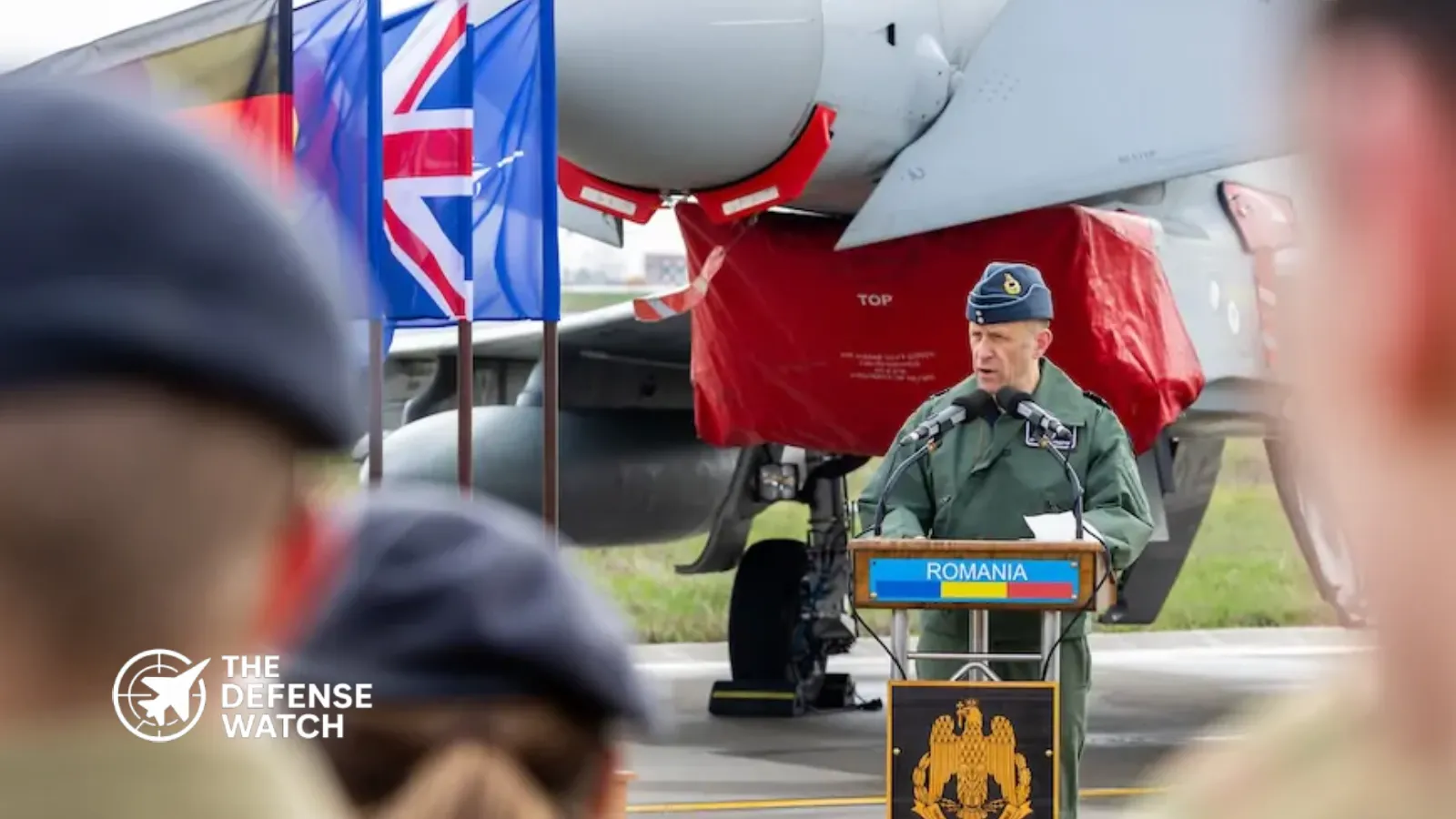
- The Royal Air Force has taken over NATO’s enhanced Air Policing mission in Romania.
- RAF Typhoon fighter jets are deployed to secure NATO airspace along the eastern flank.
- The mission operates from Mihail Kogălniceanu Air Base near the Black Sea.
- The deployment aims to deter potential airspace violations and reassure NATO allies.
- The rotation underscores NATO’s sustained focus on eastern Europe amid ongoing regional tensions.
RAF NATO Air Policing Romania Mission Strengthens Eastern Flank Defense
The RAF NATO air policing Romania mission has officially transitioned to the United Kingdom, reinforcing NATO’s eastern flank as alliance members continue to respond to heightened security pressures near the Black Sea.
The deployment, led by the Royal Air Force, involves advanced Eurofighter Typhoon jets operating under NATO command to secure Romanian airspace and deter potential incursions.
Operating from Mihail Kogălniceanu Air Base, the RAF contingent replaces previous allied rotations as part of NATO’s enhanced Air Policing framework. The mission ensures rapid response capability to unidentified or non-compliant aircraft approaching alliance airspace.
Strategic Context: NATO’s Eastern Flank Under Pressure
The RAF NATO air policing Romania mission reflects a broader strategic shift by NATO to maintain persistent air defense coverage along its eastern perimeter.
Since Russia’s invasion of Ukraine in 2022, NATO has significantly expanded its forward presence across Eastern Europe. Romania, located on the Black Sea and bordering Ukraine, has emerged as a critical node in the alliance’s defensive architecture.
Air policing missions, while not new, have taken on increased operational importance. These deployments now serve not only as deterrence but also as a visible signal of alliance unity and readiness.
From an operational standpoint, RAF Typhoons provide quick reaction alert capabilities, meaning aircraft can be scrambled within minutes to intercept potential threats. This includes unidentified aircraft, military probes, or civilian planes deviating from flight plans.
RAF Typhoon Capability and Mission Role
The RAF NATO air policing Romania mission leverages the Typhoon’s multirole capabilities, particularly its air superiority and interception strengths.
Equipped with advanced radar systems and beyond-visual-range missiles, the Typhoon is optimized for quick interception missions. Its ability to operate in contested environments makes it suitable for NATO’s current threat landscape.
In Romania, the aircraft operate under strict NATO rules of engagement. Missions typically include:
- Airspace surveillance and patrol
- Identification of unknown aircraft
- Interception and escort operations
- Coordination with Romanian and NATO air defense networks
This layered approach ensures that NATO maintains a continuous and credible air defense posture in the region.
Operational Impact on Regional Security
The RAF NATO air policing Romania mission contributes directly to regional stability, particularly in the Black Sea area, where air and naval activity has increased in recent years.
Romania’s geographic position places it at the intersection of several strategic concerns, including proximity to Crimea and key maritime routes. As a result, maintaining secure and monitored airspace is critical.
From a deterrence perspective, the presence of RAF fighters complicates any adversary’s operational planning. It raises the cost and risk of airspace violations while ensuring rapid NATO response.
At the same time, these missions provide reassurance to frontline NATO states. For countries like Romania, visible allied deployments reinforce collective defense commitments under Article 5.
Alliance Integration and Interoperability
Another key dimension of the RAF NATO air policing Romania mission is interoperability. RAF personnel work closely with Romanian forces and other NATO allies to ensure seamless coordination.
This includes joint training, shared command structures, and integrated air defense systems. Such cooperation enhances overall readiness and reduces response times during real-world incidents.
Rotational deployments also allow NATO members to distribute operational burden while maintaining a continuous presence. The UK’s participation highlights its ongoing commitment to European security despite evolving geopolitical dynamics.
Analysis: A Persistent Mission With Growing Importance
While air policing missions have long been part of NATO’s toolkit, their role has evolved significantly. The RAF NATO air policing Romania mission is no longer a routine rotation but a frontline deterrence measure.
Three key trends stand out:
First, frequency and scale have increased. NATO is sustaining more continuous deployments across multiple eastern locations, including the Baltic states and southeastern Europe.
Second, missions are becoming more integrated with broader defense strategies. Air policing is now linked with ground forces, missile defense systems, and intelligence networks.
Third, the geopolitical signaling value has grown. Deployments like this send a clear message to both allies and adversaries about NATO’s readiness to defend its airspace.
In this context, the RAF’s role in Romania is part of a larger pattern of sustained vigilance rather than a temporary response.
Get real time update about this post category directly on your device, subscribe now.