
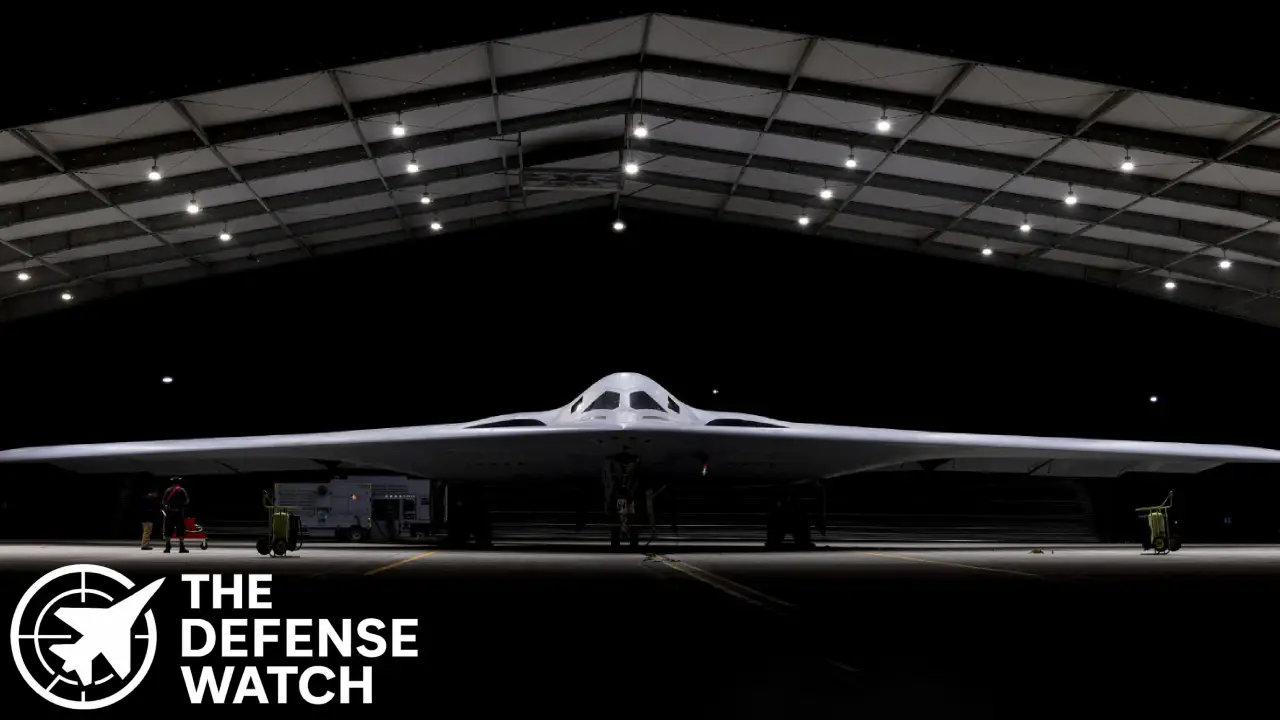
Production Contracts Loom for the B-21 Raider
In its latest earnings call, Northrop Grumman revealed it expects to finalize new contracts with the United States Air Force by year-end for the next production lots of the B-21 Raider stealth bomber. CEO Kathy Warden confirmed that the company is also in active discussions with the service about structuring a deal to ramp up the bomber’s production rate.
Congress has allocated $4.5 billion in a recent budget reconciliation bill to accelerate B-21 manufacturing capacity. While the negotiations remain ongoing — with delays related to the federal government shutdown — the potential agreement could pave the way for an earlier full-rate production transition.
Northrop is poised to receive the contract for Low-Rate Initial Production (LRIP) Lot 3, and an advance procurement award for Lot 5, during the fourth quarter of 2025.
Testing Milestones and Production Reality
The B-21 program continues to advance technically. The second B-21 test aircraft began flight testing in September, marking a shift from initial flight-handling validation to full mission-system and weapons-integration testing. Multiple other airframes are currently undergoing ground tests to reduce risk ahead of flight operations.
However, the production landscape remains challenging. In April, Northrop took a $477 million charge linked to a major manufacturing-process change intended to enable higher future production rates. CFO Ken Crews stated that while the engineering and manufacturing development costs for flight-test aircraft exceeded expectations, a contract restructure for the remaining LRIP lots largely offset that overrun.
Warden noted that the precise production rate and financial outcome depend on the result of talks with the Air Force, and declined to give firm predictions.
Strategic Procurement and Fleet Size
The U.S. Air Force’s current “program of record” for the B-21 stands at a minimum of 100 aircraft, intended to replace the aging B‑2 Spirit and B‑1 Lancer fleets by the 2030s. Some Air Force and combatant-command officials have proposed raising that number toward 145 or more aircraft in light of a more contested global environment.
Importantly, Warden emphasized that discussions about increasing the total quantity of B-21s would be a separate negotiation from the production-rate acceleration talks.
Analysis: What It Means for U.S. Defense and Airpower
The ongoing negotiations and production acceleration effort for the B-21 stand at the intersection of three major strategic realities for U.S. defense:
- Deterrence and long-range strike capability. The B-21 is designed to penetrate advanced air-defence systems and deliver both conventional and nuclear payloads. Faster production means the U.S. Air Force can field the next-generation bomber in greater numbers and sooner—important as peer competitors develop increasingly sophisticated anti-access/area denial (A2/AD) capabilities.
- Industrial base and affordability pressure. Northrop’s manufacturing hit underscores the challenge of moving from development to production in a complex stealth program. The decision to invest up-front (with losses now) to enable higher production later reflects a long-term mindset—but it also highlights cost-risk for both the contractor and the government. The $4.5 billion congressional funding is a recognition that accelerating production requires transition investment—not just the unit cost of the aircraft.
- Geopolitical timing and scale. In an era of intensifying great-power competition, the U.S. may require more than the initial 100-aircraft fleet to maintain strategic flexibility across the Indo-Pacific, Europe, and other forward-leaning theatres. The fact that talks are underway to both speed up production and maintain optionality for higher quantities signals awareness of this reality.
For Northrop, the arrangement could improve profit margins and revenue sooner if production ramps up. Analysts estimate the B-21 program could eventually amount to over 10 % of Northrop’s revenues depending on final contract terms. But the company must manage the downside risk of scaling production while maintaining affordability and performance.
Internationally, a more rapid fielding of the B-21 could shift deterrence equations—not only vis-à-vis Russia and China, but also in the context of allied burden-sharing, integration, and interoperable strike planning. The stealth bomber becomes a visible symbol of U.S. long-range strike capability, which in turn may influence allied planning and adversary calculations.
Conclusion: A Forward Look
As the Air Force and Northrop Grumman negotiate the details of ramped-up B-21 Raider production, the coming months will be pivotal. A signed agreement will likely trigger a sharper ramp-up in manufacturing, earlier revenue recognition for Northrop, and faster delivery of a transformational air-power asset for the U.S. military.
If the acceleration deal proceeds, the B-21 Raider may reach higher production rates and potentially exceed the current 100-aircraft baseline in response to evolving strategic demands. Conversely, any delay could push delivery timelines and force the Air Force to retain legacy bombers longer. In short: the next phase of the B-21 programme is entering the launch stage — and how smoothly it proceeds will shape U.S. deterrence posture for decades to come.
Get real time update about this post category directly on your device, subscribe now.

12 comments
[…] new risk vectors for strategic materials sourcing, pushing the U.S. either to re-on-shore production or seek alternate international […]
[…] to Northrop Grumman’s vice president of targeting and survivability, Jim Conroy, the upcoming production run will […]
[…] in the new framework. Traditional prime contractors — including RTX, Lockheed Martin, Boeing, and Northrop Grumman — have historically operated within highly structured procurement cycles. The Warfighting […]
[…] in performance. After the initial burn, the second pulse ignites during termination, providing additional thrust to improve speed, maneuverability, and terminal […]
[…] A $131 million contract went to Northrop Grumman. […]
[…] sources familiar with early Golden Dome contracts indicate firms such as Lockheed Martin, Northrop Grumman, Anduril Industries, and True Anomaly were among the initial contractors […]
[…] to Northrop Grumman, the US Navy confirmed that the AN/AQS-24 minehunting system and MCM USV combination met all […]
[…] with Lockheed saying it shares the focus on speed and accountability. Other firms such as RTX, Northrop Grumman and General Dynamics have not commented. Boeing declined to […]
[…] units are contributed by Bulgaria, Czechia, Germany, Greece, Italy, Lithuania, Spain, and Turkey. Additional forces from Belgium, France, and the United Kingdom are linking national training activities into the […]
[…] the B-21 program continues advancing through its planned production phases. Warden confirmed that Northrop received the contract for the third lot of low-rate initial production in the final quarter of 2025, as well as a […]
[…] motor tests using Highly Loaded Grain (HLG) solid propellant technologies, conducted with partner Northrop Grumman. These efforts focused on extending range and energy output over conventional […]
[…] Northrop Grumman said it will pause share buybacks beyond January, and L3Harris expects its share count to remain roughly the same in 2026, signaling limited repurchases. […]