
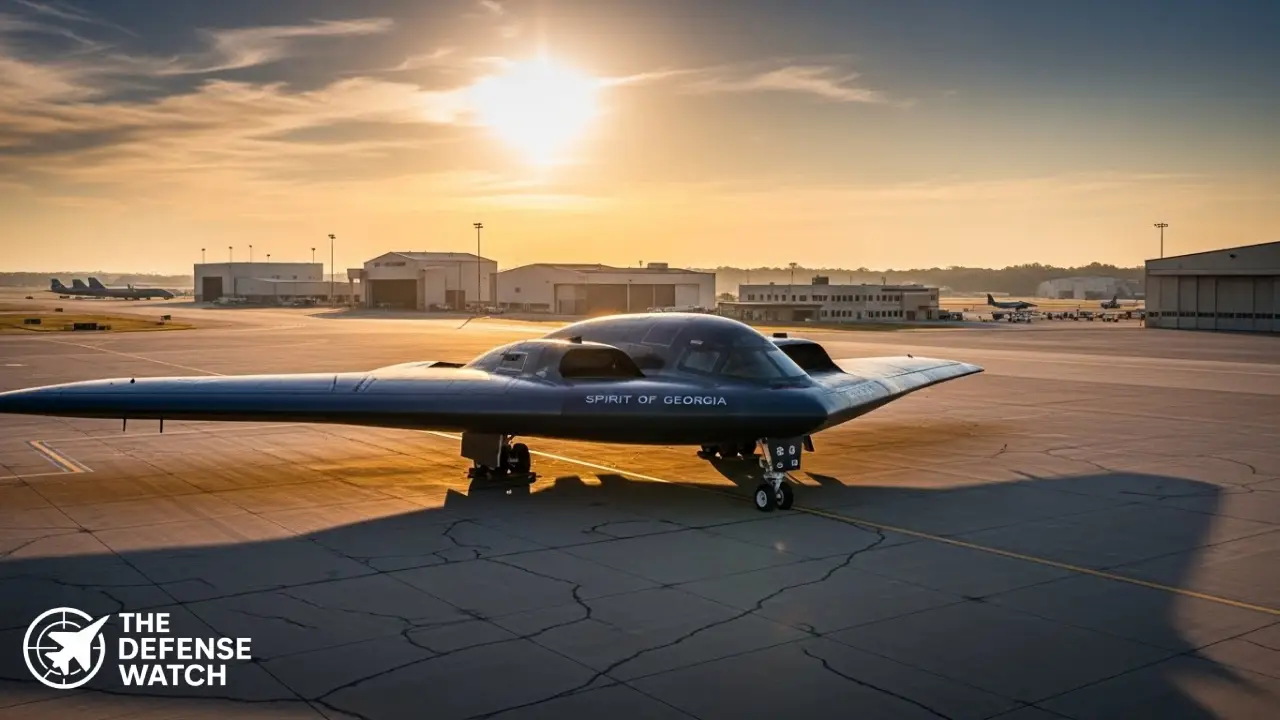
The B-2 Spirit stealth bomber known as “Spirit of Georgia” (tail number 89-0129) officially rejoined the U.S. Air Force’s operational fleet, following extensive repairs to structural damage sustained in a landing gear collapse at Whiteman Air Force Base, Missouri.
Background: Gear Collapse Incident and Fleet Significance
The incident occurred on September 14, 2021, during landing at Whiteman AFB. A hydraulic failure triggered an emergency gear-extension, but upon touchdown the left main landing gear (LMLG) failed to remain locked, causing it to collapse. The bomber veered off runway — its left wing scraped the ground and the aircraft came to rest roughly one mile from the landing point.
At the time, initial repairs were estimated at a minimum of US$10.1 million. But given the complex damage to the wing bay, lower wing skin, and landing-gear bay structures — including potential impact on stealth skin and internal fuel tanks — further analysis was required.
With the restoration of Spirit of Georgia, the B-2 fleet returns to 19 operational bombers, following the retirement of another damaged B-2 — “Spirit of Hawaii” — in 2024 after a separate crash-landing and fire.
Repair Details: The Restoration Journey
Phase 1: Damage Discovery and Recovery
Immediately after the collapse, maintenance crews from the 509th Maintenance Group and the B-2 System Program Office used airbags to lift the aircraft, manually locked the main gear, and towed the bomber into a hangar for inspection.
Non-Destructive Inspections revealed the bulk of the damage was concentrated in the left main landing gear bay and the lower wing region. Outside wing spars were reportedly intact.
Phase 2: Ferry Flight to Palmdale
After temporary repairs, Spirit of Georgia was cleared for a ferry flight from Whiteman AFB to the maintenance facility at Northrop Grumman in Palmdale, California. This move marked a key milestone toward full structural repair.
Phase 3: Structural Repair — Innovation Saves Time and Cost
Rather than fabricate a completely new composite skin for the damaged left wing, engineers sourced an existing 8×4 ft composite skin section from a B-2 test article (Test Article 0998). This donor part significantly reduced both cost and time compared with building from scratch.
Repair work included:
- Replacement of the left-hand wingtip;
- Replacement of the outboard wing major-mate skin panel;
- Replacement of the left main landing gear door hinges;
- Repairing disbonded composite skin and rigging the landing-gear door.
Structural repairs were finalized on May 12, 2025.
Phase 4: Certification and Return to Service
Following the repairs, engineers developed airworthiness artifacts and certifications to ensure the bomber met all safety and stealth-integrity standards. Once cleared, the aircraft was returned to Whiteman AFB and reinstated to operational status on November 6, 2025.
The total cost of the repair effort was approximately US$23.7 million.
Col. Jason Shirley, Senior Materiel Leader of the B-2 System Program Office at the Air Force Life Cycle Management Center (AFLCMC), characterized the achievement as a “remarkable recovery,” crediting the 509th Maintenance team’s rapid response and the engineering creativity that accelerated repair and kept costs well below potential replacement value.
Why It Matters — Strategic Implications for the USAF
- Fleet Size and Stealth Capability: With only 19 B-2 bombers now operational, the return of the Spirit of Georgia restores one of the USAF’s most critical stealth assets. Given the limited size of the fleet and its centrality to nuclear deterrence and global strike missions, each aircraft’s availability bears outsized strategic weight.
- Cost-Effective Maintenance and Sustainment: The successful use of donor composite material demonstrated an efficient, cost-effective approach to restoring low-observable airframes — a model that could inform future maintenance strategies across stealth fleets.
- Operational Readiness and Confidence: The restoration affirms the U.S. commitment to sustaining legacy stealth capabilities even as newer platforms emerge. It also sends a message of resilience: the USAF can recover from serious mishaps without permanently losing high-value aircraft.
What’s Next
With Spirit of Georgia back in service, the USAF may refocus maintenance resources on other aging B-2 airframes. Ongoing sustainment of stealth skin integrity — notoriously labor-intensive — will remain a priority, especially as the bomber continues to operate alongside emerging platforms like the B-21 Raider.
Further, the successful repair could influence policy decisions favoring restoration over early retirement for select legacy aircraft — provided the damage is contained and the airframe remains structurally sound.
Get real time update about this post category directly on your device, subscribe now.


4 comments
[…] its success, the aircraft was officially retired in 2008 as newer stealth platforms such as the B-2 Spirit and later the F-22 Raptor became available. Advances in stealth shaping and materials also made the […]
[…] of deeply buried facilities—such as underground nuclear sites or hardened command bunkers—the B-2 Spirit stealth bomber armed with Massive Ordnance Penetrators (MOP) represents the ultimate bunker-defeat capability. The […]
[…] Midnight Hammer deployed 125 aircraft, including seven B-2 Spirit stealth bombers that flew a 36-hour, 12,000-nautical-mile roundtrip mission from Whiteman Air Force Base, Missouri, […]
[…] thermal power plants damaged or out of service, Ukraine has increasingly relied on imports and strict load management to sustain essential […]