
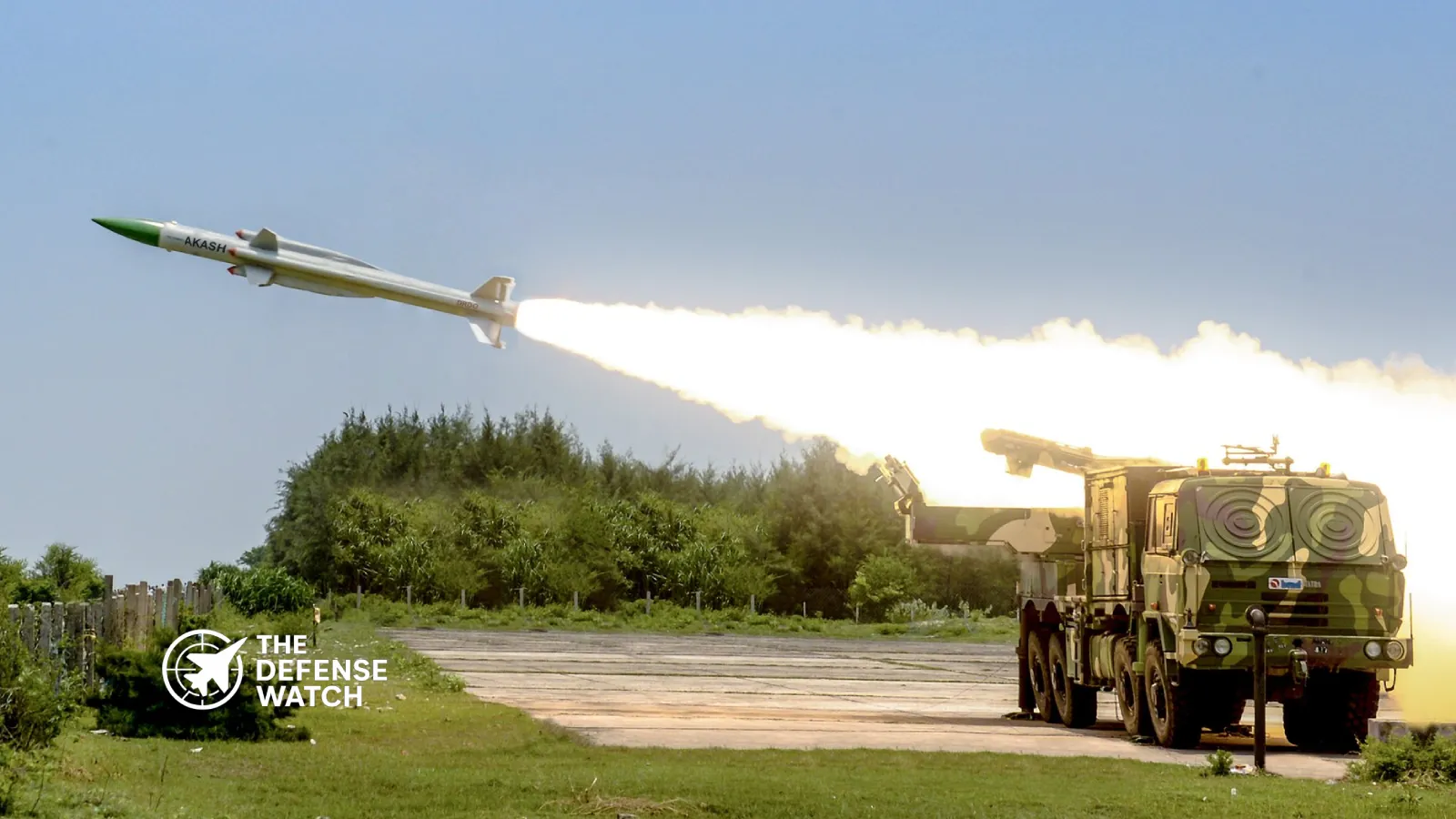
- ► BDL completes First-off Production Model of Advanced Akash Weapon System.
- ► Upgraded subsystems improve tracking, engagement, and reliability.
- ► System designed to counter aircraft, drones, and cruise missile threats.
- ► Marks transition from development to scaled production phase.
- ► Enhances India’s layered air defense architecture and operational readiness.
Advanced Akash Weapon System FOPM Signals Production Breakthrough
The Advanced Akash Weapon System FOPM has been successfully completed by Bharat Dynamics Limited (BDL), marking a key milestone in India’s air defense modernization effort. The First-off Production Model confirms that the upgraded system has transitioned from development into production-ready configuration.
BDL announced that the system incorporates improved subsystems designed to enhance overall performance, reliability, and combat effectiveness for the Indian Armed Forces.
This milestone follows ongoing efforts by India’s defense industry to strengthen indigenous missile capabilities under long-term modernization programs.
Upgraded Subsystems Enhance Combat Capability
The Advanced Akash system builds on the legacy Akash surface-to-air missile platform, widely deployed by both the Indian Army and Air Force. The upgraded version integrates refined electronics, improved guidance systems, and enhanced radar coordination.
These upgrades are expected to improve:
- Target tracking accuracy in complex environments
- Engagement capability against faster and lower-flying threats
- System reliability and maintainability in field conditions
The Akash system is designed to intercept a range of aerial threats, including fighter aircraft, unmanned aerial vehicles, and certain types of cruise missiles.
From an operational perspective, the improvements suggest a focus on countering evolving aerial threats, particularly those involving low-observable or high-speed targets.
Strategic Role in India’s Air Defense Network
The Advanced Akash Weapon System FOPM plays a key role in India’s layered air defense architecture. The system is positioned as a medium-range surface-to-air missile platform, bridging the gap between short-range air defense systems and longer-range assets such as the S-400.
Its mobility and networked radar integration allow it to be deployed for both point defense and area defense missions.
India’s approach reflects a broader trend seen globally, where countries are investing in multi-layered air defense systems to counter increasingly diverse aerial threats, including drones and precision-guided munitions.
Industrial and Production Implications
Completion of the First-off Production Model typically indicates that the system has passed validation checks required for series production. For BDL, this milestone confirms readiness to move toward larger-scale manufacturing.
As the primary production agency for several Indian missile systems, BDL’s role is central to sustaining supply chains and meeting operational requirements.
The transition to production also suggests that additional orders or follow-on contracts may be aligned with India’s long-term force structure planning, though no new procurement figures were disclosed in the announcement.
Broader Modernization Context
The Advanced Akash Weapon System FOPM milestone comes amid a wider push by India to upgrade its air defense capabilities across multiple layers.
This includes:
- Expansion of indigenous missile programs
- Integration of advanced radar and sensor networks
- Increased focus on counter-drone technologies
The emphasis on domestic production reflects policy priorities aimed at reducing reliance on foreign defense imports while strengthening local industry.
From a regional perspective, improvements to India’s air defense systems may influence threat calculations and defense planning across South Asia, particularly in scenarios involving contested airspace or rapid-response operations.
Get real time update about this post category directly on your device, subscribe now.


