
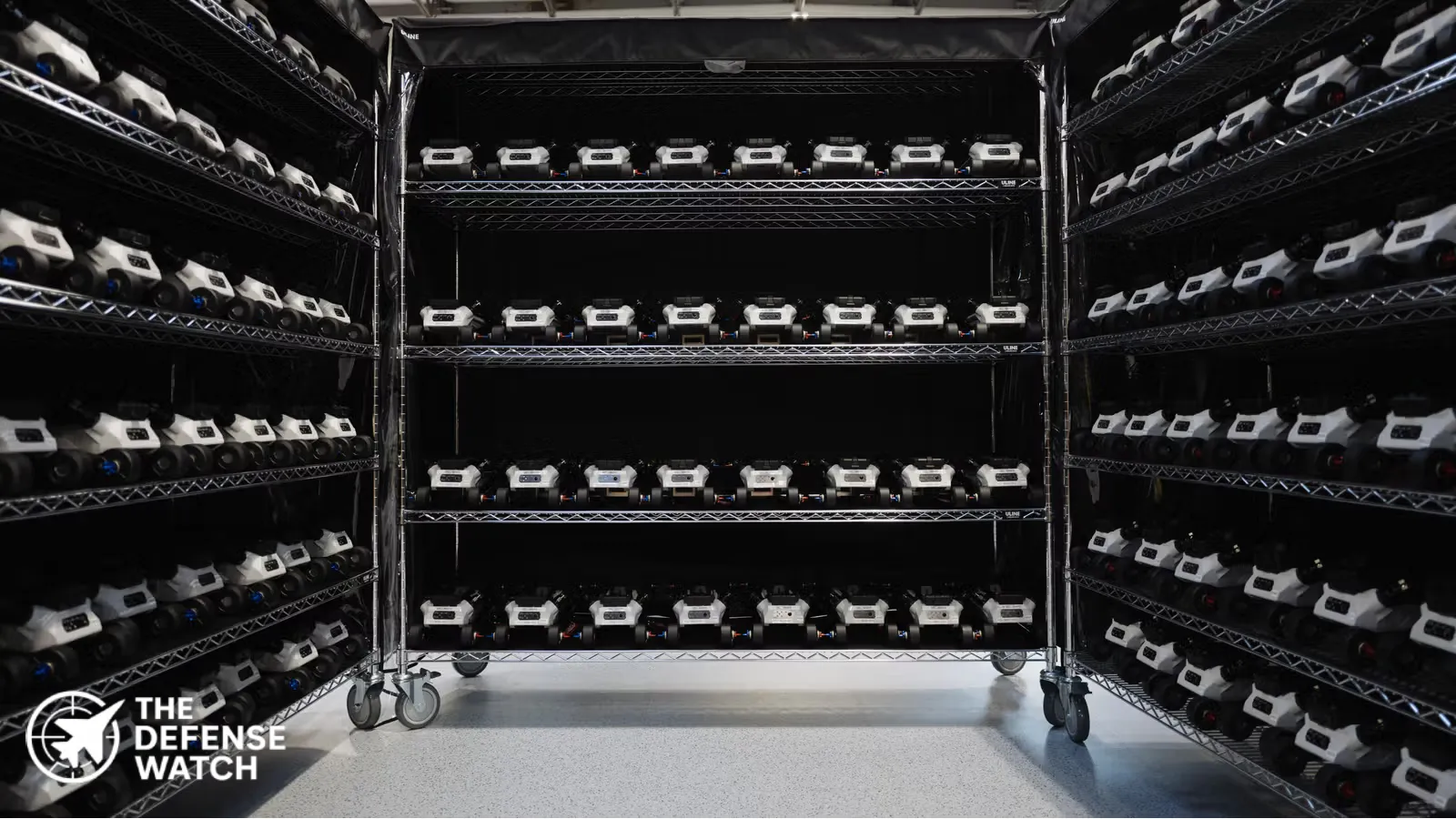
US Marines Pick Anduril Bolt-M Loitering Munition for OPF-L (Intro)
The Anduril Bolt-M loitering munition has been selected by the United States Marine Corps as the initial fielding solution under the Organic Precision Fires-Light (OPF-L) program, following successful testing and a new contract award, Marine officials and the company say.
Small, mobile and designed for infantry use, the Bolt-M will give dismounted Marine rifle squads a beyond-line-of-sight precision strike option once deployed in units starting in summer 2026.
Contract Award and Schedule
In January 2026, Anduril Industries announced it received a $23.9 million award to produce and deliver more than 600 Bolt-M systems to the Marine Corps under OPF-L.
Deliveries of the systems, along with ground control stations and support gear, are scheduled from February 2026 through April 2027. The first Marine units are expected to begin fielding and training with the systems in summer 2026.
Marine Corps Program officials have framed OPF-L as a way to push precision fires down to the rifle squad level, giving frontline units tools that were traditionally available only through higher-echelon support.
What Bolt-M Brings to Infantry Units
The Bolt-M is a vertical take-off and landing (VTOL) loitering munition that can be carried in a pack and launched rapidly by small teams. Its design supports fast deployment in confined terrain without elaborate launch gear.
Built to operate beyond visual line of sight, Bolt-M features autonomy, modular warhead options, and onboard guidance that eases operator workload. It integrates with Anduril’s software suite to plan missions, track targets and execute strikes.
Bolt-M systems weigh roughly 13 to 15 pounds, have a flight endurance around 40 minutes and a range in the 20 kilometer class, giving squads the ability to gather information and strike targets at distance.
Testing and Evaluation
Before the contract award, the Marine Corps evaluated more than 250 Bolt-M systems over about 13 months of testing. The systems were assessed for safety, environmental performance and mission reliability across hundreds of flights.
Officials said performance across endurance, payload and range checks informed the decision to select Bolt-M for initial fielding under OPF-L.
Production Scaling
Anduril says it has invested in manufacturing capacity for Bolt-M, aiming to produce more than 100 all-up rounds per month and increasing that capacity across Bolt variants to above 175 systems per month in 2026.
Analysts note that scaling production capability will be important as the Marine Corps integrates loitering munitions more broadly across its infantry formations.
Program Context
OPF-L is part of the Corps’ broader effort to provide organic precision fires at lower echelons, giving commanders more options in fast-moving, distributed operations. It sits alongside other loitering munition efforts, including systems from AeroVironment and Teledyne FLIR, chosen for separate roles in the same program.
Marine leaders have emphasized that OPF-L tools are intended to complement existing fires, not replace systems such as artillery or air support.
Operational Outlook
Bolt-M fielding aligns with a shift in infantry tactics that places a premium on small, networked precision strike options. For the Marine Corps, providing squads with organic strike capability may improve responsiveness in complex environments where traditional fire support is delayed or constrained.
As units begin training in 2026, commanders will be watching how Bolt-M performs in realistic conditions and how it fits within broader Marine combat operations.
Get real time update about this post category directly on your device, subscribe now.
