P-8A Operational Flight Trainer Upgrade Moves Into Execution
Aerospace Training Systems Partners JV LLP has secured a $10,096,092 firm-fixed-price contract to design, fabricate, install, integrate, test and deliver projection system upgrades for P-8A Operational Flight Trainers used by the U.S. Navy and Royal Australian Air Force.
- P-8A Operational Flight Trainer Upgrade Moves Into Execution
- Takeaways
- Contract Covers Three P-8A Training Locations
- What The Projection Upgrade Changes
- Why Projection Technology Matters In A P-8A Trainer
- Training Modernization Follows P-8A Capability Growth
- U.S. And Australian Funding Supports A Shared Training Enterprise
- From Market Research To Contract Award
- What The Contract Means For P-8A Readiness
- Work Continues Through 2028
Takeaways
Aerospace Training Systems Partners will upgrade P-8A Operational Flight Trainer projection systems used by the U.S. Navy and Royal Australian Air Force.
The award, identified as contract N6134026C1017, was made by the Naval Air Warfare Center Training Systems Division in Orlando, Florida. The contract is scheduled for completion in November 2028 and extends an upgrade effort that the Navy began developing through a competitive acquisition process earlier this year.
The procurement is significant because the P-8A is a primary maritime patrol and reconnaissance aircraft for both the United States and Australia. Maintaining high-fidelity ground training systems allows aircrews to rehearse complex missions without requiring an aircraft for every training event.
Contract Covers Three P-8A Training Locations
Work under the new contract will be divided among three locations:
| Location | Share Of Work |
|---|---|
| Jacksonville, Florida | 50% |
| Oak Harbor, Washington | 40% |
| Edinburgh, Australia | 10% |
| Total | 100% |
Jacksonville supports the Navy’s P-8A training enterprise on the U.S. East Coast, while Oak Harbor is associated with the Navy’s P-8A operations in the Pacific Northwest.
The Australian portion will be performed at RAAF Base Edinburgh, South Australia, where Australia operates its own P-8A training infrastructure. Boeing has described the Edinburgh training environment as a high-fidelity synthetic training system that allows crews to conduct substantial training on the ground, including demanding maritime missions.
The geographic distribution also reflects the close operational relationship between the U.S. Navy and Royal Australian Air Force P-8A fleets.
What The Projection Upgrade Changes
The contract is focused specifically on the projection system used by the Operational Flight Trainer rather than replacing the aircraft simulator itself.
The Navy’s earlier procurement documents called for a comprehensive upgrade involving the design, fabrication, installation, integration, testing and delivery of a new projection system for P-8A training devices. The requirement was developed for training systems at Jacksonville, Whidbey Island and RAAF Base Edinburgh.
The underlying procurement documentation identified 19 Operational Flight Trainer devices across the three locations. The planned distribution included 10 devices at Naval Air Station Jacksonville, seven at Naval Air Station Whidbey Island and two at RAAF Base Edinburgh.
The upgrade therefore represents a distributed modernization effort rather than a single simulator installation.
Earlier procurement material also identified replacement of existing out-the-window projection equipment and associated hardware, along with integration into the existing training architecture. The objective is to bring the affected devices toward a common hardware and software baseline while preserving compatibility with existing trainer interfaces.
Why Projection Technology Matters In A P-8A Trainer
Projection systems are a core component of high-fidelity flight simulation because they provide the visual environment surrounding the simulated aircraft.
For a P-8A crew, that environment can support training involving navigation, takeoffs and landings, formation activities, weather conditions, maritime operations and other scenarios that require accurate visual cues.
Modernizing the projection layer can therefore affect more than image quality. A simulator’s visual system has to work with the aircraft model, flight software, display hardware and training scenario infrastructure. Changes to one part of the system must be integrated and tested against the rest of the trainer.
That makes this contract an integration project as much as a hardware modernization effort.
The Navy’s procurement documents specifically called for design, integration and testing rather than simply purchasing replacement projectors. The requirement also included compatibility with existing Operational Flight Trainer interfaces and operational requirements.
Training Modernization Follows P-8A Capability Growth
The timing of the training-system upgrade is also relevant to the broader P-8A modernization program.
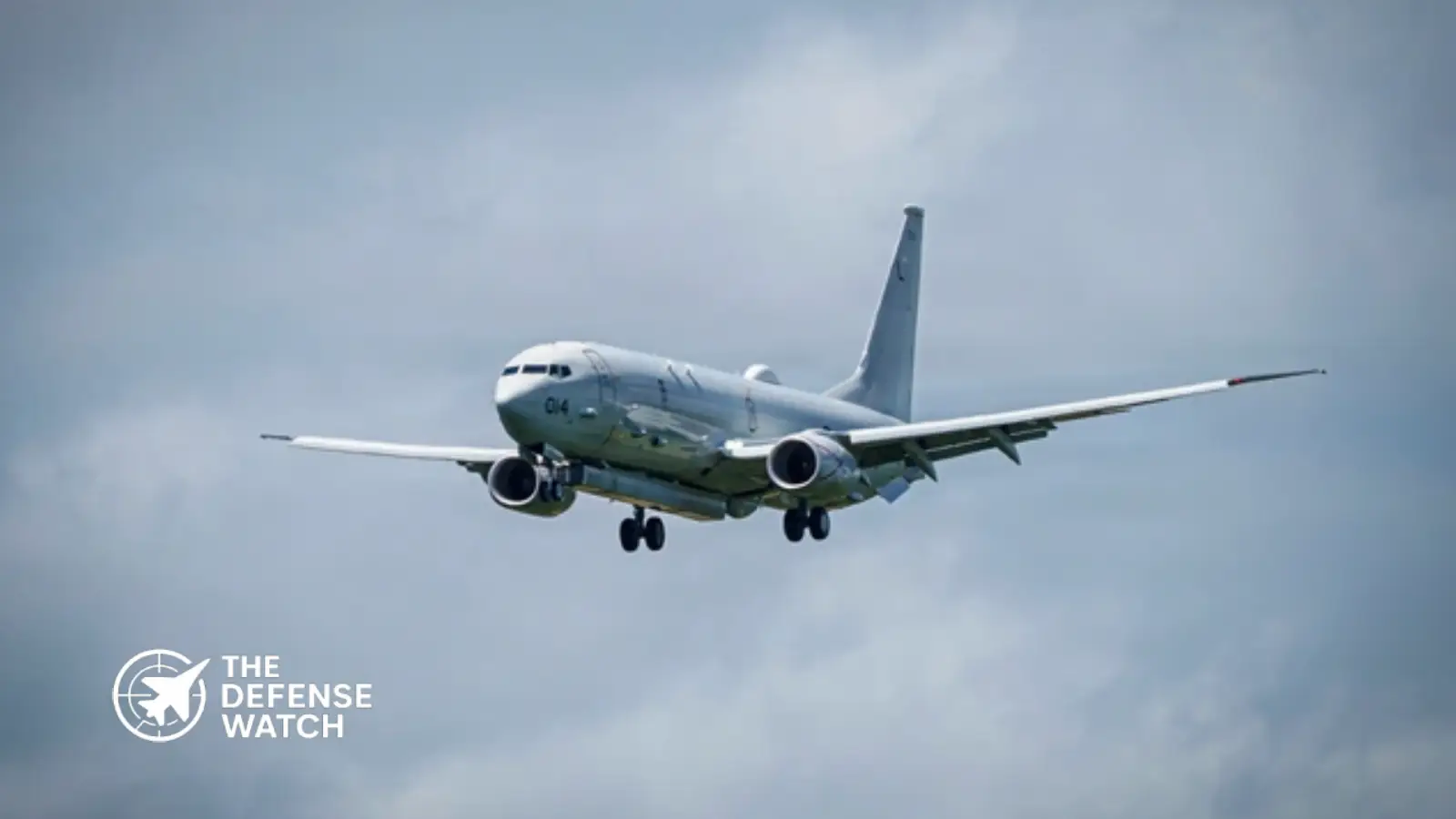
In April 2026, Naval Air Systems Command announced that the P-8A Poseidon Increment 3 Block 2 configuration had reached initial operational capability. NAVAIR said the modification includes new airframe racks, radome, antennas, sensors and wiring and is intended to improve the aircraft’s maritime intelligence, surveillance, reconnaissance and targeting capabilities.
As aircraft systems evolve, training devices have to remain aligned with the aircraft configuration they represent.
A mismatch between an operational aircraft and its associated trainer can reduce the value of simulator-based training. Conversely, maintaining a common and current trainer configuration allows crews to practice procedures and aircraft responses in a controlled environment before performing them in flight.
The projection upgrade does not by itself represent a new P-8A weapon or sensor capability. Its importance lies in maintaining the training infrastructure that supports crews operating an increasingly capable aircraft.
U.S. And Australian Funding Supports A Shared Training Enterprise
The contract is funded by both countries.
The U.S. Navy will obligate $8,202,118 in fiscal 2026 aircraft procurement funds, while $1,893,974 in Royal Australian Air Force cooperative funds will be obligated at award.
That brings the initial obligated funding to the full contract value of $10,096,092.
The shared funding structure is consistent with the fact that the upgrade supports P-8A training systems operated by both countries. Australia is one of the major international P-8A operators, and common training architecture can support greater consistency across allied P-8A fleets.
The procurement was conducted as a small-business set-aside, with four offers received. The award demonstrates that specialized simulator modernization work continues to provide opportunities for smaller defense training and engineering companies alongside major aircraft and systems manufacturers.
From Market Research To Contract Award
The award follows a procurement process that began publicly in January 2026.
NAWCTSD released a sources-sought notice in January seeking potential contractors capable of designing, fabricating, installing, integrating, testing and delivering the P-8A Operational Flight Trainer projection system upgrade.
The Navy subsequently conducted an industry day in April to brief prospective vendors on the planned requirement and draft solicitation. The acquisition was identified as a small-business set-aside commercial competition.
The final award to Aerospace Training Systems Partners now moves the program from procurement into execution.
Aerospace Training Systems Partners describes itself as a joint venture established in 2013 and provides training support, training device support, electronic hardware sustainment, engineering, cybersecurity and program management services.
What The Contract Means For P-8A Readiness
The immediate effect of the award will be modernization of the visual projection systems supporting P-8A Operational Flight Trainers in the United States and Australia.
The broader significance is that simulator infrastructure is becoming an increasingly important part of maintaining readiness as aircraft fleets receive new sensors, avionics and mission capabilities.
For a maritime patrol aircraft such as the P-8A, training extends well beyond basic aircraft handling. Crews operate sophisticated mission systems and conduct missions that can require coordination among pilots, naval flight officers and other aircrew.
High-fidelity synthetic training provides a way to rehearse those activities repeatedly while reducing dependence on live aircraft hours for selected training events.
The Navy’s decision to upgrade projection systems across multiple existing trainers also points to a lifecycle approach to training infrastructure. Instead of replacing complete devices, the service is modernizing a critical subsystem while retaining the existing trainer architecture.
That approach can reduce the disruption associated with replacing an entire training system and can help maintain continuity across established training centers.
Work Continues Through 2028
Aerospace Training Systems Partners is expected to complete the P-8A Operational Flight Trainer projection system upgrade contract in November 2028.
The work will be distributed between Jacksonville, Oak Harbor and Edinburgh, linking U.S. Navy and Australian P-8A training infrastructure under the same modernization effort.
For the Navy and Royal Australian Air Force, the contract provides a defined path to update the visual systems supporting existing P-8A training devices while the aircraft itself continues to receive capability improvements.
The result will not be a new aircraft or weapons system. Instead, it is an investment in the training infrastructure required to ensure that crews can continue preparing for P-8A missions using modern, high-fidelity simulation.
Contract At A Glance
| Item | Details |
|---|---|
| Contractor | Aerospace Training Systems Partners JV LLP |
| Headquarters | Norman, Oklahoma |
| Contract Number | N6134026C1017 |
| Contract Value | $10,096,092 |
| Contract Type | Firm-fixed-price |
| Customer | U.S. Navy and Royal Australian Air Force |
| Contracting Activity | Naval Air Warfare Center Training Systems Division |
| Primary Work | P-8A Operational Flight Trainer projection system upgrades |
| Jacksonville Share | 50% |
| Oak Harbor Share | 40% |
| Edinburgh Share | 10% |
| U.S. Funding | $8,202,118 |
| Australian Funding | $1,893,974 |
| Offers Received | Four |
| Procurement | Small-business set-aside |
| Expected Completion | November 2028 |