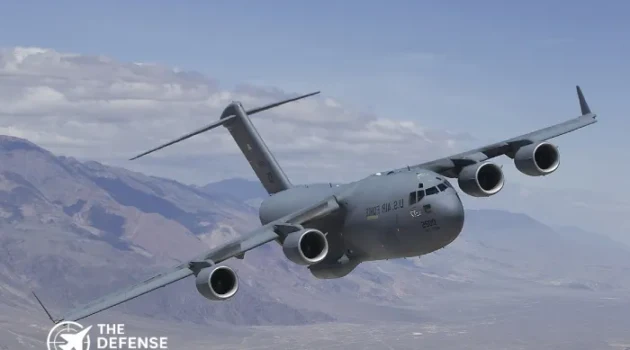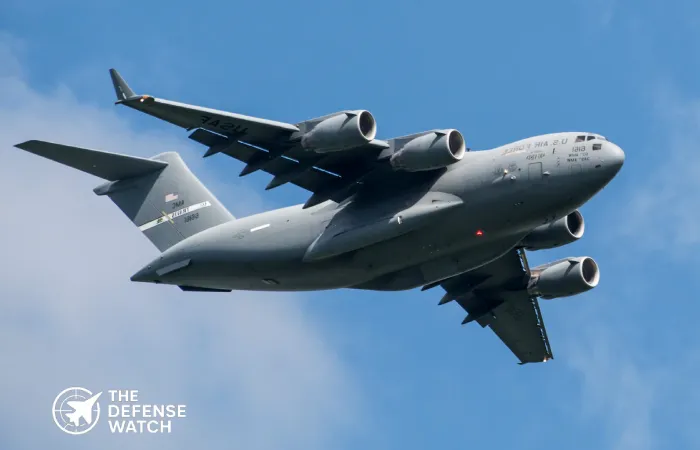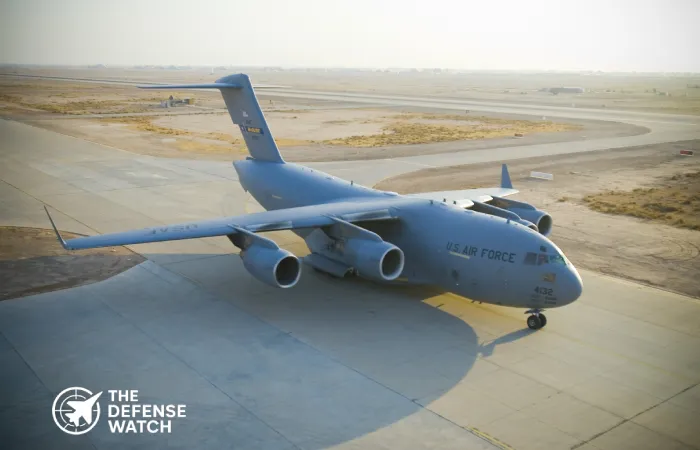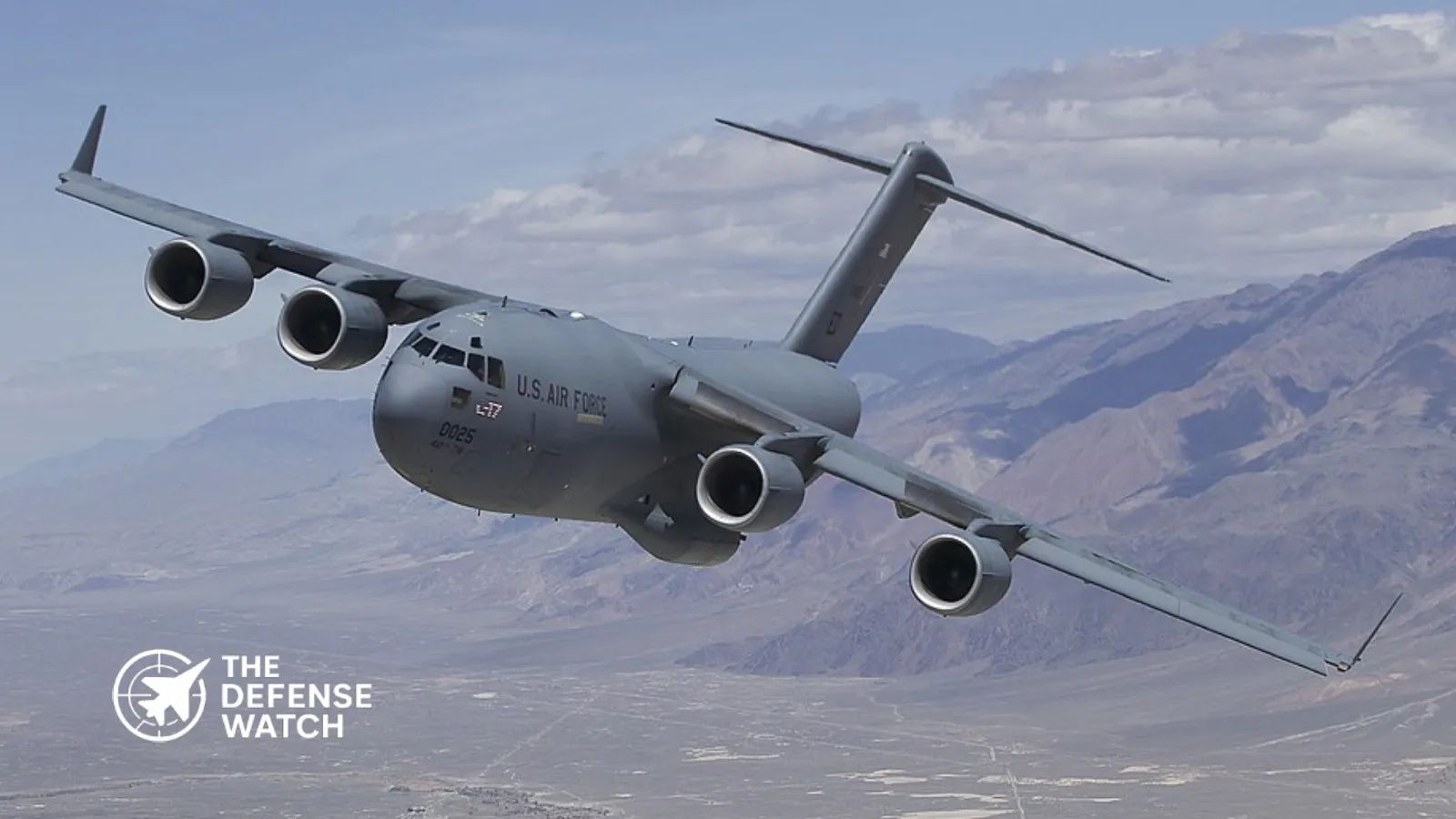
- ► The Boeing Company was awarded a $13,150,150 firm fixed price contract for C-17 infrared countermeasures upgrades.
- ► The contract upgrades Block 10 aircraft to Block 30 configuration on eight Royal Australian Air Force and five Royal Canadian Air Force C-17s.
- ► Scope includes procurement of Group A kits, Group A and B installation, and supplier technical support.
- ► Work will be performed in San Antonio, Texas, with completion expected by July 2030.
- ► The award was issued as a sole source acquisition under the Foreign Military Sales program.
- ► The Air Force Life Cycle Management Center at Warner Robins, Georgia, is the contracting activity.
C-17 Infrared Countermeasures Upgrade Expands Allied Airlift Survivability
The C-17 infrared countermeasures upgrade awarded to The Boeing Company signals a steady shift in how U.S. allies are protecting their strategic airlift fleets against evolving missile threats.
Under a $13.15 million firm fixed price contract, Boeing will upgrade Block 10 aircraft to Block 30 configuration for eight Royal Australian Air Force C-17s and five Royal Canadian Air Force aircraft. The work will be performed in San Antonio, Texas, with completion expected by July 2030. The contract is executed through the U.S. Foreign Military Sales framework and managed by the Air Force Life Cycle Management Center at Warner Robins, Georgia.
At face value, this is a modest sustainment contract. In operational terms, it reflects a broader recalibration of survivability standards for strategic transport aircraft operating in contested environments.
Why Infrared Countermeasures Matter More Now
Strategic airlifters like the Boeing C-17 Globemaster III were originally designed for rapid global mobility, including operations into semi prepared or austere airfields. Historically, survivability enhancements focused on radar warning receivers, electronic countermeasures, and flare dispensing systems to defeat legacy infrared guided missiles.
The threat landscape has changed.
Man portable air defense systems, or MANPADS, have proliferated widely. Modern variants field improved seekers, resistance to decoys, and greater range. State and non state actors now operate advanced infrared guided systems that can threaten large aircraft during takeoff, landing, or low altitude operations.
Upgrading from Block 10 to Block 30 configuration enhances aircraft defensive suites, including improved infrared countermeasure integration. While detailed technical specifications are not public, Block 30 modifications generally reflect updated survivability hardware and system architecture aligned with U.S. Air Force fleet standards.

For Australia and Canada, this matters because both air forces routinely deploy their C-17s into operational theaters where threat levels cannot be dismissed as permissive.
Operational Impact for Australia and Canada
Australia operates eight C-17 aircraft and relies on them for regional rapid response across the Indo Pacific. The aircraft support humanitarian assistance, military deployments, and joint operations with the United States and regional partners.
In a potential high intensity contingency in the Western Pacific, large transport aircraft would be tasked with moving troops, heavy equipment, and supplies across vast distances. Forward airfields could be within reach of advanced missile systems. Enhanced infrared countermeasures increase the probability that these aircraft can operate in higher risk airspace with reduced vulnerability.
Canada’s fleet of five C-17s supports Arctic sovereignty missions, NATO deployments in Europe, and international crisis response. With NATO increasingly focused on deterrence along its eastern flank, Canadian airlift assets may be required to operate closer to areas where advanced air defense systems are present.
In both cases, survivability upgrades extend operational flexibility. They allow commanders to accept missions in environments that might otherwise require additional escort or standoff measures.
Interoperability Within the U.S. Security Architecture
The fact that this upgrade flows through Foreign Military Sales is significant.
Foreign Military Sales is not simply a contracting mechanism. It ensures configuration alignment between U.S. platforms and allied fleets. By moving Australian and Canadian aircraft to Block 30 standards, the U.S. Air Force maintains a higher degree of interoperability across combined operations.
This reduces logistical friction. It simplifies software updates, spare parts provisioning, and technical support. It also ensures allied fleets remain compatible with evolving U.S. threat libraries and defensive system upgrades.
The Air Force Life Cycle Management Center’s role underscores that this is not an isolated modification. It is part of a managed sustainment and modernization pathway that keeps allied C-17 fleets aligned with U.S. baselines.
In coalition operations, configuration divergence can create risk. Standardization mitigates that risk.
Industrial and Budget Dimensions
The contract value, $13.15 million, is relatively modest in defense procurement terms. That suggests this effort focuses primarily on retrofit kits, installation, and technical support rather than major structural redesign.
Work in San Antonio aligns with Boeing’s long standing sustainment footprint for the C-17 fleet. Although production of new C-17 aircraft ended in 2015, sustainment remains an active industrial base function. Upgrades such as this one help maintain skilled labor and technical expertise tied to the platform.
For Australia and Canada, incremental modernization is more cost effective than fleet replacement. Neither country is pursuing a near term successor to the C-17. Instead, both appear committed to sustaining the platform well into the 2030s and beyond.
This contract signals that survivability upgrades are now a routine line item in lifecycle management, not an optional add on.
Comparison to Global Airlift Competitors
The C-17 competes in the heavy airlift category primarily with the Airbus A400M Atlas, although the A400M occupies a slightly lighter payload class.
European operators of the A400M have similarly invested in defensive aids subsystems to counter infrared and radar guided threats. As European air forces reassess operating concepts under high threat conditions, survivability upgrades have become standard across modern transport fleets.
The U.S. Air Force continues to operate more than 220 C-17s, and its own upgrades often cascade to allied users through FMS channels. In effect, allies benefit from U.S. funded development and testing, reducing technical and financial risk.
In contrast, nations operating smaller tactical transports without advanced defensive suites may face greater vulnerability in contested environments. The modernization gap between strategic airlifters with integrated infrared countermeasures and those without is widening.
Regional Security Context
For Australia, the Indo Pacific security environment is deteriorating. Military planners must account for the presence of long range precision fires, advanced air defense systems, and gray zone coercion. Strategic mobility underpins any credible response plan.
For Canada, renewed attention to Arctic defense and NATO commitments in Europe increases the likelihood of operating near sophisticated integrated air defense networks. Even if C-17 aircraft are not penetrating defended airspace, threat envelopes can extend far beyond front lines.
In both theaters, survivability upgrades support deterrence. They signal that allied airlift will not be easily neutralized in early phases of a crisis.
Strategic Assessment
The C-17 infrared countermeasures upgrade does not shift the global military balance on its own. However, it contributes to a broader pattern.
First, it reinforces the survivability of allied strategic lift, a core enabler of power projection. Without secure airlift, reinforcement timelines slow, and deterrence credibility erodes.
Second, it strengthens alliance cohesion. By maintaining configuration alignment through Foreign Military Sales, the United States ensures that key partners remain technically integrated within its operational architecture. That reduces fragmentation inside NATO and the Indo Pacific security network.
Third, it reflects a procurement signal. Even support aircraft are being hardened against advanced missile threats. This suggests defense planners expect future operations to unfold in contested airspace, not permissive environments.
Who benefits? Australia and Canada gain improved survivability and operational flexibility. Boeing sustains its support ecosystem for a legacy but still critical platform. The U.S. benefits from more capable, interoperable partners.
Who is threatened? Any adversary relying on infrared guided surface to air missiles to disrupt allied airlift operations faces a more resilient target set. While this does not negate advanced air defenses, it raises the cost and uncertainty of attempting to interdict strategic mobility.
What happens next? Similar survivability enhancements are likely to continue across allied fleets, particularly as threat assessments evolve. Expect incremental upgrades tied to software, threat libraries, and countermeasure effectiveness as missile technology advances.
In an era where logistics determines staying power, protecting the aircraft that move armies may be as important as acquiring new combat platforms.
Get real time update about this post category directly on your device, subscribe now.