• Home
  • About
  • Defense Systems
  • Manufacturer
  • Comparisons
  • Compare 
  • Tools
TheDefenseWatch.com
  • Aerospace & Aviation
  • Military & Ordnance
  • Naval & Maritime
  • Cyber & Space Defense
  • Policy & Strategy
  • Global News
  • Tools Library
    • Smart Calculator
    • Drone Flight Time Calculator
    • Drone Range Calculator
    • Counter-Drone Jammer Effective Range Calculator
    • Counter-Battery Radar Detection Calculator
    • Artillery Fire Correction Calculator
    • Thermal Camera Detection Range Calculator
    • Missile Range & Time-of-Flight Calculator
    • Radar Detection Range Calculator
    • FPV Strike Drone Payload vs Range Calculator
    • Loitering Munition Endurance Calculator
    • Sniper Ballistic Drop & Windage Calculator
    • Bullet Drop Calculator
    • U.S. Army Combat Fitness Test (ACFT) Calculator
    • Military Pension Calculator
    • Military Retirement Calculator
    • Military Pension Calculator
    • Large Number Calculator
Font ResizerAa

TheDefenseWatch.com

The Defense Watch | U.S. & Global Defense News, Analysis & Military Updates

Search
  • Home
  • About
  • Defense Systems
  • Manufacturer
  • Comparisons
  • Compare 
  • Tools

Stay Updated

Get the latest update

Subscribe

Explore

  • Drone
  • Fighter Jets & Military Aircraft
  • Hypersonic Weapons
  • Aircraft Carriers
  • Strategic History & Missions
  • Tools Library
Home » KC-46 Pegasus vs. KC-135 Stratotanker: Comparing America’s Tanker Fleet Transition
Head-to-Head

KC-46 Pegasus vs. KC-135 Stratotanker: Comparing America’s Tanker Fleet Transition

TeamDefenseWatch
Last updated: September 9, 2026 4:10 am
TeamDefenseWatch
Share
3 Min Read
KC-46 Pegasus vs KC-135 Stratotanker
AI Generated Image
SHARE

KC-46 Pegasus vs. KC-135 Stratotanker: Comparing America’s Tanker Fleet Transition

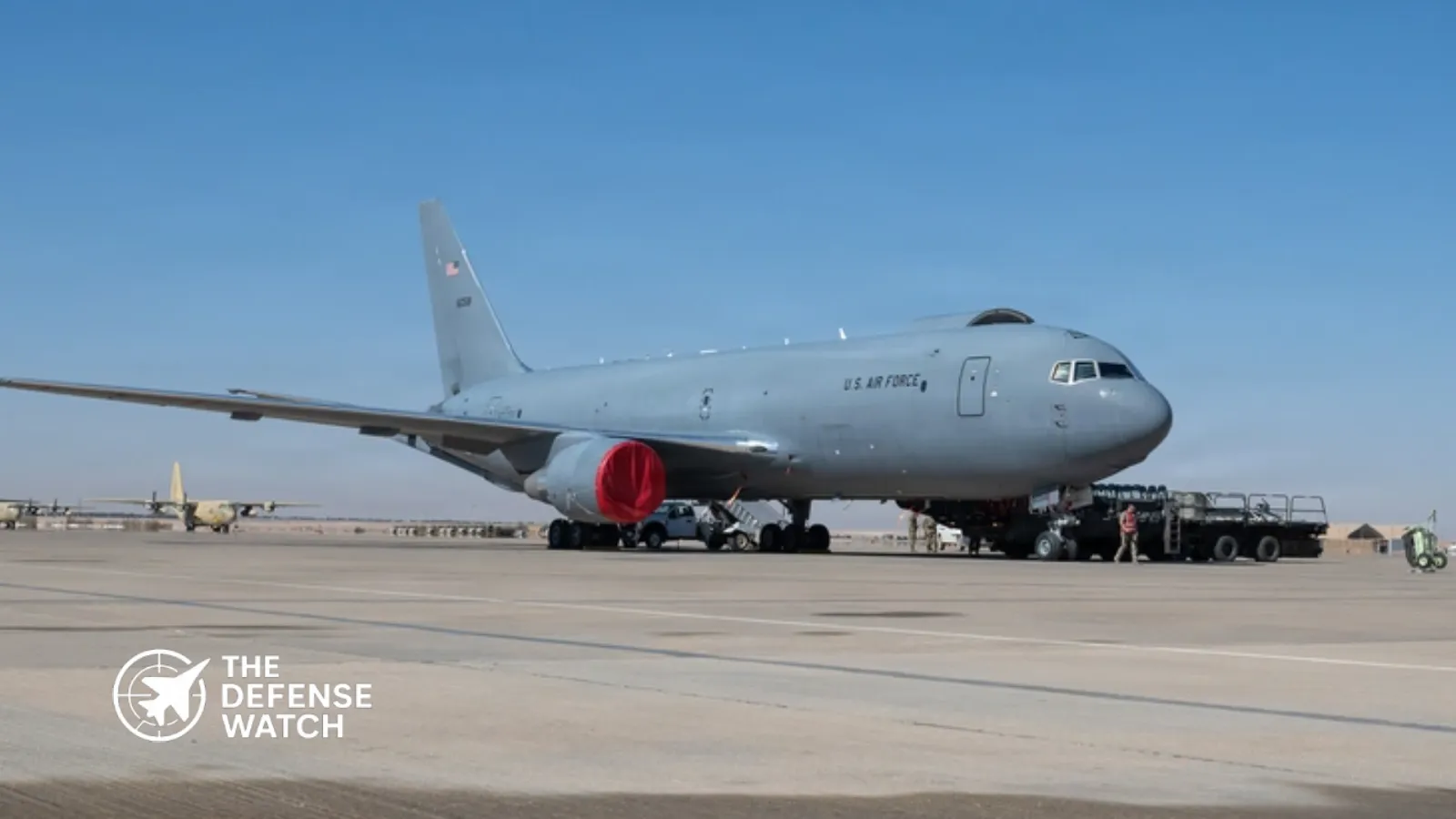
The U.S. Air Force (USAF) is balancing two generations of aerial refueling capability: the Cold War-era KC-135 Stratotanker and the next-generation KC-46 Pegasus. While the KC-135 has been the backbone of U.S. global airpower projection since the 1950s, the KC-46 represents the future—designed to meet the demands of modern warfare, Indo-Pacific operations, and multi-role missions.

Contents
  • KC-46 Pegasus vs. KC-135 Stratotanker: Comparing America’s Tanker Fleet Transition
  • Design and Performance
    • KC-135 Stratotanker: A Proven Workhorse
    • KC-46 Pegasus: Efficiency and Survivability
  • Key Specifications Side by Side
  • Operational Advantages and Challenges
    • KC-135 Advantages
    • KC-46 Advantages
    • KC-46 Challenges
  • Strategic Outlook
  • FAQs

As of September 2025, the Air Force operates approximately 396 KC-135s alongside more than 70 KC-46s, with a total of 179 Pegasus aircraft planned under current contracts. The transition underscores both the reliability of the Stratotanker and the challenges of fielding a technologically advanced replacement.

Design and Performance

KC-135 Stratotanker: A Proven Workhorse

Introduced in 1957 and derived from the Boeing 707, the KC-135 has fueled U.S. fighters, bombers, and allies across every major conflict since Vietnam. Its four CFM International F108-CF-100 turbofans provide redundancy but consume more fuel compared to modern engines. The aircraft can carry about 200,000 pounds of fuel and up to 80 passengers, with limited aeromedical capabilities.

Despite its age, extensive upgrades—including re-engining and avionics modernization—have extended its service life well into the 2040s. Its lower operating costs (around $20,000 per flight hour) make it an economical platform for routine operations.

- Advertisement -

KC-46 Pegasus: Efficiency and Survivability

Based on the Boeing 767-200ER airframe, the KC-46 Pegasus brings a modern twin-engine design powered by Pratt & Whitney PW4062 turbofans. It can carry 212,299 pounds of fuel, nearly three times more cargo pallets than the KC-135, and up to 114 passengers—doubling personnel capacity.

Equipped with advanced Large Aircraft Infrared Countermeasures (LAIRCM), radar warning systems, and hardened systems for contested environments, the Pegasus offers survivability features the Stratotanker never had. Its fly-by-wire refueling boom and wing-mounted hose-and-drogue pods provide compatibility with U.S. and allied aircraft, reducing contact times and easing pilot workload.

Key Specifications Side by Side

FeatureKC-135 StratotankerKC-46 Pegasus
Manufacturer/Base ModelBoeing (707 prototype, 1950s design)Boeing (767-200ER airliner, 1980s design)
Crew3 (pilot, co-pilot, boom operator; navigator optional)3 (pilot, co-pilot, boom operator; remote station)
Engines4 × CFM International F108-CF-100 turbofans (high-bypass upgrades)2 × Pratt & Whitney PW4062 turbofans
Max Takeoff Weight322,500 lb (146,285 kg)415,000 lb (188,240 kg)
Fuel Capacity200,000 lb (90,718 kg)212,299 lb (96,297 kg)
Refueling MethodsPrimarily flying boom; limited drogue adaptersBoom + hose-and-drogue (wing pods for independent ops)
Cargo CapacityUp to 6 pallets; ~83,000 lb totalUp to 18 pallets (3x more than KC-135); ~65,000 lb
Passenger CapacityUp to 80Up to 114 (double the KC-135)
Aeromedical Evac (Medevac)Limited (basic litter setup)Up to 54 patients (30% more capacity)
Range~7,000 nmi (unrefueled)~7,200 nmi (unrefueled)
Max SpeedMach 0.90 (530 kn, 981 km/h)Mach 0.86 (530 kn, 981 km/h)
Service Ceiling50,000 ft (15,240 m)43,100 ft (13,140 m)
Defensive SystemsBasic radar warning; limited IR countermeasuresAdvanced: LAIRCM (IR countermeasures), RDR (radar warning), tactical datalinks
Ramp Space NeededLarger footprint (4 engines)Smaller (2 engines; shorter runways viable)
Unit Cost (FY2025 est.)~$39.6M (upgraded R-model)~$150M (includes modern avionics)

Operational Advantages and Challenges

KC-135 Advantages

  • Proven reliability across six decades of operations
  • Lower cost per flight hour
  • Massive fleet size for surge capacity
  • Available across active, Reserve, and Guard units

KC-46 Advantages

  • Multi-mission versatility: cargo, medevac, passengers, and refueling
  • Advanced defensive systems for contested environments
  • Glass cockpit and data links for modern battlespace integration
  • Certified for 20+ receiver aircraft, including the F-35 Lightning II

KC-46 Challenges

Despite its strengths, the KC-46 has faced setbacks. Issues with the Auxiliary Power Unit (APU) led to temporary restrictions in July 2025, while boom nozzle binding incidents and structural cracks caused delivery pauses earlier this year. Only about 70 aircraft have been fielded, short of initial goals, though Boeing continues to address deficiencies.

Strategic Outlook

The USAF’s tanker recapitalization strategy is phased. The KC-46 will replace roughly half of the KC-135 fleet, while a future KC-Y program is expected to address long-term replacement needs. Until then, the KC-135 remains indispensable, ensuring global refueling capacity while the Pegasus matures.

For contested regions like the Indo-Pacific, where range and survivability are critical, the KC-46 will likely prove essential once fully operational. However, the KC-135’s endurance and cost-effectiveness ensure it remains a cornerstone during the transition period.

Analysis: The transition from KC-135 to KC-46 reflects broader defense modernization challenges: balancing legacy reliability with new capability. Like other next-generation programs, the Pegasus offers leap-ahead technology but faces cost overruns and technical hurdles. The USAF’s decision to maintain both fleets for the foreseeable future reflects pragmatism—leveraging the old while integrating the new.

Source: U.S. Air Force official fact sheets

FAQs

Why is the KC-135 still in service after nearly 70 years?

The KC-135 has proven reliable, cost-effective, and adaptable through upgrades, making it indispensable until the KC-46 fleet is fully fielded.

What makes the KC-46 different from the KC-135?

The KC-46 offers multi-role versatility, advanced defensive systems, and interoperability with allied aircraft—capabilities the KC-135 lacks.

When will the KC-46 fully replace the KC-135?

Current USAF plans aim for phased replacement into the 2030s, but some KC-135s may remain operational into the 2040s.

How much does the KC-46 cost compared to the KC-135?

The KC-46 costs about $150 million per unit, compared to an estimated $39.6 million for an upgraded KC-135R model.


TAGGED:aerial refuelingBoeing DefenseKC-135 StratotankerKC-46 PegasusU.S. Air Force Tanker Fleet
Share This Article
Facebook Copy Link Print
ByTeamDefenseWatch
TeamDefenseWatch is the official editorial byline of TheDefenseWatch.com. Working under one umbrella, TheDefenseWatch.com, the team delivers verified, factual reporting on global defense, military technology, aerospace systems, and security developments. Articles are sourced from official statements, defense industry releases, and trusted media, with editorial review to ensure accuracy and clarity.Contact: info@TheDefenseWtach.com
3 Comments
  • Pingback: Rafale vs F-35: Europe’s Multirole Fighter Against America’s Stealth Power
  • Pingback: RFA Tidespring Completes Record 291-Day Mission Supporting UK Carrier Strike Group | TheDefenseWatch.com
  • Pingback: US Moves Patriot Missiles to Mobile Launchers at Qatar Base as Tensions With Iran Rise | TheDefenseWatch.com

Leave a Reply Cancel reply

Your email address will not be published. Required fields are marked *

F-22 Reptor

Latest Defense Systems

  • B61 Nuclear Bomb B61 Nuclear Bomb
  • Japan E-767 Airborne Japan E-767 Airborne
  • Remington 870 Shotgun Remington 870 Shotgun
  • RUTA B1 Cruise Missile RUTA B1 Cruise Missile
  • XQ-67A Drone XQ-67A Drone
  • B-25 Mitchell Bomber B-25 Mitchell Bomber
  • F-100 Super Sabre F-100 Super Sabre
  • North American F-86 Sabre North American F-86 Sabre
  • North American XB-70 Valkyrie North American XB-70 Valkyrie

Recent Compares

  • J-10C vs JF-17 Thunder: Which Fighter Is More Capable? J-10C vs JF-17 Thunder: Which Fighter Is More Capable? View Comparison →
  • Tejas vs Gripen: Key Differences and Capabilities Tejas vs Gripen: Key Differences and Capabilities View Comparison →
  • Tejas vs MiG-21 Bison: How India Replaced Its Iconic Supersonic Fighter Tejas vs MiG-21 Bison: How India Replaced Its Iconic Supersonic Fighter View Comparison →
  • F-35 vs F-16: Stealth, Sensors and Combat Roles F-35 vs F-16: Stealth, Sensors and Combat Roles View Comparison →
  • Tejas Fighter Jet vs F-16 Fighting Falcon: Capability Compared Tejas Fighter Jet vs F-16 Fighting Falcon: Capability Compared View Comparison →
  • Rafale Fighter Jet vs F-16 Fighting Falcon : Which Fighter Has the Edge? Rafale Fighter Jet vs F-16 Fighting Falcon : Which Fighter Has the Edge? View Comparison →
  • Su-57 Fighter Jet vs J-20 Fighter Jet: Stealth and Air Combat Compared Su-57 Fighter Jet vs J-20 Fighter Jet: Stealth and Air Combat Compared View Comparison →
  • Mirage 2000 vs Tejas Mk1A: Legacy Combat Power vs Indigenous Modernization Mirage 2000 vs Tejas Mk1A: Legacy Combat Power vs Indigenous Modernization View Comparison →
  • Rafale Fighter Jet vs F-22 Raptor: Which Air Dominance Fighter Has the Edge? Rafale Fighter Jet vs F-22 Raptor: Which Air Dominance Fighter Has the Edge? View Comparison →
  • Tejas Fighter Jet vs. Rafale Fighter Jet: India’s Indigenous Fighter Meets France’s Proven Multirole Combat Aircraft Tejas Fighter Jet vs. Rafale Fighter Jet: India’s Indigenous Fighter Meets France’s Proven Multirole Combat Aircraft View Comparison →

Recent Posts

  • Remington 870 in Military Service: Mark 1 to MCS
  • Boeing Receives $16.9 Million Contract Modification for Japan’s E-767 AWACS Support
  • Lockheed Martin Wins $80 Million Air Force Mission Planning Software Contract
  • Pakistan Tests Indigenous Fa’az Air-to-Air Missile for First Time
  • Operation Unified Resolve Reports 70% Drop in Rio Grande Valley Border Crossings

You Might Also Like

Eurofighter Typhoon vs Rafale vs F-35
Head-to-Head

Eurofighter Typhoon vs Rafale vs F-35: European Airpower Comparison

September 8, 2026
HIMARS vs Kalibr
Head-to-Head

HIMARS vs Kalibr: Detailed Range, Strike Power & Capability Comparison

September 9, 2026
KC-46 tanker problems
Aerospace & AviationFighter Jets & Military Aircraft

USAF Says Boeing Must Fix KC-46 Tanker Problems Before New 75 Aircraft Order

September 8, 2026
Boeing engineers supporting AN/USQ-82 integrated combat system aboard a U.S. Navy destroyer during fleet modernization operations
Defense Contracts

Boeing Secures $18.6 Million AN/USQ-82 Support Contract for U.S. Navy and Allied Fleets

May 16, 2026

Logo

Copyright © 2026 TheDefenseWatch.com

Helpful Links

  • Home
  • About Us
  • Privacy Policy
  • Terms of Use / Disclaimer
  • U.S. Privacy Notice – CCPA Compliance

Defense Systems

  • Defense Systems
  • Comparisons 
  • Manufacturer
  • Tactical Calculators

Popuplar

Which 5 Air Forces Possess the Costliest Fighter Jet Fleets in the World
Evolving Strategic Value: Carrier Strike Groups in the Indo-Pacific’s Future Security Architecture
Autonomous Weapon Systems Spark U.S. Ethics Debate Amid Rapid Military AI Integration

We report on developments involving military forces, governments, defense companies, research organizations, and security institutions around the world. 

Welcome Back!

Sign in to your account

Username or Email Address
Password

Lost your password?