

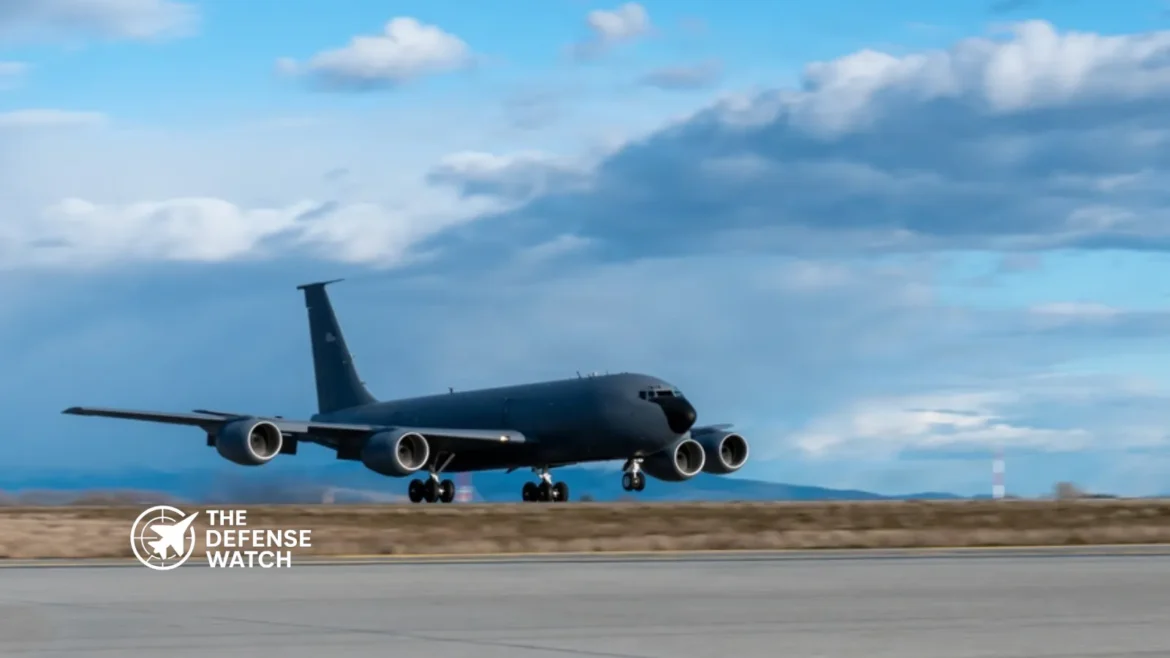
- Five US Air Force KC-135 Stratotanker aircraft were reportedly damaged during an Iranian missile strike on Prince Sultan Air Base in Saudi Arabia.
- The aircraft were on the ground when the strike occurred and sustained varying levels of damage but were not destroyed.
- The attack highlights the vulnerability of forward deployed support aircraft critical to US air operations in the Middle East.
- The strike occurred amid escalating US Iranian tensions linked to ongoing military operations in the region.
- Aerial refueling tankers remain a cornerstone capability enabling long range strike and persistent airpower.
Iranian Missile Strike Damages US KC-135 Tankers
The Iranian missile strike KC-135 incident has reportedly damaged five U.S. Air Force KC-135 Stratotanker aerial refueling aircraft at Prince Sultan Air Base in Saudi Arabia, according to U.S. officials cited in multiple reports. The aircraft were struck while parked on the ground during a missile attack linked to escalating regional tensions involving Iran and U.S. forces.
Officials said the tankers were damaged but not destroyed, and repair efforts are underway. No casualties were reported in the attack.
The incident represents one of the most significant reported hits on U.S. aerial refueling infrastructure during the current Middle East crisis.
The Big Picture
Aerial refueling aircraft are among the most critical enabling assets in modern air warfare. The KC-135 Stratotanker, a long serving U.S. Air Force tanker introduced in the late 1950s, allows fighters, bombers, and surveillance aircraft to remain airborne for extended missions far from their home bases.
In the Middle East theater, tanker aircraft are essential to maintaining U.S. airpower projection across large operational distances. Aircraft supporting strike missions, intelligence flights, and air patrols rely heavily on mid air refueling to sustain high sortie rates.
Forward bases such as Prince Sultan Air Base in Saudi Arabia serve as critical hubs for these operations, enabling coalition aircraft to conduct long range missions over Iraq, Syria, the Persian Gulf, and Iran.
When these support assets are disrupted, operational tempo and mission flexibility can quickly become constrained.
What’s Happening
According to reporting citing two U.S. officials, five KC-135 Stratotanker aircraft were hit during an Iranian missile strike on Prince Sultan Air Base in Saudi Arabia.
The tankers were reportedly parked on the airfield at the time of the attack. Initial assessments indicate the aircraft suffered structural or systems damage but were not completely destroyed.
Officials said maintenance teams are working to repair the aircraft, though the timeline for returning them to service remains unclear.
The attack occurred amid broader Iranian retaliatory strikes targeting regional infrastructure and U.S. military facilities following escalating hostilities between Iran and U.S. aligned forces.
Iran has conducted missile and drone strikes against multiple targets across Saudi Arabia since the conflict began, including energy infrastructure and military installations.
Prince Sultan Air Base hosts significant U.S. and coalition forces and has played a key role in regional air operations.
Why It Matters
The Iranian missile strike KC-135 incident underscores the vulnerability of high value support aircraft stationed at forward operating bases.
Unlike hardened fighter shelters, tanker aircraft are often parked on open ramps due to their large size and operational requirements. This makes them difficult to protect during missile or drone attacks.
While the reported damage did not destroy the aircraft, even temporary loss of tanker availability can disrupt complex air campaigns.
Aerial refueling capacity directly affects:
- fighter patrol duration
- bomber strike range
- intelligence and surveillance missions
- rapid response capability
When tanker availability drops, combat aircraft may need to operate closer to their bases or reduce time on station.
This can limit operational reach during sustained conflict.
Strategic Implications
The damage to five U.S. tanker aircraft illustrates how adversaries increasingly target enabling infrastructure rather than frontline combat systems.
Support assets such as tankers, surveillance aircraft, and logistics hubs are central to modern expeditionary warfare.
Disrupting these systems can have cascading operational effects.
Iran’s missile and drone capabilities have steadily expanded over the past decade, enabling the country to strike regional bases at long distances with increasing precision.
Attacks on air bases in Saudi Arabia and the Gulf also signal Tehran’s willingness to target coalition infrastructure supporting U.S. operations.
For U.S. planners, the incident reinforces the need for stronger base defense measures, including:
- layered missile defense systems
- hardened aircraft shelters
- dispersal of high value aircraft across multiple bases
- rapid runway and infrastructure repair capabilities
Such measures aim to reduce the operational risk posed by missile attacks.
Competitor View
Iran and its regional partners likely view attacks on U.S. logistical and support assets as an effective way to challenge American military superiority.
Rather than confronting advanced U.S. fighter aircraft directly, targeting tanker aircraft, drones, or air bases can impose operational costs on U.S. forces.
Strategically, these attacks demonstrate that Iran retains the capability to threaten U.S. and allied military infrastructure throughout the Gulf region.
Russia and China are also closely observing how such attacks affect U.S. expeditionary operations.
Both countries have invested heavily in strategies designed to disrupt logistics and support systems during conflict, often referred to as anti access or area denial approaches.
Events like the Iranian missile strike KC-135 incident provide real world examples of how such strategies could play out during major power conflict.
What To Watch Next
Several developments may follow in the coming weeks.
First, the U.S. military may increase air defense deployments around key regional bases. Systems such as Patriot and THAAD are commonly used to defend against ballistic and cruise missile threats.
Second, the U.S. Air Force may disperse tanker aircraft across additional bases to reduce the risk of concentrated losses.
Third, maintenance assessments will determine how quickly the damaged aircraft can return to service.
Even moderate structural damage to large aircraft like the KC-135 can require extensive inspection and repair.
Finally, the United States may increase the deployment of newer tanker platforms such as the KC-46 Pegasus to sustain refueling capacity in the theater.
Capability Gap
The incident highlights a persistent challenge in modern air operations.
Support aircraft remain large, slow, and difficult to harden against missile attack.
While fighters and bombers benefit from hardened shelters and dispersal strategies, tanker fleets often rely on exposed ramp space.
This creates a structural vulnerability that adversaries can exploit.
At the same time, replacing tanker capacity quickly during wartime remains difficult. Tankers are expensive, limited in number, and critical to global U.S. airpower.
Protecting them has become an increasingly important part of airbase defense planning.
The Bottom Line
The reported Iranian missile strike damaging five KC-135 Stratotanker aircraft highlights how attacks on support infrastructure can disrupt the operational backbone of modern airpower.

KC-46 Pegasus vs. KC-135 Stratotanker: Comparing America’s Tanker Fleet Transition
The U.S. Air Force (USAF) is balancing two generations of aerial refueling capability: the Cold War-era KC-135 Stratotanker and the next-generation KC-46 Pegasus. While the KC-135 has been the backbone of U.S. global airpower projection since the 1950s, the KC-46 represents the future—designed to meet the demands of modern warfare, Indo-Pacific operations, and multi-role missions.
As of September 2025, the Air Force operates approximately 396 KC-135s alongside more than 70 KC-46s, with a total of 179 Pegasus aircraft planned under current contracts. The transition underscores both the reliability of the Stratotanker and the challenges of fielding a technologically advanced replacement.
Design and Performance
KC-135 Stratotanker: A Proven Workhorse
Introduced in 1957 and derived from the Boeing 707, the KC-135 has fueled U.S. fighters, bombers, and allies across every major conflict since Vietnam. Its four CFM International F108-CF-100 turbofans provide redundancy but consume more fuel compared to modern engines. The aircraft can carry about 200,000 pounds of fuel and up to 80 passengers, with limited aeromedical capabilities.
Despite its age, extensive upgrades—including re-engining and avionics modernization—have extended its service life well into the 2040s. Its lower operating costs (around $20,000 per flight hour) make it an economical platform for routine operations.
KC-46 Pegasus: Efficiency and Survivability
Based on the Boeing 767-200ER airframe, the KC-46 Pegasus brings a modern twin-engine design powered by Pratt & Whitney PW4062 turbofans. It can carry 212,299 pounds of fuel, nearly three times more cargo pallets than the KC-135, and up to 114 passengers—doubling personnel capacity.
Equipped with advanced Large Aircraft Infrared Countermeasures (LAIRCM), radar warning systems, and hardened systems for contested environments, the Pegasus offers survivability features the Stratotanker never had. Its fly-by-wire refueling boom and wing-mounted hose-and-drogue pods provide compatibility with U.S. and allied aircraft, reducing contact times and easing pilot workload.
Key Specifications Side by Side
Feature KC-135 Stratotanker KC-46 Pegasus Manufacturer/Base Model Boeing (707 prototype, 1950s design) Boeing (767-200ER airliner, 1980s design) Crew 3 (pilot, co-pilot, boom operator; navigator optional) 3 (pilot, co-pilot, boom operator; remote station) Engines 4 × CFM International F108-CF-100 turbofans (high-bypass upgrades) 2 × Pratt & Whitney PW4062 turbofans Max Takeoff Weight 322,500 lb (146,285 kg) 415,000 lb (188,240 kg) Fuel Capacity 200,000 lb (90,718 kg) 212,299 lb (96,297 kg) Refueling Methods Primarily flying boom; limited drogue adapters Boom + hose-and-drogue (wing pods for independent ops) Cargo Capacity Up to 6 pallets; ~83,000 lb total Up to 18 pallets (3x more than KC-135); ~65,000 lb Passenger Capacity Up to 80 Up to 114 (double the KC-135) Aeromedical Evac (Medevac) Limited (basic litter setup) Up to 54 patients (30% more capacity) Range ~7,000 nmi (unrefueled) ~7,200 nmi (unrefueled) Max Speed Mach 0.90 (530 kn, 981 km/h) Mach 0.86 (530 kn, 981 km/h) Service Ceiling 50,000 ft (15,240 m) 43,100 ft (13,140 m) Defensive Systems Basic radar warning; limited IR countermeasures Advanced: LAIRCM (IR countermeasures), RDR (radar warning), tactical datalinks Ramp Space Needed Larger footprint (4 engines) Smaller (2 engines; shorter runways viable) Unit Cost (FY2025 est.) ~$39.6M (upgraded R-model) ~$150M (includes modern avionics) Operational Advantages and Challenges
KC-135 Advantages
- Proven reliability across six decades of operations
- Lower cost per flight hour
- Massive fleet size for surge capacity
- Available across active, Reserve, and Guard units
KC-46 Advantages
- Multi-mission versatility: cargo, medevac, passengers, and refueling
- Advanced defensive systems for contested environments
- Glass cockpit and data links for modern battlespace integration
- Certified for 20+ receiver aircraft, including the F-35 Lightning II
KC-46 Challenges
Despite its strengths, the KC-46 has faced setbacks. Issues with the Auxiliary Power Unit (APU) led to temporary restrictions in July 2025, while boom nozzle binding incidents and structural cracks caused delivery pauses earlier this year. Only about 70 aircraft have been fielded, short of initial goals, though Boeing continues to address deficiencies.
Strategic Outlook
The USAF’s tanker recapitalization strategy is phased. The KC-46 will replace roughly half of the KC-135 fleet, while a future KC-Y program is expected to address long-term replacement needs. Until then, the KC-135 remains indispensable, ensuring global refueling capacity while the Pegasus matures.
For contested regions like the Indo-Pacific, where range and survivability are critical, the KC-46 will likely prove essential once fully operational. However, the KC-135’s endurance and cost-effectiveness ensure it remains a cornerstone during the transition period.
Analysis: The transition from KC-135 to KC-46 reflects broader defense modernization challenges: balancing legacy reliability with new capability. Like other next-generation programs, the Pegasus offers leap-ahead technology but faces cost overruns and technical hurdles. The USAF’s decision to maintain both fleets for the foreseeable future reflects pragmatism—leveraging the old while integrating the new.
Source: U.S. Air Force official fact sheets
FAQs
Why is the KC-135 still in service after nearly 70 years?The KC-135 has proven reliable, cost-effective, and adaptable through upgrades, making it indispensable until the KC-46 fleet is fully fielded.
What makes the KC-46 different from the KC-135?The KC-46 offers multi-role versatility, advanced defensive systems, and interoperability with allied aircraft—capabilities the KC-135 lacks.
When will the KC-46 fully replace the KC-135?Current USAF plans aim for phased replacement into the 2030s, but some KC-135s may remain operational into the 2040s.
How much does the KC-46 cost compared to the KC-135?The KC-46 costs about $150 million per unit, compared to an estimated $39.6 million for an upgraded KC-135R model.


