

Table of Contents
The Black Hawk: America’s Most Versatile Military Helicopter
The Black Hawk helicopter has served as the backbone of US Army aviation for more than four decades, delivering unmatched versatility in combat, transport, and medical evacuation missions. Officially designated the UH-60 Black Hawk, this medium-lift utility helicopter entered service in 1979 and has since evolved into one of the most recognizable military helicopters in modern military aviation.
Manufactured by Sikorsky Aircraft Corporation, now a Lockheed Martin subsidiary, the Black Hawk was designed to replace the aging UH-1 Iroquois “Huey” fleet. The US Army helicopter program sought a platform capable of operating in diverse environments, from high-altitude mountainous terrain to desert combat zones. Today, more than 4,000 Black Hawks have been produced, serving not only the United States but also allied nations worldwide.

The helicopter aircraft’s enduring success stems from its adaptability. The Black Hawk has been modified into numerous variants supporting roles ranging from special operations insertion to electronic warfare, demonstrating why it remains indispensable to US military strategy.
Design and Technical Specifications
The Black Hawk helicopter incorporates several design features that distinguish it from other military helicopters. Its twin General Electric T700 turboshaft engines provide approximately 1,940 shaft horsepower each, enabling the aircraft to carry 11 fully equipped troops or 2,600 pounds of cargo internally. External cargo hooks can lift up to 9,000 pounds.
The rotor system features four titanium-spar composite blades designed for survivability. These blades can withstand hits from 23mm rounds and continue operating, a critical feature in combat environments. The helicopter’s maximum speed reaches 183 miles per hour, with a combat radius of approximately 368 miles and service ceiling of 19,000 feet.
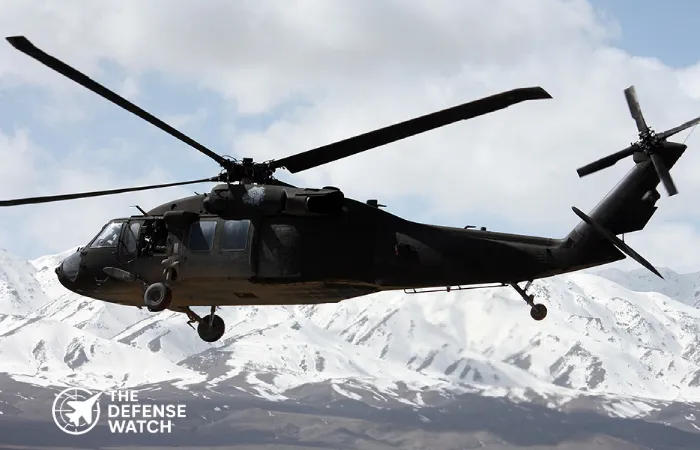
Crashworthiness represents another key design priority. The Black Hawk incorporates energy-absorbing landing gear and crew seats designed to withstand vertical impacts up to 38 feet per second, significantly improving crew survival rates during hard landings or crashes.
The cockpit accommodates two pilots and features advanced avionics that have been progressively upgraded throughout the platform’s service life. Modern variants include digital flight controls, integrated mission systems, and compatibility with night vision equipment, ensuring the Black Hawk remains relevant in contemporary operations.
Primary Variants and Mission Profiles
UH-60A/L: Standard Utility Configuration
The baseline UH-60A entered Army service in 1979, with the improved UH-60L variant following in 1989. These utility versions perform general transport, air assault, and casualty evacuation missions. The UH-60L introduced more powerful T700-GE-701C engines and an improved gearbox, increasing lift capacity and high-altitude performance.
These variants constitute the majority of the Army’s Black Hawk fleet and have deployed to every major US military operation since Grenada in 1983, including sustained combat operations in Iraq and Afghanistan.
UH-60M: Digital Black Hawk
The UH-60M, introduced in 2006, represents the most significant modernization of the platform. This variant features a fully integrated digital cockpit, fly-by-wire controls, and upgraded engines producing 2,000 shaft horsepower. The improvements enhance situational awareness, reduce pilot workload, and improve survivability through integrated defensive systems.
As of December 2024, the US Army continues transitioning its fleet to the M-model standard, with the variant expected to serve well into the 2050s. The UH-60M also serves as the baseline for international customers, with nations including Sweden, Saudi Arabia, and Poland operating this configuration.
HH-60M: Combat Search and Rescue
The HH-60M variant serves dedicated combat search and rescue (CSAR) missions. This configuration includes enhanced communication systems, additional fuel capacity, rescue hoist, and defensive countermeasures. The US Army fields these helicopters to recover downed aircrew in hostile territory, a mission requiring extended range and advanced electronic warfare capabilities.
MH-60 Series: Special Operations Aviation
Multiple MH-60 variants support US Special Operations Command (USSOCOM). The MH-60M, operated by the 160th Special Operations Aviation Regiment (Airborne), features terrain-following radar, forward-looking infrared sensors, aerial refueling capability, and advanced communications systems enabling deep penetration missions.

The MH-60L DAP (Direct Action Penetrator) variant carries offensive weaponry including 30mm chain guns, rocket pods, and Hellfire missiles, providing direct fire support for special operations forces. These heavily modified helicopters participated in notable operations including the 2011 raid that killed Osama bin Laden.
HH-60W Jolly Green II: Air Force Adoption
While not an Army variant, the US Air Force’s HH-60W deserves mention as it demonstrates the Black Hawk’s continued evolution. This CSAR variant, designated “Jolly Green II,” incorporates the latest avionics, defensive systems, and structural improvements. The Air Force began receiving these helicopters in 2021 to replace its aging HH-60G Pave Hawk fleet.
Operational History and Combat Proven Performance
The Black Hawk helicopter has participated in virtually every US military operation since its introduction. Its combat debut occurred during the 1983 Grenada invasion, where it demonstrated superior performance compared to the Huey it replaced.
Operation Desert Storm in 1991 saw extensive Black Hawk employment in air assault and medical evacuation roles. The helicopter’s ability to operate in desert conditions with minimal maintenance requirements validated design decisions made during development.
The Battle of Mogadishu in 1993, immortalized in the film “Black Hawk Down,” highlighted both the helicopter’s vulnerability to concentrated ground fire and crew survivability features. Two UH-60s were shot down during the operation, yet survival rates among crew and passengers exceeded expectations given the intensity of hostile fire.
Operations in Iraq and Afghanistan represented the most sustained combat employment of the Black Hawk. Between 2001 and 2021, these military helicopters accumulated millions of flight hours supporting counterinsurgency operations, special operations raids, and casualty evacuation missions. The demanding operational tempo accelerated modernization efforts, leading to rapid fielding of upgraded variants.
The Black Hawk has also proven invaluable in humanitarian operations. Following Hurricane Katrina in 2005, Army and National Guard Black Hawks rescued thousands of civilians from flooded areas. Similar rescue operations occurred after earthquakes in Haiti and Nepal, demonstrating the platform’s utility beyond military applications.
International Operators and Export Success
Beyond US military service, the Black Hawk helicopter operates with more than 30 nations worldwide, making it one of the most successful military helicopter exports in history. Key international operators include:
NATO Allies: Turkey operates the largest foreign Black Hawk fleet with over 100 helicopters, many assembled domestically under license. Other significant NATO users include Greece, Poland, and Romania.
Middle East: Saudi Arabia, Jordan, Egypt, and the United Arab Emirates operate Black Hawks in various configurations, primarily for utility and VIP transport roles.
Asia-Pacific: Japan, South Korea, Taiwan, and the Philippines employ Black Hawks for defense and disaster response missions. Japan’s Ground Self-Defense Force has acquired UH-60JA variants specifically modified to Japanese requirements.
Latin America: Colombia, Mexico, and Brazil operate Black Hawks primarily for counternarcotics and internal security operations.
This international presence creates interoperability advantages during coalition operations and provides Lockheed Martin with sustained production and support revenue, ensuring the platform’s viability for decades.
Modernization and Future Developments
The US Army continues investing in Black Hawk modernization despite developing next-generation platforms. Current upgrade programs focus on extending airframe service life, improving engines, and integrating advanced mission systems.
The Improved Turbine Engine Program (ITEP) will replace existing T700 engines with the GE T901, providing 50 percent more power while reducing fuel consumption. This upgrade enables operations in high-altitude environments while carrying heavier loads, addressing capability gaps identified in Afghanistan.
The Army is also integrating the Modular Open Systems Approach (MOSA) architecture, allowing rapid insertion of new technologies without extensive redesign. This includes improved communications, enhanced defensive systems, and potential autonomous flight capabilities.
Additionally, the Army is exploring unmanned Black Hawk operations. Sikorsky has demonstrated autonomous flight capabilities using optionally piloted vehicles, technology that could enable resupply missions to contested areas without risking crew.
Analysis: Why the Black Hawk Endures
The Black Hawk helicopter’s longevity reflects several strategic and practical factors that ensure its continued relevance in modern military aviation.
Platform Maturity: After 45 years of service, the Black Hawk represents a known quantity. Maintenance procedures are well-established, spare parts supply chains are robust, and training pipelines are mature. Replacing the entire fleet with a new platform would require massive investment and introduce operational risk during transition.
Upgrade Pathway: The Black Hawk’s design accommodates modernization without fundamental redesign. Unlike some legacy systems that cannot incorporate new technology, the UH-60 airframe accepts new engines, avionics, and mission systems, extending its operational relevance.
Production Economics: Lockheed Martin continues Black Hawk production, with international orders sustaining the manufacturing line. This ongoing production keeps unit costs manageable compared to starting new helicopter programs from scratch.
Future Vertical Lift Context: While the Army is developing Future Long-Range Assault Aircraft (FLRAA) under the Future Vertical Lift program—with Bell’s V-280 Valor selected in December 2022—the Black Hawk will not be immediately replaced. The FLRAA will initially supplement rather than replace the Black Hawk fleet, with full transition unlikely before the 2040s.
Operational Flexibility: The Black Hawk’s medium-lift category positions it ideally between light utility helicopters and heavy-lift platforms like the CH-47 Chinook. This “Goldilocks zone” makes it suitable for the widest range of missions, maximizing fleet utility.
The combination of these factors suggests the Black Hawk helicopter will remain a fixture in US Army aviation and allied forces for at least another 25-30 years, likely making it one of the longest-serving military aircraft in history.
FAQs
How many troops can a Black Hawk helicopter carry?A standard UH-60 Black Hawk can transport 11 fully equipped combat troops plus a crew of four (two pilots and two crew chiefs/door gunners). In medevac configuration, it accommodates six litter patients and medical attendants.
What is the difference between UH-60 and MH-60 Black Hawks?The UH-60 designation indicates utility variants operated by the US Army for general transport and assault missions. MH-60 variants are modified for special operations, featuring enhanced avionics, terrain-following radar, aerial refueling capability, and advanced mission systems for deep penetration and special warfare support.
How fast can a Black Hawk fly?The UH-60 Black Hawk has a maximum speed of approximately 183 mph (294 km/h) and a cruise speed of around 174 mph (280 km/h). Combat radius is approximately 368 miles (592 km) with internal fuel.
Are Black Hawks still in production?Yes, Lockheed Martin continues Black Hawk production at facilities in Connecticut and Poland. The US Army receives UH-60M variants, while international customers order various configurations. Annual production rates vary based on US and foreign military sales orders.
What will replace the Black Hawk helicopter?The US Army selected Bell’s V-280 Valor tiltrotor as the Future Long-Range Assault Aircraft (FLRAA) in December 2022. However, FLRAA will initially supplement rather than replace the Black Hawk fleet. Full transition is not expected until the 2040s or beyond, meaning Black Hawks will serve alongside next-generation platforms for decades.
Get real time update about this post category directly on your device, subscribe now.


8 comments
[…] compromising mobility. This modular approach allows a single vehicle type to fulfill multiple operational roles within a […]
[…] The jets will be assigned to two frontline units, the Southern Lions Squadron (116 Squadron) and the Golden Eagle Squadron (140 Squadron). Upon arrival, the aircraft received the Israel Air Force emblem, marking their formal induction into operational service. […]
[…] MV-75, derived from Bell’s V-280 Valor tiltrotor demonstrator, was selected by the Army in 2022 to replace aging UH-60 Black Hawk helicopters under the FLRAA initiative. Its tiltrotor design aims to combine vertical takeoff and landing with […]
[…] margin declined to 7.6% from 11.1% in 2024. Despite program challenges, the segment saw increased Black Hawk helicopter production and growth in the River Class Destroyer […]
[…] According to Leonardo, the M-346 series has more than 150,000 flight hours logged and has been selected by some 20 countries worldwide for training and operational roles. […]
[…] RSAF began collaborating on the A3R program in 2020, aiming to bring automated boom refueling into operational service. Earlier milestones included successful daytime certification in 2022 and extensive night operation […]
[…] Ellison, Director of National Resilience at the NCSC, said these hacktivist operations can prevent people from accessing services they depend on and cause wider downstream impacts. The NCSC encourages organisations to adopt […]
[…] multirole fighters in the world. According to the US Air Force, more than two dozen nations operate variants of the aircraft. Sustaining avionics test equipment is critical to maintaining readiness rates across such a […]