

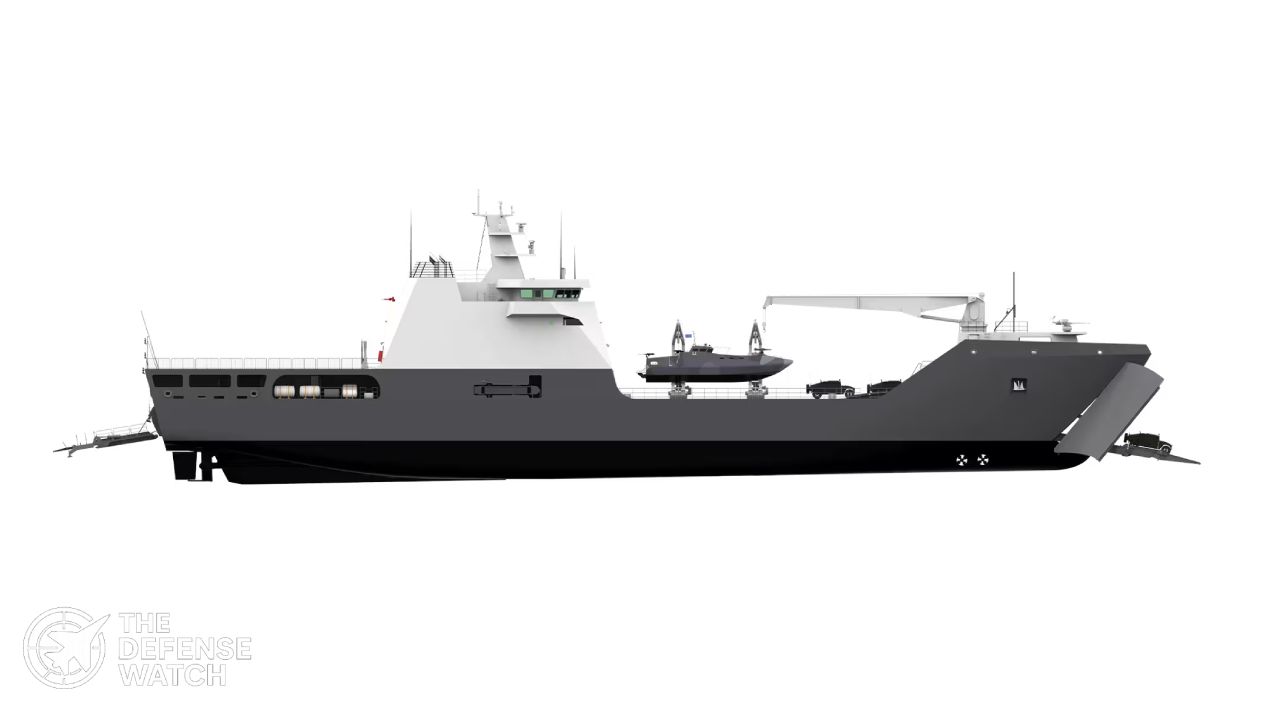
In a major shift in amphibious capability planning, the United States Navy (USN) and United States Marine Corps (USMC) have formally selected the Dutch-designed Damen LST-100 as the foundational design for the new Medium Landing Ship (LSM) program. The announcement was made by John C. Phelan, Secretary of the Navy, via video on his official social media channel on December 5.
The decision closes a long-running procurement loop, underscoring a pivot toward proven off-the-shelf designs to meet the Corps’ expeditionary and distributed-operations needs across littoral zones.
Context: Why the LSM Gap Matters
For years, the Marine Corps has operated with a capability gap between large-deck amphibious vessels — like LPDs, LHAs, and LHDs — and small landing craft or connectors. Large ships offer robust force projection but are expensive to operate and ill-suited for high-risk littoral environments where ports may be unavailable. Smaller craft have limited range, payload, and endurance.
The LSM program was conceived to fill this gap: a mid-sized, sea-going landing ship transport tailored for agile deployments, logistical support, and small-unit landings — especially for the dispersed “island-hopping” and forward-basing scenarios envisioned in future Indo-Pacific theaters.
Initial attempts to develop a bespoke U.S. design foundered in 2023–2024 as responses to the request for proposals proved too costly and complex. The Navy and Marines then pivoted to evaluating existing designs, seeking a ready-made solution that could be adapted and built quickly.
The LST-100: Key Specifications and Capabilities
The Damen LST-100 brings a mature, proven footprint that aligns well with USMC requirements. According to Damen, the ship is 100 meters long with a beam of 16 meters. It displaces roughly 3,900–4,000 tonnes when fully loaded.
Some of the critical features include:
- Cargo and personnel transport: Approximately 500 tonnes of vehicles and supplies, with around 1,020 m² of roll-on/roll-off (Ro-Ro) deck space. Enough capacity to move light armored vehicles, logistics equipment, and supplies in support of Marine operations.
- Amphibious capability: Bow and stern ramps (each rated for loads up to 70 tonnes) allow beaching or port access for direct offload of vehicles, troops, and cargo.
- Helicopter/small-craft support: An aft flight deck suitable for a medium helicopter (such as an NH-90), and capacity for deploying smaller landing craft via onboard cranes.
- Endurance and range: The vessel is capable of over 3,400 nautical miles of range — sufficient for long-distance intra-theater repositioning, island-to-island transfers, or extended logistic runs without reliance on major ports.
- Crew & living spaces: Designed for a core crew (around 18–20) plus berthing for embarked Marines.
With these features, the LST-100 offers a balance of capacity, flexibility, and cost that makes it well suited to modern littoral and distributed maritime operations — a key objective of the LSM program.
Why the U.S. Navy Chose LST-100
According to official statements, the choice of LST-100 reflects a combination of operational fit, fiscal discipline, and schedule realism. In President Phelan’s words, the selection “is operationally driven” and helps deliver capability to the Fleet within a “responsible timeline.”
Instead of pursuing a full new-design development — which previously proved too costly and slow — the Navy and Marines are now opting for a “build-to-print” approach. Under this model, the USN will adapt Damen’s existing 3D design, integrate U.S.-standard systems (survivability, communications, habitability), and then contract out construction to U.S. shipyards.
This reduces technical risk, avoids lengthy R&D phases, and enables procurement of dozens of ships — with a target fleet size of at least 35 vessels — in a relatively short period.
The program is also structured to encourage competition: the Navy will appoint a Vessel Construction Manager (VCM) who will oversee serial production and coordinate between multiple yards.
Strategic Implications: What LST-100 Means for Future Operations
The addition of a dedicated medium landing ship fleet transforms USMC amphibious and littoral mobility. In potential contested environments — such as island chains in the Indo-Pacific — LST-100 will allow the Marines to:
- Insert and sustain forces without relying on major ports or fixed infrastructure.
- Conduct distributed operations: Multiple small units can be landed and resupplied over dispersed island or coastal locations.
- Provide logistic & sustainment support over long distances — enabling sustained presence, humanitarian aid, or rapid reinforcement.
- Enhance flexibility: The mix of vehicle transport, helicopter support, and small-craft handling makes the vessel suitable for a wide variety of missions — from evacuation, disaster relief, humanitarian assistance, to amphibious assault and maritime security.
By prioritizing a smaller, more numerous fleet over a few large-deck amphibs, the Navy is adapting to modern operational demands: contested littorals, anti-access/area-denial (A2/AD) environments, and fast-paced distributed operations.
What Comes Next — Timeline and Procurement Path
With the design selected, the next steps will involve finalizing the U.S.-adapted technical data package and awarding a contract for the lead ship. The Navy expects to begin construction on the first LSM hull once design work is complete and has signaled that multiple shipyards may compete for follow-on production.
If all goes according to plan, the first operational LSM could enter service by the late 2020s, with a full class of 35 ships completed through the early 2030s.

7 comments
[…] full-rate production efforts and increases the cumulative number of ACV-30 variants ordered by the Marine Corps to more than 100 […]
[…] he oversees budget development, force structure planning, and long term resource allocation for the Marine Corps from the […]
[…] Marine Medium Tiltrotor Squadron 163 (Reinforced), the aviation element of the 11th MEU, flew AH-1Z Vipers from the USS Boxer Amphibious Ready Group in the U.S. 3rd Fleet area on January 23. […]
[…] impacts on ship design and […]
[…] objective of 1,122 vehicles, the current target stands at 632 units, adjusted to align with Marine Corps Force Design 2030 modernization initiatives. Fiscal constraints and inflationary pressures have impacted […]
[…] can accommodate up to 70 personnel and has an operational range exceeding 9,000 nautical miles. The ship’s design supports extended deployments at sea for hydrographic […]
[…] Water Autonomy selected Damen’s Stan Patrol 6009 hull design for its distinctive Axe Bow configuration, a vertical bow design that minimizes wave slamming and […]