

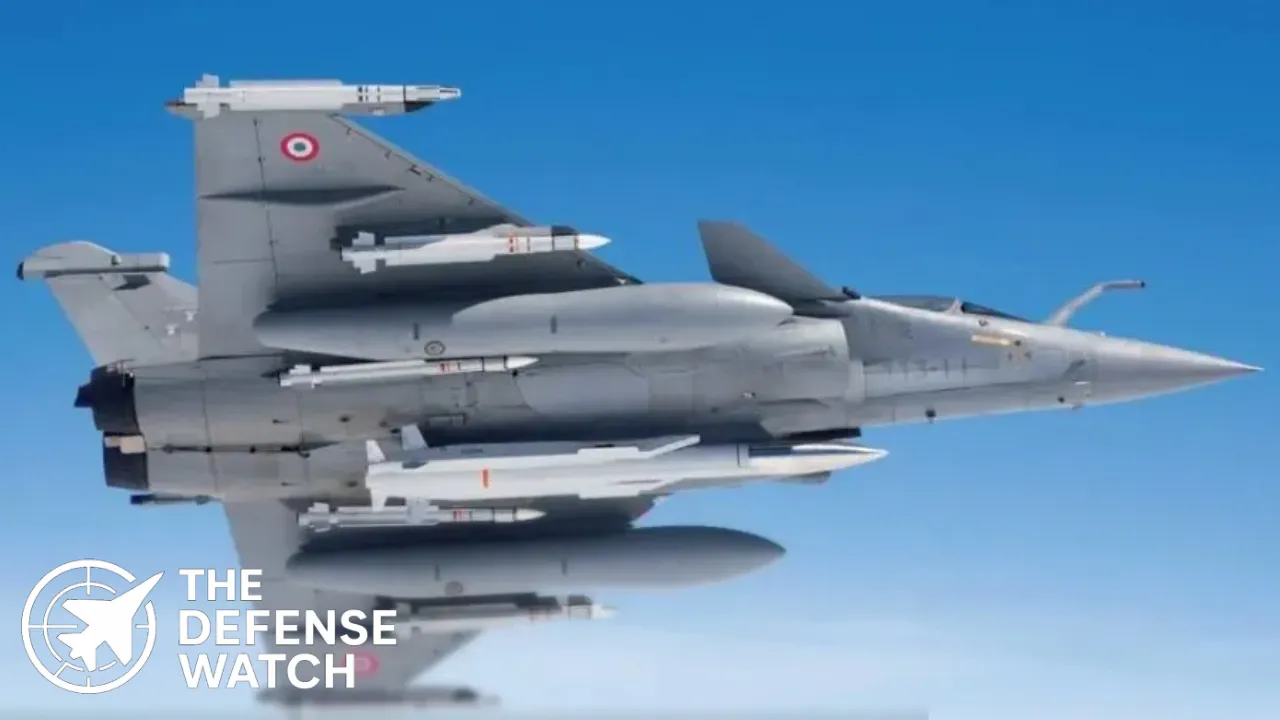
France Conducts Successful ASMPA-R Missile Test from Rafale-M
France has publicly unveiled images of its advanced nuclear-capable medium-range cruise missile, the Air-Sol Moyenne Portée-Renove (ASMPA-R), following a successful test launch from the Dassault Rafale-M naval fighter jet. This marks a significant milestone for France’s Naval Nuclear Aviation Force (FANU) and reinforces its strategic nuclear capabilities.
According to the French Ministry of Armed Forces, the evaluation shot was conducted under the Nuclear Aeronaval Force, which includes the aircraft carrier Charles de Gaulle and its Rafale-M air wing. The ASMPA-R missile had already been operational with the French Strategic Air Forces (FAS) since 2023, launched from land-based Rafale variants.
Technical Overview: ASMPA-R Missile
ASMPA‑R Nuclear Cruise MissileThe ASMPA-R is a medium-range, nuclear-capable, ramjet-powered cruise missile capable of speeds up to Mach 3. To achieve the required launch velocity, an internal solid-fuel booster ignites prior to ramjet operation. The missile boasts a range of approximately 600 km (372 miles), an improvement over the earlier ASMPA-A variant’s 500 km.
While the missile maintains a similar outward appearance to its predecessor, subtle design changes enhance its aerodynamic efficiency. Notably, the tail fin arrangement differs: larger rear fins replace the smaller rear fins of the ASMPA-A, improving stability at supersonic speeds.
Historically, the ASMP series dates back to 1986, evolving through ASMP, ASMP-A, and now the ASMPA-R, reflecting over three decades of iterative upgrades to France’s air-launched nuclear deterrent.
Strengthening France’s Nuclear Deterrent
The successful naval test launch of ASMPA-R strengthens France’s Force de Frappe, the country’s independent nuclear triad. France currently maintains a dual-component nuclear force:
- Sea-based: Four Triomphant-class SSBNs equipped with M51 submarine-launched ballistic missiles (range 9,000–12,000 km).
- Air-based: Rafale fighter jets armed with ASMPA-R cruise missiles, capable of rapid deployment from both land bases and aircraft carriers.
France also plans a next-generation missile, ASN4G, to arm upcoming Rafale F5 variants. This missile, expected by 2035, will feature hypersonic speeds (Mach 5+), further enhancing France’s strategic reach and deterrence posture.
Strategic Context and Implications
The Rafale-M ASMPA-R test underscores France’s commitment to modernizing its nuclear arsenal amid evolving global security challenges. With rapid advances in hypersonic and missile defense technologies worldwide, France’s upgraded nuclear-capable cruise missiles provide a credible sea- and air-based deterrent, reinforcing NATO’s collective security while ensuring national strategic autonomy.
The ASMPA-R also highlights France’s integrated approach to air and naval operations, enabling carrier-based launch capability that complements its land-based nuclear aviation fleet. This capability ensures that France retains a flexible, survivable nuclear strike option in diverse operational scenarios.
FAQs
It is a nuclear-capable, supersonic, medium-range air-to-surface cruise missile used by France.
Both land-based Rafale and carrier-based Rafale-M fighter jets.
The missile has a range of 600 km (372 miles) and can reach speeds up to Mach 3.
It provides a flexible, sea- and air-based strike option, strengthening France’s nuclear triad.
The ASN4G missile, capable of hypersonic speeds, is expected to enter service by 2035.

23 comments
[…] note that Russia is combining large drone salvos with more capable missile systems — such as Iskander-M/KN-23 and air-launched cruise missiles — to overwhelm Ukraine’s layered air-defense […]
[…] Attack Cruise Missile […]
[…] Scramjet-powered hypersonic cruise missiles […]
[…] “Standard 2+” configuration and possibly upgraded later to Standard 2++, incorporating advanced capabilities such as new cruise missile systems (e.g., MdCN) and enhanced CMS/electronic […]
[…] hypersonic glide vehicle, the Kinzhal air-launched ballistic missile, and the Zircon anti-ship cruise missile. Each system employs different technologies to achieve hypersonic speed, with the Avangard […]
[…] Russian cruise missiles […]
[…] with Moog and under a CRADA with U.S. Special Operations Command and AFSOC, is advancing its Small Cruise Missile (SCM) — nicknamed Black Arrow. The missile reportedly weighs around 91 kg and can carry kinetic […]
[…] one reported August 2025 strike, Air Command West said it intercepted 42 Shahed drones and 11 cruise missiles in a single attack, with visual footage of a Skynex turret engaging multiple targets—firing a […]
[…] to improve energy resilience and operational readiness. Microreactors are compact, transportable nuclear power systems capable of generating reliable electricity in environments where conventional power grids may be vulnerable […]
[…] to the French Navy, the strike — from the initial launch to bomb release — was organized and executed in under 24 […]
[…] The bomber already carries advanced weapons such as the AGM-158 Joint Air-to-Surface Standoff Missile and the emerging AGM-181 nuclear cruise missile. Modern radar performance helps support targeting and navigation for these long-range […]
[…] White House said the bombardment was intended to seriously degrade Iran’s nuclear capabilities. US President Trump claimed that these critical enrichment facilities had been “completely and […]
[…] cruise missiles, the YJ 1000 relies on gravity and aerodynamic glide rather than propulsion. This keeps costs lower […]
[…] Oreshnik missile joins a broad mix of Russian strike systems already used in Ukraine, including cruise missiles, short-range ballistic missiles, and drones. Analysts told Reuters that Russia continues to rely […]
[…] tier defenses such as Patriot and IRIS T SLM, creating a multi-layer shield against ballistic and cruise missile […]
[…] drone system is designed to provide short range air defense against Group 1 and Group 2 UAVs, cruise missiles, and rotary wing […]
[…] Michael Duffey. The direct-to-supplier model is intended to help rebuild U.S. stockpiles and strengthen deterrence by ensuring component […]
[…] short-range systems to intercept drones and reserving higher-end interceptors for ballistic and cruise missile […]
[…] Commander of Allied Maritime Command (MARCOM), French Navy Vice Admiral Ludovic Poitou, presided over the […]
[…] with activity concentrated around the Kulusuk area on Greenland’s east coast. The French MRTT departed from a base in southern France and returned there after […]
[…] missile family, featuring hit-to-kill technology designed to intercept tactical ballistic missiles, cruise missiles, and advanced aircraft threats. The system provides significantly improved range and altitude […]
[…] 28 Kh 101 or Iskander K cruise missiles […]
[…] The United States similarly maintains an extensive nuclear modernization program, with the Congressional Budget Office estimating costs exceeding $750 billion over the next decade for maintaining and upgrading America’s nuclear deterrent capabilities. […]