

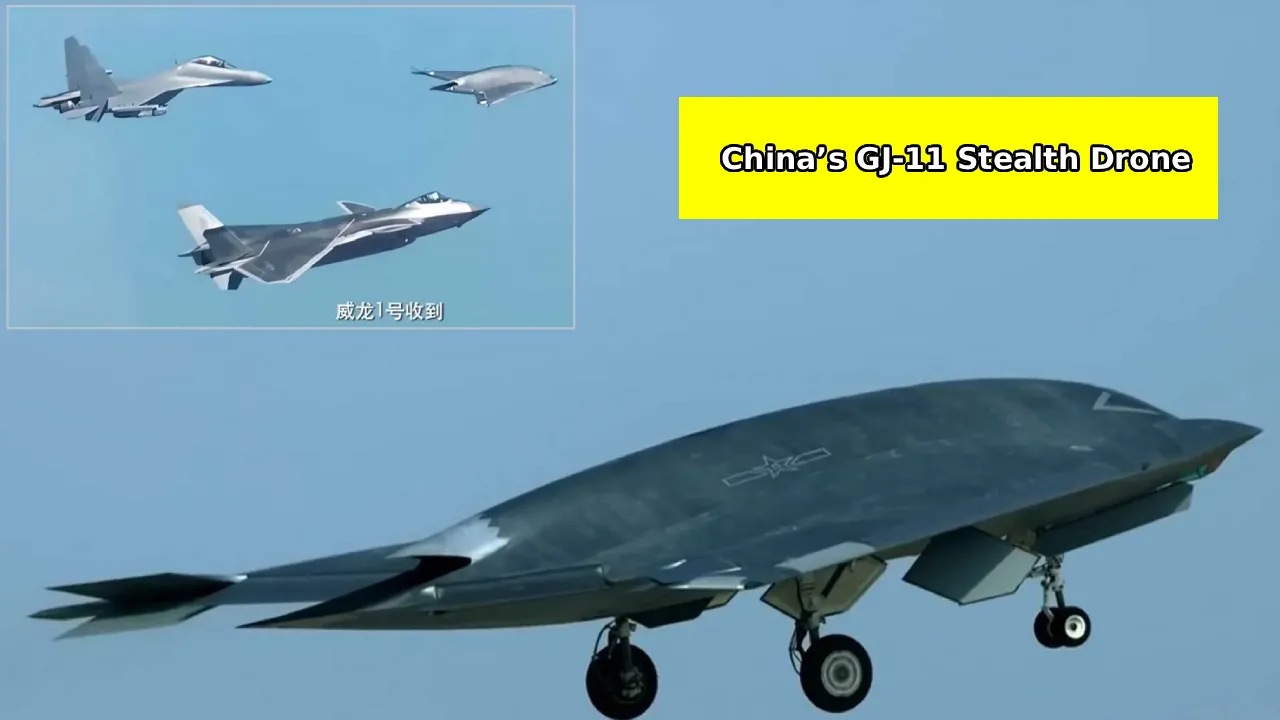
China Showcases GJ-11 Stealth Drone with J-20 Fighter in Public Flight
In a significant development for China’s military aviation sector, the GJ-11 stealth drone conducted its first publicly observed flight in formation with the J-20 fifth-generation fighter. The flight occurred during a demonstration at a Chinese airbase, highlighting Beijing’s ongoing focus on integrating unmanned aerial vehicles (UAVs) with manned combat aircraft.
Background on the GJ-11 and J-20 Integration
The GJ-11, also known as the “Sharp Sword,” is China’s advanced stealth combat drone designed for autonomous strike and reconnaissance missions. Developed under the auspices of the Chengdu Aircraft Industry Group, the GJ-11 features low-observable technology, internal weapon bays, and advanced avionics, enabling it to operate in contested airspace alongside manned aircraft such as the J-20 fighter.
The J-20, China’s flagship fifth-generation fighter, is a long-range stealth platform capable of air superiority and strike missions. Pairing the GJ-11 with the J-20 reflects China’s strategy to develop “loyal wingman” drones, which can accompany piloted aircraft to enhance situational awareness, extend reach, and provide additional strike capabilities without endangering human pilots.
Chinese GJ-11 Stealth Drone – Full Specifications
- Maximum Speed: ~1,000 km/h
- Endurance: ~6–8 hours
- Operational Range: 1,500+ km
- Payload Capacity: ~400–500 kg
Flight Demonstration Details
During the demonstration, the GJ-11 flew in close formation with the J-20, signaling progress in autonomous flight coordination between manned and unmanned systems. Observers noted the drone maintained stable flight alongside the fighter jet, demonstrating its navigation and flight control capabilities.
While specific performance data was not released, analysts suggest the GJ-11’s internal weapons bays and stealth profile indicate its potential for precision strikes while evading radar detection. Reports also highlight the drone’s modular payload capability, which could allow it to carry a variety of munitions, including air-to-ground precision-guided bombs and advanced electronic warfare equipment.
Expert Analysis and Strategic Implications
Military analysts view the public display as a clear signal of China’s growing capabilities in UAV technology and autonomous combat systems. Professor Zhang Wei, an aerospace analyst at the Beijing Institute of Technology, stated, “The GJ-11’s flight with the J-20 demonstrates a maturing of China’s UAV integration concept. It represents a shift towards more sophisticated joint operations between manned and unmanned platforms.”
The deployment of stealth drones such as the GJ-11 may also influence regional air power dynamics, offering China a means to project force while minimizing pilot risk. Autonomous drones capable of operating in high-threat environments could complement the J-20 fleet, extending operational flexibility in complex scenarios, including contested maritime and border regions.
Looking Forward: Next Steps in Drone Development
China’s demonstration of the GJ-11 alongside the J-20 reflects broader trends in modern air combat, where “loyal wingman” drones are increasingly seen as force multipliers. Future developments may include enhanced artificial intelligence for autonomous target recognition, cooperative swarm operations, and integration with other Chinese stealth platforms such as the J-31 fighter.
The demonstration also underscores Beijing’s investment in dual-use UAV technology, which has implications for both military strategy and regional security. Analysts expect the GJ-11 will continue testing and gradual integration into operational air units in the coming years, complementing the existing manned fighter fleet.


11 comments
[…] China GJ-11 stealth drone is assessed to carry a relevant weapons payload while maintaining longer endurance than crewed […]
[…] Control surfaces: The missile uses cropped delta‑style mid-body fins and smaller tail control fins. This design is optimized for carriage inside internal bays of stealth aircraft such as the J-20. […]
[…] Importance:Complements stealth aircraft by delivering massed firepower from standoff […]
[…] intercepted and destroyed high-speed drones flying at up to 650 km/h, roughly twice the speed of an F1 […]
[…] There has been no response from the U.S. Department of Defense or Northrop Grumman regarding the claims. Defense analysts contacted by SCMP cautioned that modeling based on incomplete information cannot accurately reflect the performance of an operational stealth aircraft. […]
[…] According to available imagery and analyst assessments, the PL 16 is essentially a modified version of the PL 15 long range air to air missile. The most visible change is the use of folded control fins, allowing the missile to fit within the internal bays of stealth aircraft. […]
[…] from short and austere runways. Its twin engine configuration and conventional airframe allow it to fly further than many vertical takeoff cargo drones, which trade range for […]
[…] Iranian-designed Shahed drones and Russian derivatives have been widely used in Ukraine, prompting militaries to explore both traditional and nontraditional counter-UAV […]
[…] enablers in contested airspace. By disrupting radar and communications, they allow strike and stealth aircraft to operate with reduced risk. Defense officials have repeatedly emphasized that electronic attack […]
[…] heavy-lift UAV adds to a broader trend in large-scale unmanned systems development worldwide. Military and civilian planners are watching expanded cargo UAV use for logistics, disaster aid, and contested environments where traditional routes are risky or […]
[…] industry appears to be transitioning toward parallel production of multiple stealth aircraft types, a capability historically associated with mature aerospace […]