Shield AI Builds U.S. X-BAT Production Network
Shield AI is turning the X-BAT from an aircraft development effort into a defined U.S. industrial program, with separate facilities in Washington, Kansas and Texas assigned to production, flight testing, sustainment and prototyping.
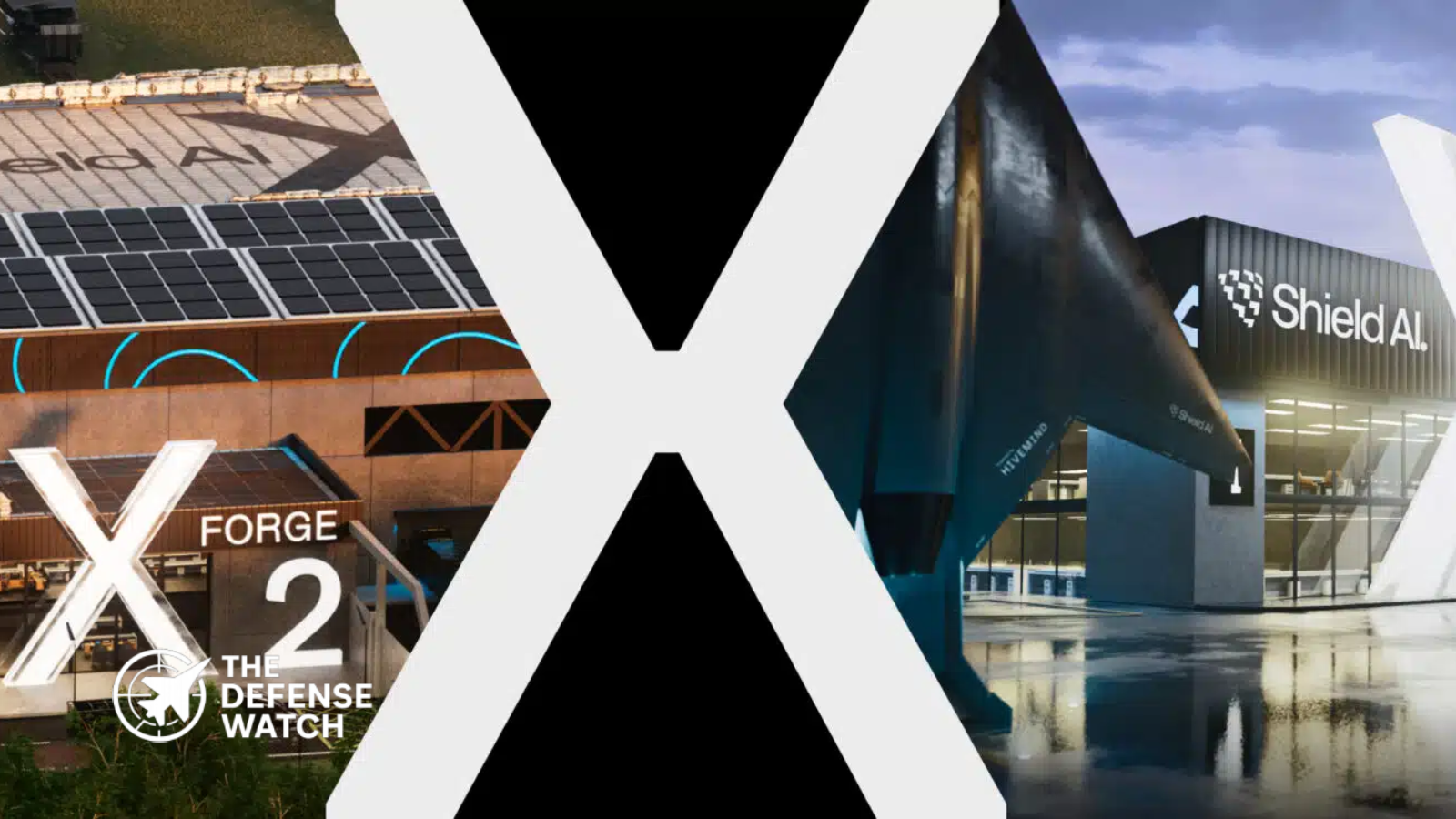
The company announced on September 30 that X-Forge 3 in Des Moines, Washington, will become the production site for the AI-piloted vertical takeoff and landing aircraft. X-Forge 2 at Newton City-County Airport in Kansas will handle development flight testing, production acceptance flights and long-term maintenance, repair and overhaul. X-Forge 1 in Frisco, Texas, will remain the program’s prototyping center.
The arrangement is important because the X-BAT has not yet reached operational status. Aviation Week reported in September that Shield AI was nearing completion of its first full-scale prototype, with vertical flight testing expected toward the end of 2026 or early 2027. The company’s public plan calls for production to begin in 2029 and full-rate production in the early 2030s.
From prototype work to a complete industrial chain
The three-site structure gives each stage of the X-BAT program a defined location.
Washington will be responsible for series manufacturing. Shield AI selected the Puget Sound region after evaluating multiple locations, citing the area’s established aerospace workforce and supplier base. The company says the Des Moines facility is being developed as X-Forge 3, with production activity expected to expand as the program moves toward its planned manufacturing phase.
Kansas will have a different role. At Newton City-County Airport, X-Forge 2 is intended to become the program’s flight-test and sustainment center. Each production aircraft is expected to undergo acceptance testing there before delivery, while customers will also be able to conduct acceptance flights from the facility.
The Kansas site is also intended to retain the engineering knowledge generated during flight testing for later fleet support. Shield AI plans to establish the X-BAT maintenance, repair and overhaul operation at Newton, creating a link between development testing, aircraft acceptance and long-term sustainment.
Texas remains the program’s development base. Frisco’s X-Forge 1 will continue to support X-BAT prototyping as well as work involving Shield AI’s V-BAT unmanned aircraft. That leaves the company with a domestic chain spanning prototype development, manufacturing, test and evaluation, delivery and sustainment.
The distinction matters for an aircraft program that is still moving through development. Establishing production and MRO infrastructure does not itself demonstrate that the aircraft has completed flight testing or achieved an operational capability.
The aircraft still has to prove the concept
X-BAT is designed around a difficult engineering proposition: a jet-powered combat aircraft that can take off and land vertically while retaining the range and payload characteristics required for missions normally performed by conventional tactical aircraft.
Shield AI says the aircraft will use a GE Aerospace F110 engine integrated with an Axisymmetric Vectoring Exhaust Nozzle, or AVEN, to provide the thrust-vectoring capability required for vertical operations. In July, GE Aerospace and Shield AI completed integration, actuation and engine light-off testing of the AVEN-equipped F110-GE-129E. That was a propulsion test milestone, not a completed X-BAT flight.
The next major technical milestone is therefore flight testing. Shield AI’s own X-BAT material describes first flight in 2026, while Aviation Week reported in September that the company expected the full-scale prototype to be completed by the end of October and was targeting initial vertical testing late in 2026 or early 2027.
That distinction should remain central to assessments of the program. X-BAT has a defined industrial pathway, but the aircraft still needs to demonstrate that its VTOL architecture, propulsion system, flight controls and autonomous mission software can work together in flight.
What makes X-BAT different from conventional fighter basing
The operational concept behind X-BAT is less about replacing a conventional fighter one-for-one and more about changing where combat aircraft can operate.
Shield AI describes X-BAT as a runway-independent aircraft capable of operating from ships, remote sites and austere locations. The company lists air-to-air, air-to-surface, electronic warfare and intelligence, surveillance and reconnaissance missions among the intended applications. It also advertises more than 2,000 nautical miles of maximum range and a ceiling above 50,000 feet. These remain manufacturer-published specifications rather than independently demonstrated operational performance.
That runway independence addresses a longstanding vulnerability in modern air operations. Conventional tactical aircraft depend on airfields, maintenance facilities, fuel storage, weapons handling areas and other infrastructure that can be identified and targeted.
Dispersal does not remove those requirements. Aircraft still need fuel, weapons, maintenance personnel, communications, spare parts and protection. But an aircraft capable of vertical operations can reduce the dependence on a long runway and potentially allow aircraft to be distributed across a larger number of operating locations.
That concept has particular relevance to the Indo-Pacific, where large distances and a limited number of suitable airfields create difficult basing requirements. It is also relevant to European air forces concerned about the vulnerability of fixed infrastructure along NATO’s eastern flank.
Shield AI has separately signed a letter of intent with Poland’s PGZ and WZL-2 covering potential cooperation on X-BAT design, production, delivery and sustainment. The agreement is not a procurement contract, but it shows that the company is pursuing an allied industrial model alongside its U.S. production plans.
Hivemind is central to the concept
The aircraft’s autonomy architecture is as important to the program as its airframe.
Shield AI’s Hivemind software is intended to provide autonomous flight and mission execution in environments where communications or satellite navigation may be degraded or unavailable. The company says X-BAT can operate as an individual aircraft or as part of a team under the control of a single commander.
There is already government evidence that Hivemind is being evaluated on other aircraft. In January 2026, the Naval Air Systems Command reported a demonstration in which two BQM-177A targets were flown autonomously using Hivemind within a live-virtual-constructive environment. The Navy said further development and fleet exercises were planned.
That work provides useful context for X-BAT, but it should not be confused with validation of the complete X-BAT aircraft. Autonomy demonstrated on surrogate aircraft does not establish that the X-BAT airframe, propulsion system, sensors, weapons and autonomous mission functions will meet their intended requirements.
Production scale remains a future milestone
Shield AI’s industrial planning indicates that the company expects X-BAT production to begin in 2029, with full-rate production targeted for the early 2030s. The company has also said the program could generate substantial employment and economic activity in the regions supporting production and testing. Those economic figures are company projections and depend on the program reaching its planned production levels.
The more consequential measure will be whether the industrial network can support the aircraft’s technical development at the pace Shield AI has outlined.
For a new autonomous combat aircraft, the production line is only one part of the challenge. Flight-test capacity, propulsion integration, software validation, weapons integration, autonomy testing, acceptance procedures and sustainment all have to mature together.
Shield AI’s three-state structure gives the X-BAT program a clearer path from prototype manufacturing to eventual fleet support. It does not, however, remove the technical and acquisition milestones that remain between the current prototype stage and an operational aircraft.
The immediate test for the program is therefore in the air, not on the factory floor. Successful VTOL flight testing would provide the first major evidence that the industrial infrastructure now being established can support the aircraft Shield AI has proposed.