Amentum Survivability Test Stand Contract Announced
Amentum Technology Inc. has received a $150 million ceiling indefinite delivery/indefinite quantity contract to design, procure and install a new Survivability Test Stand for the U.S. Air Force’s 704th Test Group at Holloman Air Force Base, New Mexico.
Takeaways
Amentum Technology Inc. will design, procure and install a new Survivability Test Stand for the U.S. Air Force’s 704th Test Group at Holloman Air Force Base.
The Air Force award notice identifies the contract as FA9101-26-D-B016. The firm-fixed-price IDIQ contract is expected to be completed by September 2031, while $2.433 million in fiscal 2026 research, development, test and evaluation funds was obligated at award. The acquisition was competitive, with two offers received.
The distinction between the $150 million ceiling and the initial obligation is important. The ceiling establishes the maximum potential value of the IDIQ arrangement, while the $2.433 million represents funding obligated at the time of the award.
| Contract Detail | Information |
|---|---|
| Contractor | Amentum Technology Inc. |
| Location | Tullahoma, Tennessee |
| Contract | FA9101-26-D-B016 |
| Contract type | Firm-fixed-price IDIQ |
| Ceiling | $150 million |
| Initial obligation | $2.433 million |
| Funding | FY2026 RDT&E |
| Customer | U.S. Air Force, 704th Test Group |
| Work location | Holloman AFB, New Mexico |
| Expected completion | September 2031 |
| Competition | Two offers received |
| Contracting activity | Air Force Test Center, Arnold AFB, Tennessee |
What the Survivability Test Stand Is Designed to Measure
The new facility is part of a broader effort to expand specialized aerospace test and evaluation infrastructure around Holloman and the National Radar Cross Section Test Facility.
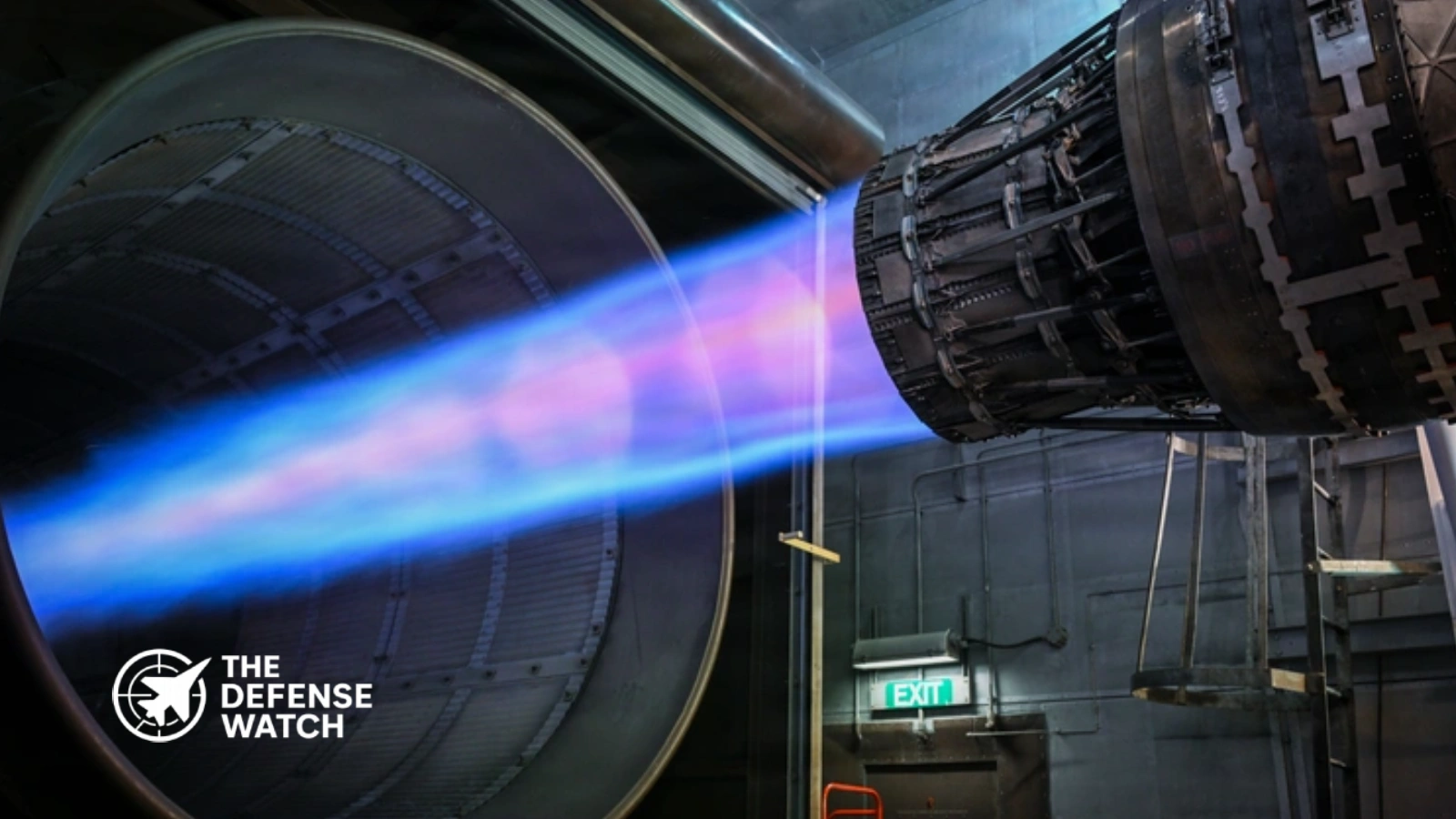
Procurement material for the requirement describes the Survivability Test Stand as a new outdoor capability intended to provide high-fidelity radar cross section, infrared and acoustic measurements associated with running aircraft engines. The planned capability is designed to support large military engines and future designs, with associated test-support, data-acquisition and infrastructure elements.
This combination is significant because aircraft survivability is not determined by a single signature.
Radar cross section, or RCS, describes how strongly an object appears to radar under particular conditions. Infrared measurements address thermal signatures, while acoustic measurements can provide information about sound generated by an operating propulsion system.
Testing these characteristics together can give engineers a more complete picture of how a propulsion system and associated aircraft characteristics appear to different sensing systems.
The procurement material also describes an intended measurement capability with a plus or minus 180-degree azimuth adjustment, allowing measurements across a broad range of viewing angles.
Why Holloman and the 704th Test Group Matter
The 704th Test Group is part of the Arnold Engineering Development Complex, which is headquartered at Arnold Air Force Base, Tennessee. Its mission includes high-speed testing, navigation and guidance testing, radar signature measurements, weapons flight testing and support to Air Force programs at White Sands Missile Range.
The group also operates or supports several specialized test organizations, including the National Radar Cross Section Test Facility, the Holloman High Speed Test Track, the 586th Flight Test Squadron and the Central Inertial and GPS Test Facility.
The location is particularly relevant to the new Survivability Test Stand because the National Radar Cross Section Test Facility, or NRTF, is located on White Sands Missile Range near Holloman.
The NRTF specializes in narrowband and wideband RCS characterization of scaled, full-scale and flyable articles. It also supports antenna radiation pattern and backscatter measurements in a secure outdoor test environment.
That existing infrastructure gives the Air Force an established test and measurement ecosystem in which the new capability can operate.
A New Layer for Engine and Aircraft Signature Testing
The planned test stand appears to address a specific limitation in conventional RCS testing: measurements involving an operating propulsion system introduce additional variables that are not present when testing a static article.
A stationary aircraft or engine can be characterized under controlled conditions, but an operating engine produces thermal and acoustic effects while its moving components and exhaust flow can affect electromagnetic and infrared measurements.
The procurement’s focus on running aircraft engines therefore adds an operational dimension to signature testing.
This matters for modern aircraft development because low observability increasingly involves the management of multiple observable characteristics rather than simply reducing radar returns.
The Air Force’s existing NRTF infrastructure is already designed to produce precise RCS measurements. Its published capabilities include testing of full-scale and subscale articles and specialized measurements for developmental systems.
The new stand is intended to extend that broader test enterprise into additional measurement areas.
The ReDI Range and Existing Test Infrastructure
The NRTF also operates within a wider modernization effort. The Research, Diagnostic and Integration Range, known as the ReDI Range, is a 2,000-foot scaled range intended to permit research, diagnostic and integration work while the main NRTF range is being used or undergoing maintenance.
That arrangement illustrates why test infrastructure itself has become an important element of aerospace development.
Advanced aircraft programs require repeated measurements during development. Access to specialized ranges, instrumentation, data systems and secure test environments can affect how quickly engineers can move from laboratory work to representative testing.
The 704th Test Group’s broader portfolio reflects the same model. Its facilities support everything from rocket sled and high-speed testing to flight testing, radar signature measurement and survivability work.
Technical Significance for Aircraft Survivability
Aircraft survivability generally involves reducing the probability that an aircraft will be detected, tracked, engaged or damaged, while maintaining the performance needed to complete its mission.
Signature testing is one part of that process.
For radar, engineers seek reliable measurements of how an aircraft or propulsion-related component reflects electromagnetic energy. For infrared systems, thermal emissions become an important observable. Acoustic signatures can also contribute to detection and classification, particularly in environments where aircraft or propulsion systems operate at lower speeds or near the ground.
The value of a dedicated test stand is therefore not simply the physical structure. It is the combination of controlled test conditions, instrumentation, repeatability and usable data.
For acquisition programs, repeatable measurements can support design decisions, validate models and identify discrepancies between predicted and observed signatures.
The Air Force already describes the NRTF as a facility supporting weapon-system development, vulnerability assessment and mission planning.
What the $150 Million Ceiling Means
The contract’s $150 million ceiling should not be interpreted as an immediate $150 million expenditure.
The IDIQ structure allows the government to issue orders within the contract’s scope over the ordering period. Only a portion of the ceiling has been obligated at the initial award, with $2.433 million in FY2026 RDT&E funding committed at that point.
The difference is substantial:
- Maximum contract ceiling: $150 million
- Initial FY2026 obligation: $2.433 million
- Difference: approximately $147.567 million in potential remaining ceiling, subject to future orders and funding
This structure gives the Air Force a framework for managing a complex facility development program without treating the full ceiling as an immediately funded requirement.
Five-Year Development Window
The Air Force expects the work to continue through September 2031.
Procurement documentation for the requirement identifies major systems-engineering and program milestones associated with the test stand, including requirements review, preliminary design review, critical design review, initial operational capability and full operational capability.
That sequence is typical of a complex test infrastructure program in which the facility, instrumentation, data systems and supporting infrastructure must be integrated before the capability can be used for operationally relevant testing.
The procurement also calls for test-support infrastructure, data acquisition and secure storage capabilities.
What Comes Next
The immediate significance of the award is the transition from procurement to execution.
Amentum’s work will cover the design, procurement and installation of the new Survivability Test Stand. Future contract actions will determine how the $150 million ceiling is ultimately used and which specific components and capabilities are delivered through individual orders.
The Air Force’s existing test architecture provides important context. The 704th Test Group already conducts advanced weapons, avionics and survivability testing, while the NRTF provides specialized outdoor RCS measurement capability.
The new test stand is therefore best understood as an addition to an established U.S. aerospace test and evaluation network rather than a standalone facility.
As the project progresses toward 2031, its value will depend on the quality of the measurements it can generate, the range of aircraft and propulsion systems it can accommodate, and how effectively those measurements can support development and survivability assessments.
For the U.S. Air Force, the central issue is not simply constructing another test facility. It is expanding the infrastructure available to characterize increasingly complex aircraft signatures under more representative operating conditions.