Raytheon LTAMDS Contract Expands Army Air Defense Modernization
The Raytheon LTAMDS contract marks another major step in the U.S. Army’s effort to modernize air and missile defense forces against increasingly advanced threats, including cruise missiles, ballistic missiles, drones, and saturation attacks.
The Department of Defense announced that Raytheon Missiles and Defense, based in Andover, Massachusetts, was awarded a $904.6 million modification to an existing production contract. The funding covers low-rate initial production of five Lower Tier Air and Missile Defense Sensor (LTAMDS) units, plus six spare systems, along with production hardware, software integration, documentation, and related support services.
Following the latest award, the total contract ceiling has grown to $5.36 billion, highlighting the scale and long-term importance of the program.
- Raytheon Missiles and Defense received a $904.6 million contract modification for LTAMDS production.
- The award supports five LTAMDS units and six spare systems for the U.S. Army.
- Total cumulative contract value now stands at $5.36 billion.
- $725.9 million in Fiscal Year 2026 Army missile procurement funds were obligated immediately.
- Work will be completed in Andover, Massachusetts, by Aug. 29, 2031.
What Is LTAMDS And Why It Matters
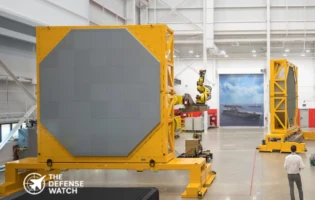
LTAMDS is the Army’s next-generation radar designed to replace or complement legacy Patriot radar systems. Unlike older radars with a narrower field of view, LTAMDS delivers 360-degree coverage, allowing forces to detect and track threats approaching from multiple directions.
That capability is increasingly important as adversaries field maneuvering missiles, low-flying drones, and swarm tactics intended to exploit radar blind spots.
Raytheon developed LTAMDS to integrate into the Army’s broader Integrated Air and Missile Defense (IAMD) architecture. In practical terms, that means the radar can feed targeting and tracking data to interceptors and command networks faster than older standalone systems.
Why This Contract Is Significant
This latest Raytheon LTAMDS contract is not just another procurement notice. It signals that the Army is moving deeper into fielding mode after years of development and testing.
Low-rate initial production typically means the military is transitioning from prototypes to operational systems while refining manufacturing processes. Ordering five additional units suggests confidence in the platform and growing urgency to deploy it.
That matters because the U.S. military has placed renewed emphasis on air defense after observing missile and drone warfare in Ukraine, the Middle East, and the Indo-Pacific.
Industrial Base And Production Outlook
Work will take place in Andover, Massachusetts, one of Raytheon’s core missile defense manufacturing hubs, with completion scheduled for Aug. 29, 2031.
The long timeline reflects the complexity of radar production, which includes advanced gallium nitride electronics, sensor arrays, software integration, and military qualification testing.
For the U.S. defense industrial base, multi-year radar production helps sustain skilled engineering and manufacturing jobs while preserving capacity for future missile defense programs.
Funding Details
The Army obligated $725.9 million in Fiscal Year 2026 Missile Procurement funds at the time of award. That immediate funding commitment suggests LTAMDS remains a protected modernization priority even amid broader Pentagon budget pressure.
With one bid received through an online solicitation, the contract also reflects the specialized nature of advanced radar production, where only a limited number of firms can meet requirements at scale.
Strategic Outlook
The LTAMDS missile defense system is expected to become a core element of U.S. Army layered defense networks over the next decade. As threats evolve, sensors often determine battlefield success before interceptors are launched.
That makes radar modernization one of the most critical, though less visible, parts of military readiness.
For Raytheon, the new award strengthens its position as a leading supplier of U.S. integrated air and missile defense systems. For the Army, it accelerates the shift toward faster, wider, and more survivable sensing capabilities.