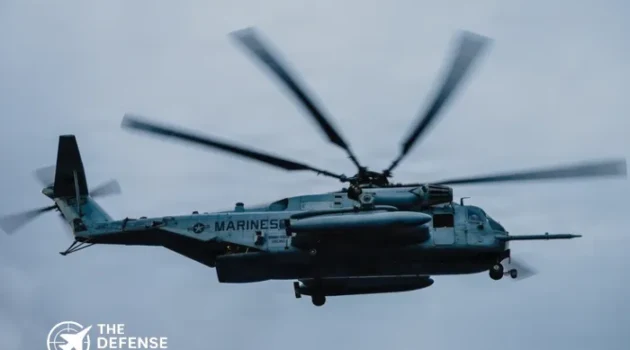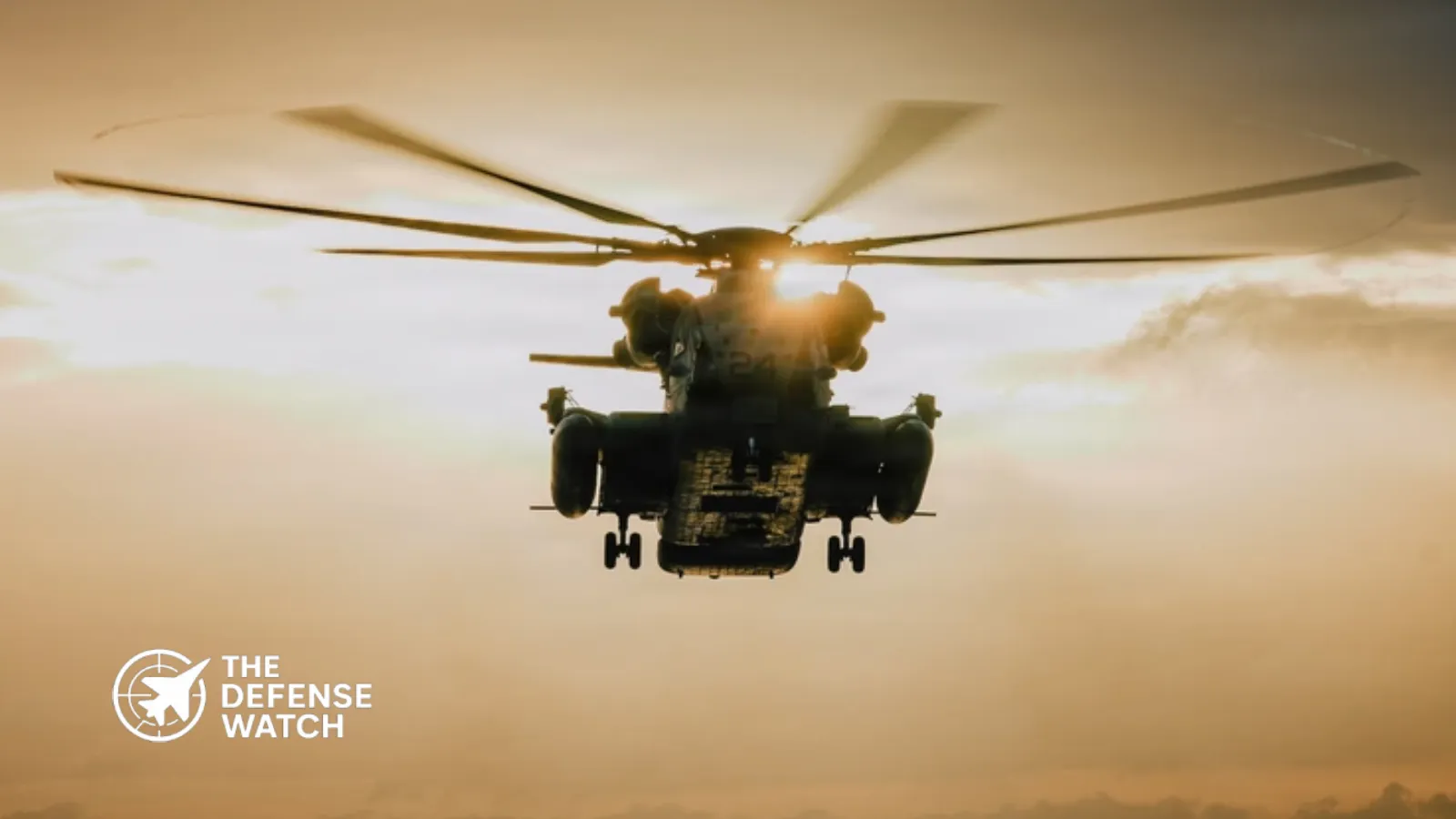
U.S. Marines Demonstrate CH-53E Refueling Test Under Combat Conditions
The CH-53E refueling test conducted by the U.S. Marine Corps marks a significant step in expanding heavy-lift aviation capability under realistic combat conditions. According to reporting by Army Recognition, Marines successfully executed aerial refueling while the CH-53E Super Stallion was simultaneously transporting two external vehicles, a complex maneuver rarely demonstrated at this scale.
This dual-operation test reflects a growing focus on operational endurance and logistics flexibility, especially in contested environments where traditional supply chains may be disrupted.
The ability to refuel mid-air while carrying heavy external loads directly enhances mission range, persistence, and survivability.
- U.S. Marines tested CH-53E aerial refueling while carrying two vehicles simultaneously.
- The exercise combined heavy-lift operations with extended-range refueling in a single mission.
- CH-53E Super Stallion is capable of lifting over 16 tons of cargo in external load operations.
- The test highlights expeditionary logistics capabilities under contested combat scenarios.
- The demonstration supports Marine Corps efforts to enhance mobility across dispersed battlefields.
Combining Heavy Lift And Aerial Refueling In One Mission
The CH-53E Super Stallion is already one of the most capable heavy-lift helicopters in the U.S. inventory. However, integrating aerial refueling into a live lift scenario introduces new operational complexity.
During the test, the helicopter maintained stability while connected to a tanker aircraft, all while managing the aerodynamic and weight challenges of carrying two vehicles via external sling loads.
This is not a routine task. External loads create drag and instability, which are further complicated during refueling due to precise positioning requirements.
By successfully completing this maneuver, Marine aviation units demonstrated improved coordination between aircrew, refueling assets, and ground logistics elements.
Operational Impact In Contested Environments
The CH-53E refueling test directly supports the Marine Corps’ evolving expeditionary doctrine, particularly concepts like Expeditionary Advanced Base Operations, often referred to as EABO.
In such scenarios, forces are expected to operate across dispersed and austere locations with limited infrastructure. Helicopters must deliver equipment, vehicles, and supplies over long distances without relying on fixed bases.
Aerial refueling enables:
- Extended mission range without landing
- Reduced vulnerability to ground threats
- Faster repositioning of combat assets
- Sustained operations in denied environments
This capability is especially relevant in the Indo-Pacific theater, where vast distances and limited basing options pose logistical challenges.
Why The CH-53E Still Matters Despite New Platforms
While the newer CH-53K King Stallion is gradually entering service, the CH-53E remains a critical platform in current Marine aviation operations.
The CH-53E refueling test underscores that legacy systems can still deliver advanced capabilities when paired with modern tactics and integration.
With a lifting capacity exceeding 16 tons and proven reliability, the CH-53E continues to play a vital role in:
- Amphibious operations
- Rapid troop and vehicle deployment
- Disaster response and humanitarian missions
Upgrades and training enhancements allow the platform to remain relevant even as next-generation systems are fielded.
Strategic Messaging And Readiness Signal
Beyond the technical achievement, the test sends a broader signal about U.S. military readiness.
Demonstrating the ability to sustain heavy-lift operations over extended distances shows that Marine forces can maintain operational tempo even under pressure.
It also reinforces interoperability between aviation units and aerial refueling assets, a key requirement for joint operations with the U.S. Air Force and Navy.
According to Army Recognition, the test aligns with ongoing efforts to refine combat logistics and improve responsiveness in high-threat environments.
Analysis: Closing The Logistics Gap In Modern Warfare
Modern warfare is increasingly defined by mobility and sustainment rather than just firepower.
The CH-53E refueling test highlights a shift toward resilient logistics, where forces must operate independently and adapt quickly to changing battlefield conditions.
Historically, logistics chains have been a vulnerability. Fixed supply points can be targeted, and long ground convoys are exposed to threats.
Aerial refueling combined with heavy lift changes that equation. It allows forces to bypass traditional choke points and maintain momentum.
This capability becomes even more critical in scenarios involving peer adversaries, where contested airspace and anti-access strategies could limit traditional resupply options.
In that context, the ability to move vehicles and equipment over long distances without landing is not just a tactical advantage, it is a strategic necessity.