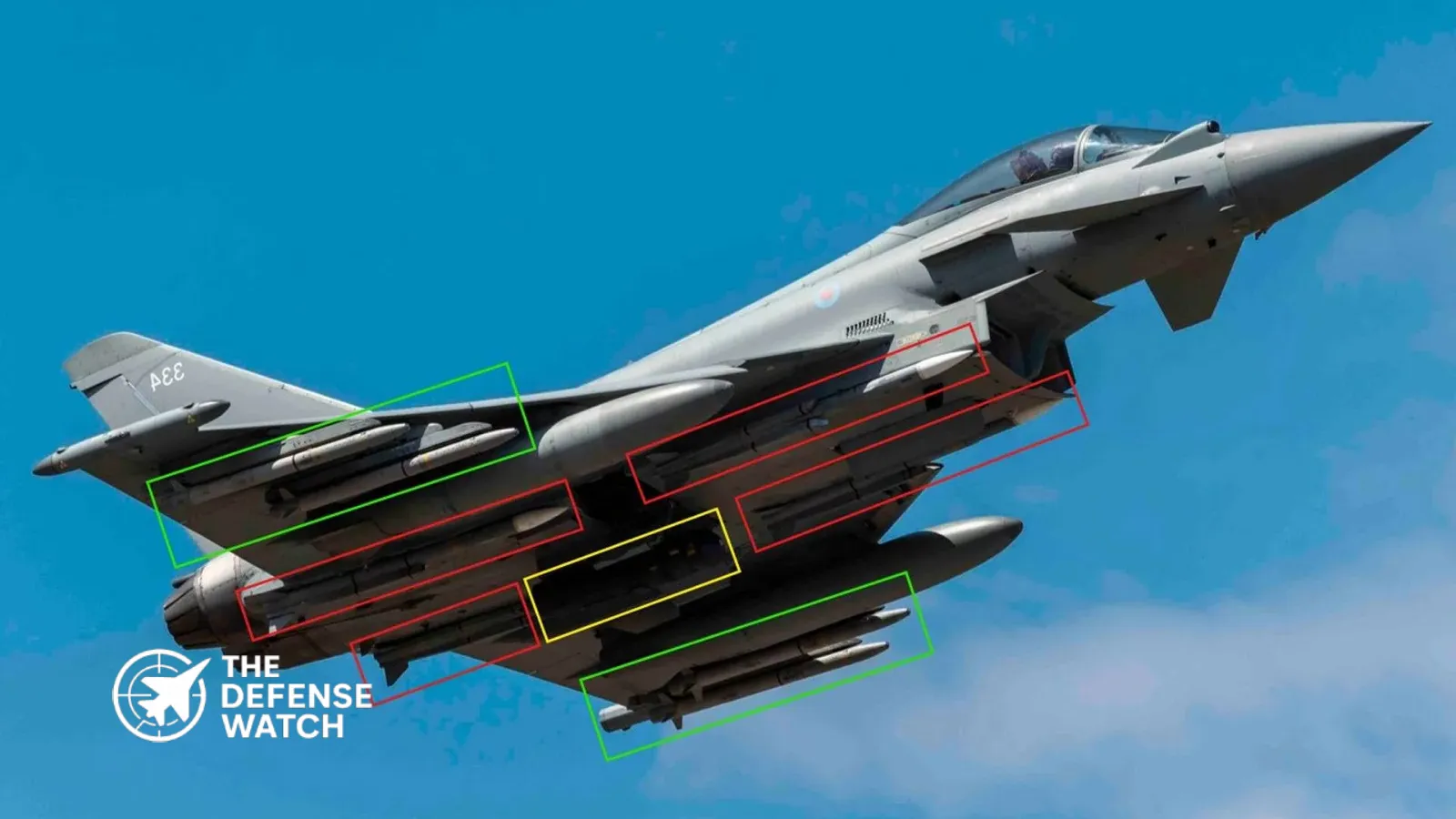
RAF Typhoon FGR4 Heavy Loadout Signals Operational Shift
The Typhoon FGR4 heavy loadout is drawing attention as the Royal Air Force strengthens its air defense posture in ongoing Middle East operations. Recent imagery show the aircraft configured with an unusually large number of air-to-air missiles, underscoring a shift toward high-readiness interception and deterrence roles.
The deployment reflects evolving threat dynamics in the region, where unmanned systems, cruise missiles, and potential state-based air threats are increasingly shaping operational planning.
Short, visible changes in aircraft configuration often signal deeper strategic intent. In this case, the Typhoon FGR4 heavy loadout points to a mission set focused less on strike and more on persistent air dominance.
- RAF Typhoon FGR4 deployed with a heavy air-to-air missile loadout during Middle East operations.
- Configuration includes a mix of beyond-visual-range and short-range air defense missiles.
- Deployment supports ongoing coalition operations and regional airspace security missions.
- Loadout highlights focus on countering aerial threats including drones and potential hostile aircraft.
- Reflects RAF emphasis on flexible, high-readiness air defense posture in contested environments.
Expanded Missile Configuration Enhances Air Defense Reach
According to reporting by Army Recognition, the Typhoon FGR4 was observed carrying a combination of beyond-visual-range and short-range air-to-air missiles. This likely includes advanced radar-guided missiles for long-distance engagements and infrared-guided weapons for close-in combat.
Such a configuration allows the aircraft to engage multiple targets across different engagement zones without returning to base. It also increases survivability in contested airspace, where reaction time is critical.
The ability to carry a heavier missile load is a core strength of the Eurofighter platform. Its multiple hardpoints and high thrust-to-weight ratio enable it to maintain performance even when fully armed.
From an operational standpoint, this loadout supports layered air defense. Aircraft can intercept threats at extended ranges while retaining capability for close engagements if required.
Middle East Deployment Reflects Changing Threat Environment
The Typhoon FGR4 heavy loadout aligns with broader coalition efforts to secure airspace across the Middle East. The region has seen a steady rise in drone activity and asymmetric aerial threats, particularly in areas linked to ongoing conflicts and regional tensions.
RAF deployments in the Middle East have historically included both strike and air policing roles. However, the current configuration suggests a stronger emphasis on defensive counter-air missions.
This shift is consistent with trends observed across NATO and allied air forces, where air defense is regaining priority due to the proliferation of low-cost aerial threats.
The presence of heavily armed fighters also serves a deterrent function. It signals readiness to respond rapidly to incursions, reducing the likelihood of escalation.
Platform Flexibility Remains a Key Advantage
One of the defining features of the Typhoon FGR4 is its adaptability. The aircraft can transition between air superiority, ground attack, and reconnaissance roles with minimal reconfiguration.
The heavy air defense loadout highlights this flexibility. While optimized for interception in this configuration, the aircraft can be rapidly re-tasked depending on mission requirements.
This multi-role capability is particularly valuable in the Middle East, where operational demands can shift quickly. Air forces must be prepared to respond to a wide range of scenarios, from counterterrorism operations to state-level threats.
The Typhoon’s advanced radar and sensor suite further enhance its effectiveness. These systems enable pilots to detect and track multiple targets simultaneously, a critical requirement in complex airspaces.
Strategic Implications For RAF And Coalition Forces
The Typhoon FGR4 heavy loadout is more than a technical detail. It reflects a broader strategic adjustment in how air power is applied in the region.
By prioritizing air defense, the RAF is aligning with a growing emphasis on protecting critical infrastructure and maintaining airspace control. This approach complements ground-based air defense systems and provides a mobile, responsive layer of protection.
It also highlights the importance of interoperability within coalition operations. Aircraft configured for air defense can integrate with allied assets, sharing data and coordinating responses to emerging threats.
From a geopolitical perspective, the deployment reinforces the UK’s commitment to regional stability and coalition operations.